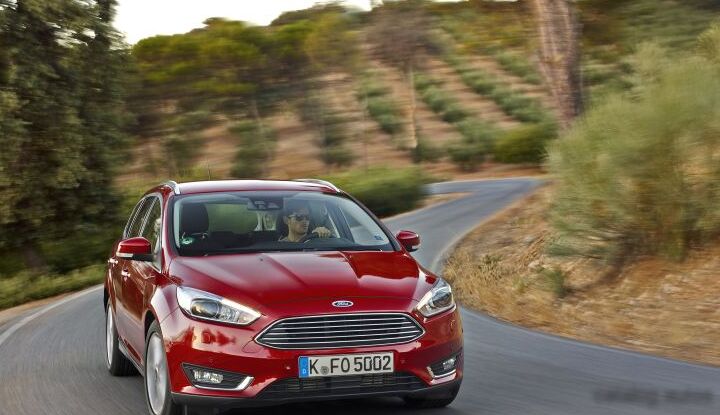
The Ford Focus III Wagon, specifically the 1.6 TDCi (95 hp) S&S variant produced from 2014 to 2015, represented an entry-level diesel option within the broader Focus Mk3 range. This model aimed to provide fuel efficiency and practicality for buyers prioritizing economy over outright performance. It was primarily marketed in Europe, where compact wagons were – and continue to be – a popular body style. The “S&S” designation indicates the inclusion of Ford’s Start-Stop technology, further enhancing fuel savings in urban driving conditions.
Technical Specifications
| Brand | Ford |
| Model | Focus |
| Generation | Focus III Wagon (facelift 2014) |
| Type (Engine) | 1.6 TDCi (95 Hp) S&S |
| Start of production | 2014 |
| End of production | 2015 |
| Powertrain Architecture | Internal Combustion engine |
| Body type | Station wagon (estate) |
| Seats | 5 |
| Doors | 5 |
| Fuel consumption (urban) | 5.1 l/100 km (46.1 US mpg, 55.4 UK mpg, 19.6 km/l) |
| Fuel consumption (extra urban) | 3.7 l/100 km (63.6 US mpg, 76.3 UK mpg, 27 km/l) |
| Fuel consumption (combined) | 4.2 l/100 km (56 US mpg, 67.3 UK mpg, 23.8 km/l) |
| CO2 emissions | 109 g/km |
| Fuel Type | Diesel |
| Acceleration 0 – 100 km/h | 12.7 sec |
| Acceleration 0 – 62 mph | 12.7 sec |
| Acceleration 0 – 60 mph | 12.1 sec |
| Maximum speed | 180 km/h (111.85 mph) |
| Emission standard | Euro 6 |
| Weight-to-power ratio | 16.1 kg/Hp, 62.1 Hp/tonne |
| Weight-to-torque ratio | 7.1 kg/Nm, 140.5 Nm/tonne |
| Power | 95 Hp @ 3800 rpm |
| Power per litre | 60.9 Hp/l |
| Torque | 215 Nm @ 1750 rpm (158.58 lb.-ft. @ 1750 rpm) |
| Engine layout | Front, Transverse |
| Engine Model/Code | TZJA, T3DA, T3DB |
| Engine displacement | 1560 cm3 (95.2 cu. in.) |
| Number of cylinders | 4 |
| Engine configuration | Inline |
| Cylinder Bore | 75 mm (2.95 in.) |
| Piston Stroke | 88.3 mm (3.48 in.) |
| Compression ratio | 16:1 |
| Number of valves per cylinder | 2 |
| Fuel injection system | Diesel Commonrail |
| Engine aspiration | Turbocharger, Intercooler |
| Valvetrain | DOHC |
| Engine oil capacity | 3.85 l (4.07 US qt | 3.39 UK qt) |
| Coolant capacity | 7.3 l (7.71 US qt | 6.42 UK qt) |
| Kerb Weight | 1530 kg (3373.07 lbs.) |
| Max. weight | 1900 kg (4188.78 lbs.) |
| Max load | 370 kg (815.71 lbs.) |
| Trunk (boot) space – minimum | 476 l (16.81 cu. ft.) |
| Trunk (boot) space – maximum | 1502 l (53.04 cu. ft.) |
| Fuel tank capacity | 53 l (14 US gal | 11.66 UK gal) |
| Length | 4556 mm (179.37 in.) |
| Width | 1823 mm (71.77 in.) |
| Height | 1505 mm (59.25 in.) |
| Wheelbase | 2648 mm (104.25 in.) |
| Front track | 1544 mm (60.79 in.) |
| Rear track | 1559 mm (61.38 in.) |
| Minimum turning circle | 11 m (36.09 ft.) |
| Drivetrain | Front wheel drive |
| Number of gears | 6 gears, manual transmission |
| Front suspension | Independent, type McPherson with coil spring and anti-roll bar |
| Rear suspension | Independent multi-link suspension |
| Front brakes | Disc |
| Rear brakes | Drum |
| Assisting systems | ABS (Anti-lock braking system) |
| Steering type | Steering rack and pinion |
| Tires size | 205/55 R16; 215/50 R17 |
| Wheel rims size | 6.5J x 16; 7.0J x 17 |
Positioning and Market Role
Within the Focus Mk3 wagon lineup, the 1.6 TDCi 95 hp S&S served as the entry point to diesel power. Ford offered more powerful diesel variants, such as the 1.6 TDCi 115 hp and the 2.0-litre TDCi engines with varying power outputs. The 95 hp model was designed for buyers who prioritized fuel economy and lower running costs over spirited performance. It was a common choice for fleet operators and private buyers covering high annual mileages. Compared to the petrol-powered Focus wagons, the 1.6 TDCi offered significantly better fuel efficiency, making it a more economical option for long journeys.
Engine and Mechanical Details
The 1.6 TDCi engine, part of Ford’s Duratorq family, is a four-cylinder diesel featuring common-rail direct injection and a turbocharger with intercooling. This configuration allowed for a reasonable balance between power and fuel efficiency. The engine’s 16:1 compression ratio is typical for diesel engines, contributing to its thermal efficiency. The S&S (Start-Stop) system automatically shuts off the engine when the vehicle is stationary (e.g., at traffic lights) and restarts it when the driver depresses the clutch pedal (in the manual transmission version). This feature further reduces fuel consumption and emissions in urban environments. The manual transmission, with its six forward gears, was geared for economy, with taller ratios in the higher gears to minimize engine speed at cruising speeds.
Comparison with Other Focus III Wagon Variants
The 1.6 TDCi 95 hp differed significantly from the more powerful diesel options. The 1.6 TDCi 115 hp, for example, offered a noticeable increase in power and torque, resulting in quicker acceleration and improved overtaking ability. However, the 115 hp version typically came at a higher price point. The 2.0-litre TDCi models, available in various power outputs, were positioned as premium options, offering even greater performance and refinement. Compared to petrol engines, the 1.6 TDCi provided superior fuel economy but generally lacked the responsiveness and higher revving nature of the gasoline counterparts. Maintenance on the 1.6 TDCi, while generally reliable, required attention to the diesel particulate filter (DPF) and the fuel injection system. DPF regeneration was crucial to prevent clogging, particularly for drivers who primarily undertook short journeys. The 1.6 TDCi was also generally less expensive to insure than the higher-powered variants.
Suspension and Handling
The Focus III Wagon, regardless of engine choice, was known for its well-tuned chassis and responsive handling. The independent front McPherson strut suspension and independent multi-link rear suspension provided a comfortable ride while maintaining good body control. The steering, utilizing a rack and pinion system, offered precise and communicative feedback. The 1.6 TDCi’s lower power output didn’t detract significantly from the car’s handling characteristics, although it didn’t offer the same level of acceleration out of corners as the more powerful models. The standard ABS system provided effective braking performance, and the wagon’s relatively low weight (1530 kg) contributed to its agility.
Legacy and Impact
The Ford Focus III Wagon 1.6 TDCi 95 hp S&S played a significant role in making diesel technology more accessible to a wider range of buyers. Its fuel efficiency and practicality made it a popular choice in Europe, contributing to the overall success of the Focus Mk3 range. While not a performance-oriented model, it demonstrated that diesel engines could offer a compelling combination of economy, refinement, and usability. The inclusion of Start-Stop technology highlighted Ford’s commitment to reducing emissions and improving fuel efficiency. The Focus III wagon, in all its variants, helped solidify Ford’s position as a leading manufacturer of compact family cars.