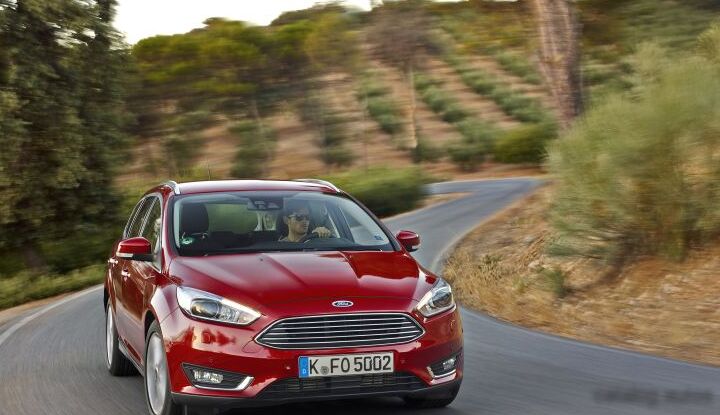
The Ford Focus III Wagon, specifically the facelifted version produced from 2014 to 2018, represented a significant evolution of Ford’s compact family car. Within the third generation (2011-2018) Focus lineup, the 1.6 Ti-VCT 125 horsepower variant occupied a middle ground, offering a balance between affordability, fuel efficiency, and practicality. This model aimed to appeal to buyers seeking a versatile wagon without the higher costs associated with more powerful engine options or premium trim levels. It was primarily marketed in Europe and other regions where wagons maintain significant popularity, offering a compelling alternative to hatchbacks and small SUVs.
Technical Specifications
| Brand | Ford |
| Model | Focus |
| Generation | Focus III Wagon (facelift 2014) |
| Type (Engine) | 1.6 Ti-VCT (125 Hp) |
| Start of production | 2014 |
| End of production | 2018 |
| Powertrain Architecture | Internal Combustion engine |
| Body type | Station wagon (estate) |
| Seats | 5 |
| Doors | 5 |
| Fuel consumption (urban) | 8.4 l/100 km (28 US mpg, 33.6 UK mpg, 11.9 km/l) |
| Fuel consumption (extra urban) | 4.7 l/100 km (50 US mpg, 60.1 UK mpg, 21.3 km/l) |
| Fuel consumption (combined) | 6 l/100 km (39.2 US mpg, 47.1 UK mpg, 16.7 km/l) |
| CO2 emissions | 139 g/km |
| Fuel Type | Petrol (Gasoline) |
| Acceleration 0 – 100 km/h | 11.1 sec |
| Acceleration 0 – 62 mph | 11.1 sec |
| Acceleration 0 – 60 mph | 10.5 sec |
| Maximum speed | 190 km/h (118.06 mph) |
| Emission standard | Euro 5 |
| Weight-to-power ratio | 11.9 kg/Hp, 84.2 Hp/tonne |
| Weight-to-torque ratio | 9.3 kg/Nm, 107.1 Nm/tonne |
| Power | 125 Hp @ 6000 rpm |
| Power per litre | 78.3 Hp/l |
| Torque | 159 Nm @ 4000 rpm (117.27 lb.-ft. @ 4000 rpm) |
| Engine layout | Front, Transverse |
| Engine Model/Code | PNDD |
| Engine displacement | 1596 cm3 (97.39 cu. in.) |
| Number of cylinders | 4 |
| Engine configuration | Inline |
| Cylinder Bore | 79 mm (3.11 in.) |
| Piston Stroke | 81.4 mm (3.2 in.) |
| Compression ratio | 11:1 |
| Number of valves per cylinder | 4 |
| Fuel injection system | Multi-port manifold injection |
| Engine aspiration | Naturally aspirated engine |
| Valvetrain | DOHC |
| Engine oil capacity | 4.1 l (4.33 US qt | 3.61 UK qt) |
| Coolant | 5.7 l (6.02 US qt | 5.02 UK qt) |
| Kerb Weight | 1485 kg (3273.86 lbs.) |
| Max. weight | 1825 kg (4023.44 lbs.) |
| Max load | 340 kg (749.57 lbs.) |
| Trunk (boot) space – minimum | 476 l (16.81 cu. ft.) |
| Trunk (boot) space – maximum | 1502 l (53.04 cu. ft.) |
| Fuel tank capacity | 55 l (14.53 US gal | 12.1 UK gal) |
| Length | 4556 mm (179.37 in.) |
| Width | 1823 mm (71.77 in.) |
| Height | 1505 mm (59.25 in.) |
| Wheelbase | 2648 mm (104.25 in.) |
| Front track | 1544 mm (60.79 in.) |
| Rear (Back) track | 1559 mm (61.38 in.) |
| Minimum turning circle | 11 m (36.09 ft.) |
| Drivetrain Architecture | Front wheel drive |
| Number of gears and type of gearbox | 5 gears, manual transmission |
| Front suspension | Independent, type McPherson with coil spring and anti-roll bar |
| Rear suspension | Independent multi-link suspension |
| Front brakes | Disc |
| Rear brakes | Disc |
| Assisting systems | ABS (Anti-lock braking system) |
| Steering type | Steering rack and pinion |
| Tires size | 205/55 R16; 215/50 R17 |
| Wheel rims size | 6.5J x 16; 7.0J x 17 |
Powertrain & Engine Architecture
The heart of this Focus variant is the 1.6-liter Ti-VCT (Twin Independent Variable Camshaft Timing) inline-four cylinder engine, designated with the engine code PNDD. This engine is a naturally aspirated unit, meaning it doesn’t rely on turbocharging or supercharging for power. The Ti-VCT system allows for independent control of both intake and exhaust valve timing, optimizing engine performance and efficiency across a wider range of engine speeds. Fuel delivery is managed by a multi-port fuel injection system. The engine produces 125 horsepower at 6000 rpm and 159 Nm (117 lb-ft) of torque at 4000 rpm. This power is delivered to the front wheels through a five-speed manual transmission. While an automatic transmission was offered in some markets, the 5-speed manual was the more common pairing for this engine.
Driving Characteristics
The 1.6 Ti-VCT engine, paired with the five-speed manual transmission, provides adequate, though not exhilarating, performance. Acceleration from 0 to 60 mph takes around 10.5 seconds, and the top speed is approximately 118 mph. The engine feels responsive enough for everyday driving, but it requires downshifting to maintain momentum when overtaking or climbing hills. Compared to the more powerful 1.5 EcoBoost or diesel variants, this engine prioritizes fuel economy over outright speed. The gear ratios in the five-speed manual are well-spaced, offering a balance between fuel efficiency and usable power. The steering is precise and well-weighted, contributing to a confident driving experience.
Equipment & Trim Levels
The 1.6 Ti-VCT variant typically came equipped as a mid-range trim level, often designated as ‘Zetec’ or similar depending on the specific market. Standard features generally included air conditioning, power windows, power mirrors, a basic audio system with USB connectivity, and alloy wheels. Safety features such as ABS, electronic stability control, and multiple airbags were also standard. Optional extras included features like a sunroof, upgraded audio systems, parking sensors, and climate control. Interior upholstery was typically cloth, with a functional and durable design. The dashboard layout was straightforward and user-friendly, with logically placed controls.
Chassis & Braking
The Focus III Wagon utilizes an independent front suspension with McPherson struts and a multi-link independent rear suspension. This setup provides a comfortable ride quality while maintaining good handling characteristics. The front and rear brakes are both disc brakes, offering adequate stopping power for the vehicle’s weight and performance. ABS (Anti-lock Braking System) is standard, enhancing safety during emergency braking situations. The suspension tuning is geared towards comfort and everyday usability, rather than outright sportiness. Stabilizer bars are fitted to both the front and rear axles to reduce body roll during cornering.
Market Reception & Comparison
The 1.6 Ti-VCT Focus Wagon was generally well-received by automotive critics as a practical and affordable family car. It was praised for its fuel efficiency, spacious interior, and comfortable ride. However, some reviewers noted that the engine lacked the punch of the turbocharged EcoBoost options. Compared to the diesel variants, the 1.6 Ti-VCT offered lower running costs in terms of fuel, but potentially higher maintenance costs due to the complexities of the Ti-VCT system. It positioned itself as a sensible choice for buyers prioritizing value and practicality over performance.
Legacy
The 1.6 Ti-VCT engine, while not the most powerful option in the Focus III lineup, proved to be a relatively reliable unit. Common issues are generally limited to routine maintenance items such as spark plugs, air filters, and oil changes. The Ti-VCT system itself can require occasional maintenance, but is generally durable. On the used car market, these models represent a good value proposition, offering a well-rounded package at an affordable price. Their continued presence in the used car market is a testament to their durability and practicality, making them a popular choice for budget-conscious buyers seeking a versatile family wagon.