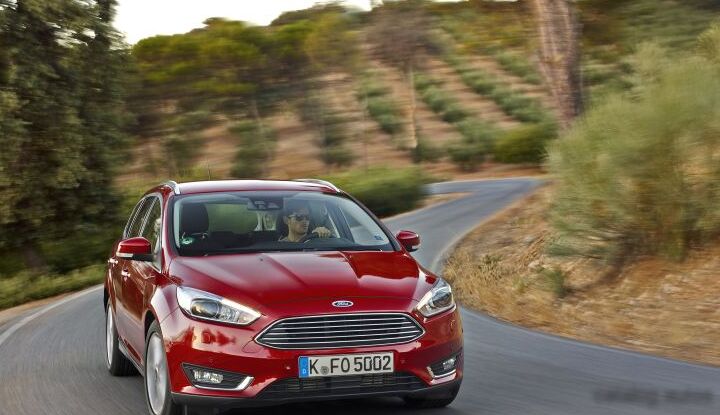
The Ford Focus III Wagon ST 2.0 TDCi (185 hp) represents a performance-oriented variant of the popular third-generation Focus wagon, produced from 2014 to 2018. Positioned as a sporty diesel option within the Focus lineup, it aimed to deliver a blend of practicality, fuel efficiency, and engaging driving dynamics. This model was primarily marketed in Europe, where diesel engines held a significant market share, and offered a compelling alternative to gasoline-powered ST models or more conventional family wagons. It built upon the facelifted Mk3 Focus (introduced in 2014) with styling and technology updates.
Technical Specifications
| Brand | Ford |
| Model | Focus |
| Generation | Focus III Wagon (facelift 2014) |
| Type (Engine) | ST 2.0 TDCi (185 Hp) |
| Start of production | 2014 |
| End of production | 2018 |
| Powertrain Architecture | Internal Combustion engine |
| Body type | Station wagon (estate) |
| Seats | 5 |
| Doors | 5 |
| Fuel consumption (combined) | 4.4 l/100 km (53.5 US mpg, 64.2 UK mpg, 22.7 km/l) |
| CO2 emissions | 114 g/km |
| Fuel Type | Diesel |
| Acceleration 0 – 100 km/h | 8.1 sec |
| Acceleration 0 – 62 mph | 8.1 sec |
| Acceleration 0 – 60 mph | 7.7 sec |
| Maximum speed | 217 km/h (134.84 mph) |
| Emission standard | Euro 6 |
| Weight-to-power ratio | 8 kg/Hp, 124.3 Hp/tonne |
| Weight-to-torque ratio | 3.7 kg/Nm, 268.8 Nm/tonne |
| Power | 185 Hp @ 3500 rpm |
| Power per litre | 92.6 Hp/l |
| Torque | 400 Nm @ 2000-2750 rpm (295.02 lb.-ft. @ 2000-2750 rpm) |
| Engine layout | Front, Transverse |
| Engine Model/Code | T8DA |
| Engine displacement | 1997 cm3 (121.86 cu. in.) |
| Number of cylinders | 4 |
| Engine configuration | Inline |
| Cylinder Bore | 85 mm (3.35 in.) |
| Piston Stroke | 88 mm (3.46 in.) |
| Compression ratio | 16.7:1 |
| Number of valves per cylinder | 4 |
| Fuel injection system | Diesel Commonrail |
| Engine aspiration | Turbocharger, Intercooler |
| Valvetrain | DOHC |
| Engine oil capacity | 6.1 l (6.45 US qt | 5.37 UK qt) |
| Coolant | 8 l (8.45 US qt | 7.04 UK qt) |
| Kerb Weight | 1488 kg (3280.48 lbs.) |
| Max. weight | 2025 kg (4464.36 lbs.) |
| Max load | 537 kg (1183.88 lbs.) |
| Trunk (boot) space – minimum | 476 l (16.81 cu. ft.) |
| Trunk (boot) space – maximum | 1502 l (53.04 cu. ft.) |
| Fuel tank capacity | 60 l (15.85 US gal | 13.2 UK gal) |
| Length | 4563 mm (179.65 in.) |
| Width | 1823 mm (71.77 in.) |
| Height | 1486 mm (58.5 in.) |
| Wheelbase | 2648 mm (104.25 in.) |
| Front track | 1550 mm (61.02 in.) |
| Rear (Back) track | 1534 mm (60.39 in.) |
| Minimum turning circle | 12.4 m (40.68 ft.) |
| Drivetrain Architecture | Front wheel drive |
| Number of gears and type of gearbox | 6 gears, manual transmission |
| Front suspension | Independent type McPherson |
| Rear suspension | Double wishbone |
| Front brakes | Ventilated discs |
| Rear brakes | Disc |
| Tires size | 235/40 R18; 235/35 R19 |
| Wheel rims size | 8.5J x 18; 8.0J x 19 |
Powertrain & Engine Architecture
The heart of the Focus III Wagon ST 2.0 TDCi is the T8DA engine, a 2.0-liter inline-four cylinder diesel. This engine is a member of Ford’s Duratorq family, known for its robust construction and efficiency. The T8DA utilizes a common-rail direct fuel injection system, delivering fuel at extremely high pressure for optimized combustion. A turbocharger with an intercooler is employed to boost power output, providing 185 horsepower at 3500 rpm and a substantial 400 Nm (295 lb-ft) of torque between 2000 and 2750 rpm. The engine features a double overhead camshaft (DOHC) valvetrain with four valves per cylinder, enhancing breathing and contributing to its performance. The 6-speed manual transmission was the only transmission option available, providing drivers with full control over the engine’s power delivery.
Driving Characteristics
The 2.0 TDCi ST wagon offered a noticeably different driving experience compared to the higher-output gasoline ST models. While lacking the outright acceleration of its petrol counterpart, the diesel variant excelled in providing strong, readily available torque across a wide rev range. This made it particularly well-suited for everyday driving and long-distance journeys, offering effortless overtaking and relaxed cruising. The 6-speed manual transmission was well-matched to the engine’s characteristics, with gear ratios optimized for both fuel efficiency and responsive acceleration. Compared to lower-powered Focus wagons, the ST 2.0 TDCi provided a more engaging and dynamic driving experience, thanks to its increased power and sport-tuned suspension. However, it didn’t possess the same sharp handling and aggressive character as the petrol ST.
Equipment & Trim Levels
The ST 2.0 TDCi trim level typically included a generous array of standard features. Interior appointments included sport seats, often upholstered in a combination of cloth and leather-style materials. The dashboard featured a unique ST-specific design with aluminum pedals and accents. Standard equipment often included air conditioning, a CD/MP3 stereo system, power windows and mirrors, and alloy wheels. Optional extras could include a navigation system, parking sensors, heated front seats, and a panoramic sunroof. The ST trim generally represented a mid-range offering, bridging the gap between the more basic Focus models and the fully-loaded Titanium variants.
Chassis & Braking
The Focus III Wagon ST 2.0 TDCi benefited from a sport-tuned chassis designed to enhance handling and stability. The front suspension utilized an independent McPherson strut setup, while the rear employed a multi-link double wishbone configuration. Compared to standard Focus wagons, the ST models featured stiffer springs and dampers, along with a thicker stabilizer bar, to reduce body roll and improve cornering performance. Braking duties were handled by ventilated discs at the front and solid discs at the rear, providing adequate stopping power for the vehicle’s weight and performance. Anti-lock braking system (ABS) was standard, enhancing safety and control during emergency braking situations.
Market Reception & Comparison
The Ford Focus III Wagon ST 2.0 TDCi was generally well-received by automotive critics, who praised its blend of practicality, fuel efficiency, and driving dynamics. It was often seen as a sensible alternative to the more expensive and less economical petrol ST models. Fuel economy was a significant strength, with combined figures of around 4.4 l/100 km (53.5 mpg) being achievable in real-world driving. Compared to other diesel-powered wagons in its class, the Focus ST 2.0 TDCi offered a compelling combination of performance and value. However, some critics noted that the diesel engine lacked the refinement and responsiveness of its petrol counterpart.
Legacy
The Ford Focus III Wagon ST 2.0 TDCi has proven to be a relatively reliable and durable vehicle. The Duratorq diesel engine is known for its longevity, and with proper maintenance, can provide many years of trouble-free service. On the used car market, these models remain popular due to their practicality, fuel efficiency, and relatively affordable price point. While not as sought-after as the petrol ST models, the diesel variant offers a compelling option for buyers seeking a sporty and economical wagon. Common issues reported by owners include wear and tear on suspension components and occasional problems with the diesel particulate filter (DPF), particularly on vehicles that have primarily been used for short journeys.