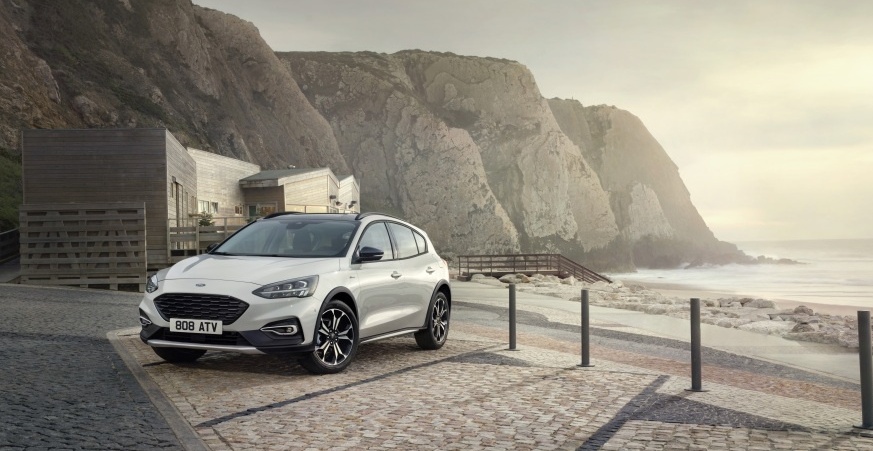
The Ford Focus IV Active Hatchback 2.0 EcoBlue, producing 150 horsepower, was a variant of the fourth-generation Ford Focus, manufactured between 2019 and 2021. Positioned as a crossover within the Focus lineup, it aimed to blend the practicality of a hatchback with a slightly raised ride height and more rugged styling. This model played a significant role in Ford’s European strategy, offering a diesel-powered option in a segment increasingly focused on fuel efficiency and versatility. While the Focus was discontinued in the North American market prior to the fourth generation, this variant represents a key offering in Europe and other global markets.
Technical Specifications
| Brand | Ford |
| Model | Focus |
| Generation | Focus IV Active Hatchback |
| Type (Engine) | 2.0 EcoBlue (150 Hp) |
| Start of production | 2019 |
| End of production | 2021 |
| Powertrain Architecture | Internal Combustion engine |
| Body type | Crossover |
| Seats | 5 |
| Doors | 5 |
| Fuel consumption (urban) | 5.6 l/100 km (42 US mpg, 50.4 UK mpg, 17.9 km/l) |
| Fuel consumption (extra urban) | 3.6-3.7 l/100 km (65.3 – 63.6 US mpg, 78.5 – 76.3 UK mpg, 27.8 – 27 km/l) |
| Fuel consumption (combined) | 4.4-4.5 l/100 km (53.5 – 52.3 US mpg, 64.2 – 62.8 UK mpg, 22.7 – 22.2 km/l) |
| CO2 emissions | 114-116 g/km |
| Fuel Type | Diesel |
| Acceleration 0 – 100 km/h | 8.5 sec |
| Acceleration 0 – 62 mph | 8.5 sec |
| Acceleration 0 – 60 mph | 8.1 sec |
| Maximum speed | 210 km/h (130.49 mph) |
| Emission standard | Euro 6d-Temp |
| Weight-to-power ratio | 9.5 kg/Hp, 105.8 Hp/tonne |
| Weight-to-torque ratio | 3.8 kg/Nm, 260.9 Nm/tonne |
| Power | 150 Hp |
| Torque | 370 Nm (272.9 lb.-ft.) |
| Engine Model/Code | YLDC |
| Number of cylinders | 4 |
| Engine configuration | Inline |
| Fuel injection system | Diesel Commonrail |
| Engine aspiration | Turbocharger, Intercooler |
| Engine oil capacity | 6.4 l (6.76 US qt, 5.63 UK qt) |
| Coolant capacity | 12.6 l (13.31 US qt, 11.09 UK qt) |
| Kerb Weight | 1418 kg (3126.15 lbs.) |
| Max. weight | 2020 kg (4453.34 lbs.) |
| Max load | 602 kg (1327.18 lbs.) |
| Trunk (boot) space – minimum | 273 l (9.64 cu. ft.) |
| Trunk (boot) space – maximum | 1320 l (46.62 cu. ft.) |
| Fuel tank capacity | 47 l (12.42 US gal, 10.34 UK gal) |
| AdBlue tank capacity | 10.5 l (2.77 US gal, 2.31 UK gal) |
| Permitted trailer load with brakes (12%) | 1800 kg (3968.32 lbs.) |
| Permitted trailer load without brakes | 745 kg (1642.44 lbs.) |
| Permitted towbar download | 90 kg (198.42 lbs.) |
| Length | 4397 mm (173.11 in.) |
| Width | 1844 mm (72.6 in.) |
| Width including mirrors | 1979 mm (77.91 in.) |
| Height | 1483 mm (58.39 in.) |
| Wheelbase | 2700 mm (106.3 in.) |
| Minimum turning circle | 10.7 m (35.1 ft.) |
| Drivetrain Architecture | Front wheel drive, Internal Combustion engine |
| Number of gears and type of gearbox | 6 gears, manual transmission |
| Front brakes | Disc |
| Rear brakes | Disc |
| Tires size | 215/55 R17 |
| Wheel rims size | 7J x 17 |
INTRODUCTION
The Ford Focus IV Active 2.0 EcoBlue 150 hp, introduced in 2019, represented a specific trim level within the broader fourth-generation Focus range. The “Active” designation signified a crossover-inspired variant, featuring increased ground clearance and a more robust aesthetic compared to the standard hatchback. This model was built on the C2 platform (also known as the 1HX0 platform), shared with other Ford vehicles like the Ford Kuga. The 2.0 EcoBlue engine was a key component of Ford’s efforts to offer fuel-efficient diesel options in Europe, catering to drivers prioritizing economy and lower running costs. This particular configuration, with the 150 horsepower engine and a six-speed manual transmission, occupied a middle ground in the Focus Active lineup, offering a balance between performance and affordability.
Powertrain & Engine Architecture
The heart of the Focus Active 2.0 EcoBlue is the YLDC engine, a 2.0-liter inline-four cylinder diesel engine. This engine belongs to Ford’s EcoBlue family, known for its advanced combustion technology designed to improve efficiency and reduce emissions. The YLDC utilizes a common-rail direct fuel injection system, delivering fuel directly into the cylinders at extremely high pressure for optimized combustion. A turbocharger with an intercooler is employed to increase power output and torque. The engine also features a variable geometry turbocharger (VGT) which adjusts the turbine vanes to optimize boost pressure across the engine’s rev range. The six-speed manual transmission provides a relatively conventional gear selection, with ratios geared towards maximizing fuel economy while still providing adequate acceleration. The transmission’s gear ratios are tuned to work in harmony with the engine’s torque curve, delivering smooth and predictable power delivery.
Driving Characteristics
The 150 hp 2.0 EcoBlue engine in the Focus Active provides a respectable level of performance for everyday driving. While not a sports-oriented engine, it delivers ample torque – 370 Nm (272.9 lb-ft) – which is readily available from low engine speeds. This makes it well-suited for overtaking maneuvers and navigating hilly terrain. Acceleration from 0-60 mph takes approximately 8.1 seconds, and the car has a top speed of 130.49 mph. Compared to the higher-output 1.5 EcoBlue variants, the 2.0 EcoBlue offers a more relaxed driving experience, prioritizing fuel efficiency over outright speed. The manual transmission allows for greater driver control, but the gear ratios are somewhat long, emphasizing economy over spirited acceleration. The Active’s slightly raised suspension provides a more comfortable ride than the standard Focus hatchback, absorbing bumps and imperfections in the road more effectively.
Equipment & Trim Levels
The Focus Active trim level generally included features such as a unique front grille, black plastic cladding around the wheel arches and sills, and roof rails. Standard interior features typically included air conditioning, a touchscreen infotainment system with Bluetooth connectivity, and a leather-wrapped steering wheel. Higher trim levels offered options like heated seats, a panoramic sunroof, and advanced driver-assistance systems such as adaptive cruise control and lane-keeping assist. Upholstery was typically cloth, with leather options available as an upgrade. The dashboard layout was consistent with other Focus IV models, featuring a clean and modern design.
Chassis & Braking
The Focus Active 2.0 EcoBlue utilizes a MacPherson strut front suspension and a multi-link rear suspension. The Active variant features a slightly raised ride height compared to the standard Focus, providing increased ground clearance. Braking duties are handled by disc brakes on all four wheels, providing adequate stopping power. Anti-lock Braking System (ABS) and Electronic Stability Control (ESC) are standard safety features. The suspension is tuned to provide a comfortable ride while maintaining reasonable handling characteristics. Stabilizer bars are fitted to both the front and rear axles to reduce body roll during cornering.
Market Reception & Comparison
The Ford Focus Active 2.0 EcoBlue was generally well-received by automotive critics, who praised its fuel efficiency, comfortable ride, and practical interior. However, some reviewers noted that the engine could be somewhat noisy under heavy acceleration. Compared to the 1.0 EcoBoost petrol variants, the 2.0 EcoBlue offered significantly better fuel economy, particularly on long journeys. However, the petrol engines were generally considered to be more refined and responsive. The 2.0 EcoBlue also offered a more robust and durable powertrain compared to the smaller capacity petrol engines, making it a popular choice for drivers covering high mileage.
Legacy
The 2.0 EcoBlue engine has proven to be a relatively reliable powertrain, although, like all diesel engines, it requires regular maintenance, including oil changes and diesel particulate filter (DPF) regeneration. On the used car market, the Focus Active 2.0 EcoBlue holds its value reasonably well, particularly examples with a full service history. The combination of fuel efficiency, practicality, and comfort makes it a popular choice for buyers seeking a versatile and economical family car. While Ford has shifted its focus towards electrification, the 2.0 EcoBlue engine remains a capable and efficient option for those seeking a diesel-powered vehicle.