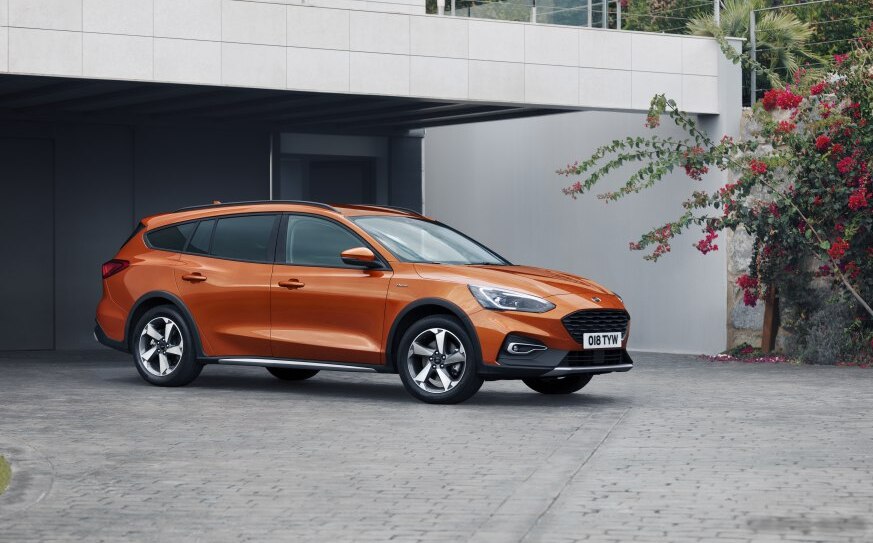
The Ford Focus IV Active Wagon 1.5 EcoBoost (182 hp) Automatic, produced from 2019 to 2021, represents a specific configuration within the fourth generation of the globally successful Ford Focus. Positioned as a mid-range offering within the Active Wagon lineup – Ford’s attempt to blend the practicality of a wagon with the slightly raised ride height and rugged styling cues of a crossover – this variant aimed to appeal to buyers seeking a versatile and fuel-efficient family vehicle. It was primarily marketed in Europe and other international markets, with the Focus IV generation not being sold in the United States. This particular model utilizes the 1HX0/A3 platform shared with other Ford models of the era.
Technical Specifications
| Brand | Ford |
| Model | Focus |
| Generation | Focus IV Active Wagon |
| Type (Engine) | 1.5 EcoBoost (182 Hp) Automatic |
| Start of production | 2019 |
| End of production | 2021 |
| Powertrain Architecture | Internal Combustion engine |
| Body type | Crossover |
| Seats | 5 |
| Doors | 5 |
| Fuel consumption (urban) | 7.5-7.6 l/100 km (31.4 – 30.9 US mpg) |
| Fuel consumption (extra urban) | 4.9-5.0 l/100 km (48 – 47 US mpg) |
| Fuel consumption (combined) | 5.9-6.0 l/100 km (39.9 – 39.2 US mpg) |
| CO2 emissions | 133-135 g/km |
| Fuel Type | Petrol (Gasoline) |
| Acceleration 0 – 100 km/h | 8.9 sec |
| Acceleration 0 – 62 mph | 8.9 sec |
| Acceleration 0 – 60 mph | 8.5 sec |
| Maximum speed | 214 km/h (132.97 mph) |
| Emission standard | Euro 6d – TEMP |
| Weight-to-power ratio | 7.5 kg/Hp |
| Weight-to-torque ratio | 5.7 kg/Nm |
| Power | 182 Hp @ 6000 rpm |
| Torque | 240 Nm @ 1600 rpm (177.01 lb.-ft. @ 1600 rpm) |
| Engine layout | Front, Transverse |
| Engine Model/Code | Y1DA |
| Engine displacement | 1497 cm3 (91.35 cu. in.) |
| Number of cylinders | 3 |
| Engine configuration | Inline |
| Cylinder Bore | 84 mm (3.31 in.) |
| Piston Stroke | 90 mm (3.54 in.) |
| Compression ratio | 11:1 |
| Number of valves per cylinder | 4 |
| Fuel injection system | Direct injection |
| Engine aspiration | Turbocharger, Intercooler |
| Valvetrain | DOHC |
| Engine oil capacity | 5.05 l (5.34 US qt | 4.44 UK qt) |
| Coolant | 5.8 l (6.13 US qt | 5.1 UK qt) |
| Kerb Weight | 1370 kg (3020.33 lbs.) |
| Max. weight | 1980 kg (4365.15 lbs.) |
| Max load | 610 kg (1344.82 lbs.) |
| Trunk (boot) space – minimum | 608 l (21.47 cu. ft.) |
| Trunk (boot) space – maximum | 1653 l (58.38 cu. ft.) |
| Fuel tank capacity | 52 l (13.74 US gal | 11.44 UK gal) |
| Max. roof load | 75 kg (165.35 lbs.) |
| Permitted trailer load with brakes (12%) | 1500 kg (3306.93 lbs.) |
| Permitted trailer load without brakes | 720 kg (1587.33 lbs.) |
| Permitted towbar download | 90 kg (198.42 lbs.) |
| Length | 4693 mm (184.76 in.) |
| Width | 1825 mm (71.85 in.) |
| Width with mirrors folded | 1848 mm (72.76 in.) |
| Width including mirrors | 1979 mm (77.91 in.) |
| Height | 1532 mm (60.31 in.) |
| Wheelbase | 2700 mm (106.3 in.) |
| Front track | 1582 mm (62.28 in.) |
| Rear (Back) track | 1576 mm (62.05 in.) |
| Front overhang | 918 mm (36.14 in.) |
| Rear overhang | 1075 mm (42.32 in.) |
| Ride height (ground clearance) | 149-163 mm (5.87 – 6.42 in.) |
| Minimum turning circle | 11.0-11.6 m (36.09 – 38.06 ft.) |
| Drivetrain Architecture | Front wheel drive |
| Drive wheel | Front wheel drive |
| Number of gears and type of gearbox | 8 gears, automatic transmission |
| Front suspension | Independent type McPherson |
| Rear suspension | Independent multi-link suspension |
| Front brakes | Ventilated discs, 282 x 27 mm |
| Rear brakes | Disc, 271 x 12 mm |
| Assisting systems | ABS (Anti-lock braking system) |
| Steering type | Steering rack and pinion |
| Power steering | Electric Steering |
| Tires size | 215/55 R17; 215/50 R18 |
INTRODUCTION
The Ford Focus IV Active Wagon 1.5 EcoBoost Automatic, launched in 2019, was a key component of Ford’s revised Focus lineup. The fourth-generation Focus, while not sold in North America, was a significant model for Ford in Europe, representing a substantial investment in a new platform and technology. The Active Wagon variant specifically targeted buyers looking for a vehicle that offered the practicality of a station wagon with a slightly more adventurous aesthetic and increased ground clearance. The 1.5-liter EcoBoost engine paired with an eight-speed automatic transmission was a popular choice, offering a balance between performance, fuel economy, and convenience.
Powertrain & Engine Architecture
At the heart of this variant lies the Ford 1.5 EcoBoost engine, internally designated as the Y1DA. This is a three-cylinder, turbocharged gasoline engine utilizing direct fuel injection and a double overhead camshaft (DOHC) valvetrain. The engine’s compact size and lightweight construction contribute to the vehicle’s overall efficiency. The turbocharger, coupled with an intercooler, helps to boost power output and improve throttle response. The 1.5 EcoBoost engine is known for its responsiveness and relatively smooth operation despite having three cylinders. The eight-speed automatic transmission, sourced from Aisin, provides smooth and efficient gear changes. This transmission is known for its responsiveness and contributes to the overall refinement of the driving experience. It features adaptive learning, adjusting shift patterns based on driving style.
Driving Characteristics
The 182 hp and 240 Nm (177 lb-ft) of torque delivered by the 1.5 EcoBoost engine, when paired with the eight-speed automatic, provides adequate performance for everyday driving. Acceleration from 0-62 mph takes approximately 8.9 seconds. While not a particularly sporty configuration, the engine offers sufficient power for overtaking maneuvers and maintaining comfortable cruising speeds on motorways. The automatic transmission is well-tuned, providing smooth shifts and contributing to a relaxed driving experience. Compared to the lower-powered 1.0 EcoBoost variants, this 1.5L engine offers a noticeable improvement in performance, particularly when fully loaded or tackling inclines. However, it doesn’t match the outright performance of the higher-spec engines, such as the 1.5 EcoBoost with 150 hp or the diesel variants.
Equipment & Trim Levels
The Active Wagon 1.5 EcoBoost Automatic typically came equipped with a generous level of standard features. These included air conditioning, a touchscreen infotainment system with Apple CarPlay and Android Auto compatibility, alloy wheels, and a suite of safety features such as lane-keeping assist and automatic emergency braking. Higher trim levels offered additional features such as a larger touchscreen, heated seats, a panoramic sunroof, and adaptive cruise control. Interior upholstery was typically cloth, with leather options available as an upgrade. The dashboard layout was modern and functional, with a focus on ease of use.
Chassis & Braking
The Focus IV Active Wagon features an independent McPherson strut suspension at the front and an independent multi-link suspension at the rear. The Active Wagon variant benefits from a slightly raised ride height compared to the standard Focus Wagon, providing improved ground clearance for tackling rougher terrain. Braking duties are handled by ventilated discs at the front and solid discs at the rear. Anti-lock braking system (ABS) is standard, along with electronic brakeforce distribution (EBD). The steering is electrically assisted, providing a light and precise feel.
Market Reception & Comparison
The Ford Focus IV Active Wagon 1.5 EcoBoost Automatic was generally well-received by automotive critics. It was praised for its comfortable ride, spacious interior, and fuel efficiency. The 1.5 EcoBoost engine was considered a good compromise between performance and economy. Compared to the 1.0 EcoBoost variants, the 1.5L offered a more refined and capable driving experience. However, some critics noted that the three-cylinder engine could be slightly rough at times. Fuel economy figures of around 39.9-39.2 US mpg (combined) were competitive for its class. Reliability reports suggest that the 1.5 EcoBoost engine is generally reliable, although some owners have reported issues with the timing belt system.
Legacy
The Ford Focus IV Active Wagon 1.5 EcoBoost Automatic remains a popular choice in the used car market. Its combination of practicality, fuel efficiency, and reasonable performance makes it an attractive option for families and individuals alike. The 1.5 EcoBoost engine, while not without its quirks, has proven to be a relatively durable and reliable unit when properly maintained. The eight-speed automatic transmission is also considered a strong point, contributing to a smooth and refined driving experience. As with any used vehicle, potential buyers should carefully inspect the car’s service history and consider a pre-purchase inspection by a qualified mechanic.