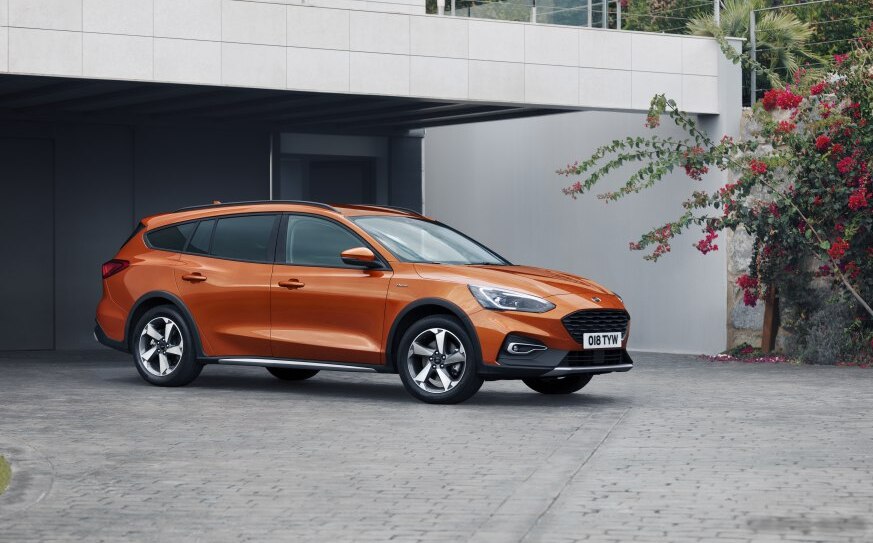
The Ford Focus IV Active Wagon 2.0 EcoBlue, producing 150 horsepower, was a variant offered between 2019 and 2021. It represented a blend of practicality, fuel efficiency, and a slightly more rugged aesthetic within the fourth generation Focus lineup (2018-2022). Positioned as a mid-range offering, it catered to buyers seeking a versatile family vehicle with improved ground clearance and a diesel engine known for its torque and economy. This model occupied a space between the lower-powered EcoBlue variants and the higher-performance ST models.
Technical Specifications
| Brand | Ford |
| Model | Focus |
| Generation | Focus IV Active Wagon |
| Type (Engine) | 2.0 EcoBlue (150 Hp) |
| Start of production | 2019 |
| End of production | 2021 |
| Powertrain Architecture | Internal Combustion engine |
| Body type | Crossover |
| Seats | 5 |
| Doors | 5 |
| Fuel consumption (urban) | 5.7 l/100 km (41.3 US mpg, 49.6 UK mpg, 17.5 km/l) |
| Fuel consumption (extra urban) | 3.8-3.9 l/100 km (61.9 – 60.3 US mpg, 74.3 – 72.4 UK mpg, 26.3 – 25.6 km/l) |
| Fuel consumption (combined) | 4.5-4.6 l/100 km (52.3 – 51.1 US mpg, 62.8 – 61.4 UK mpg, 22.2 – 21.7 km/l) |
| CO2 emissions | 117-119 g/km |
| Fuel Type | Diesel |
| Acceleration 0 – 100 km/h | 8.7 sec |
| Acceleration 0 – 62 mph | 8.7 sec |
| Acceleration 0 – 60 mph | 8.3 sec |
| Maximum speed | 208 km/h (129.25 mph) |
| Emission standard | Euro 6d-Temp |
| Weight-to-power ratio | 9.7 kg/Hp, 102.9 Hp/tonne |
| Weight-to-torque ratio | 3.9 kg/Nm, 253.8 Nm/tonne |
| Power | 150 Hp |
| Torque | 370 Nm (272.9 lb.-ft.) |
| Engine Model/Code | YLDC |
| Number of cylinders | 4 |
| Engine configuration | Inline |
| Fuel injection system | Diesel Commonrail |
| Engine aspiration | Turbocharger, Intercooler |
| Engine oil capacity | 6.4 l (6.76 US qt, 5.63 UK qt) |
| Coolant capacity | 12.6 l (13.31 US qt, 11.09 UK qt) |
| Kerb Weight | 1458 kg (3214.34 lbs.) |
| Max. weight | 2080 kg (4585.62 lbs.) |
| Max load | 622 kg (1371.28 lbs.) |
| Trunk (boot) space – minimum | 541 l (19.11 cu. ft.) |
| Trunk (boot) space – maximum | 1620 l (57.21 cu. ft.) |
| Fuel tank capacity | 47 l (12.42 US gal, 10.34 UK gal) |
| AdBlue tank capacity | 10.5 l (2.77 US gal, 2.31 UK gal) |
| Permitted trailer load with brakes (12%) | 1800 kg (3968.32 lbs.) |
| Permitted trailer load without brakes | 750 kg (1653.47 lbs.) |
| Permitted towbar download | 90 kg (198.42 lbs.) |
| Length | 4693 mm (184.76 in.) |
| Width | 1844 mm (72.6 in.) |
| Width including mirrors | 1979 mm (77.91 in.) |
| Height | 1504 mm (59.21 in.) |
| Wheelbase | 2700 mm (106.3 in.) |
| Minimum turning circle | 10.7 m (35.1 ft.) |
| Drivetrain Architecture | Front wheel drive |
| Number of gears and type of gearbox | 6 gears, manual transmission |
| Front brakes | Disc |
| Rear brakes | Disc |
| Tires size | 215/55 R17 |
| Wheel rims size | 7J x 17 |
INTRODUCTION
The Ford Focus IV Active Wagon 2.0 EcoBlue (150 hp) was introduced as part of the fourth-generation Focus range, launched in 2018. The “Active” designation signified a crossover-inspired variant, featuring increased ride height and a more robust appearance compared to the standard Focus hatchback and wagon. This particular engine and trim combination was available primarily in Europe and select global markets. It aimed to provide a balance between fuel efficiency, practicality, and a more adventurous aesthetic, appealing to families and individuals seeking a versatile vehicle for both urban and rural driving. The 2.0 EcoBlue engine was a key component of Ford’s efforts to meet increasingly stringent emissions regulations while still delivering adequate performance.
Powertrain & Engine Architecture
The heart of this Focus variant is the 2.0-liter EcoBlue turbocharged diesel engine, identified by the code YLDC. This engine is part of Ford’s EcoBlue family, designed for improved fuel efficiency and reduced emissions. It features a common-rail direct fuel injection system, delivering fuel directly into the combustion chamber at extremely high pressure for optimized combustion. The engine utilizes a single turbocharger with an intercooler to increase air density and boost power output. The valvetrain employs four valves per cylinder (DOHC) for enhanced breathing and performance. The 150 horsepower output is achieved through careful calibration of the engine management system. The engine is paired with a six-speed manual transmission, chosen for its efficiency and driver engagement. This transmission features well-spaced gear ratios designed to maximize fuel economy and provide adequate acceleration.
Driving Characteristics
The 2.0 EcoBlue 150 hp engine delivers a respectable driving experience. While not overtly sporty, it provides ample torque – 370 Nm (272.9 lb-ft) – which is readily available from low engine speeds. This makes it well-suited for everyday driving and overtaking maneuvers. The six-speed manual transmission allows for precise control, although the gear ratios are geared towards fuel efficiency rather than outright acceleration. Compared to the lower-powered 1.5 EcoBlue variants, the 2.0-liter engine offers noticeably more punch, especially when fully loaded or tackling inclines. However, it doesn’t match the performance of the higher-output versions or the petrol-powered ST models. The Active Wagon’s slightly raised suspension provides a more comfortable ride on uneven surfaces, but it also introduces a bit more body roll in corners compared to the standard Focus wagon.
Equipment & Trim Levels
The Active trim level generally included features such as alloy wheels, roof rails, and unique exterior styling elements to emphasize its crossover character. Inside, the 2.0 EcoBlue 150 hp model typically came equipped with cloth upholstery, a leather-wrapped steering wheel, and a basic infotainment system with Bluetooth connectivity. Standard safety features included ABS, electronic stability control, and multiple airbags. Optional extras included a larger touchscreen infotainment system with navigation, parking sensors, a rearview camera, and climate control. Higher trim levels within the Active range offered additional features like heated seats, automatic headlights, and rain-sensing wipers.
Chassis & Braking
The Focus IV Active Wagon utilizes a MacPherson strut front suspension and a multi-link rear suspension. The Active variant features a slightly raised ride height compared to the standard Focus, providing increased ground clearance. The braking system consists of disc brakes on all four wheels, offering adequate stopping power for the vehicle’s weight and performance. ABS (Anti-lock Braking System) and Electronic Stability Control (ESC) are standard features, enhancing safety and control. The suspension tuning is geared towards comfort and practicality, prioritizing ride quality over sporty handling. Stabilizer bars are fitted to both the front and rear axles to reduce body roll during cornering.
Market Reception & Comparison
The Ford Focus IV Active Wagon 2.0 EcoBlue (150 hp) was generally well-received by automotive critics. It was praised for its fuel efficiency, comfortable ride, and practical interior space. However, some reviewers noted that the engine could be a bit noisy under hard acceleration. Compared to the 1.5 EcoBlue variants, the 2.0-liter engine offered a significant improvement in performance, making it a more appealing option for those who frequently carry passengers or cargo. Against petrol-powered Focus models, the 2.0 EcoBlue offered superior fuel economy, but at the cost of some refinement. The Active trim level was seen as a good compromise between the practicality of a wagon and the rugged appeal of an SUV.
Legacy
The 2.0 EcoBlue engine has proven to be a relatively reliable powertrain, although, like all diesel engines, it requires regular maintenance, including oil changes and diesel particulate filter (DPF) regeneration. The DPF can be a potential point of failure if the vehicle is primarily used for short trips, preventing the filter from fully regenerating. On the used car market, the Focus IV Active Wagon 2.0 EcoBlue (150 hp) represents a good value proposition, offering a blend of practicality, fuel efficiency, and affordability. Its robust build quality and relatively simple mechanicals make it a sensible choice for buyers seeking a dependable family vehicle.