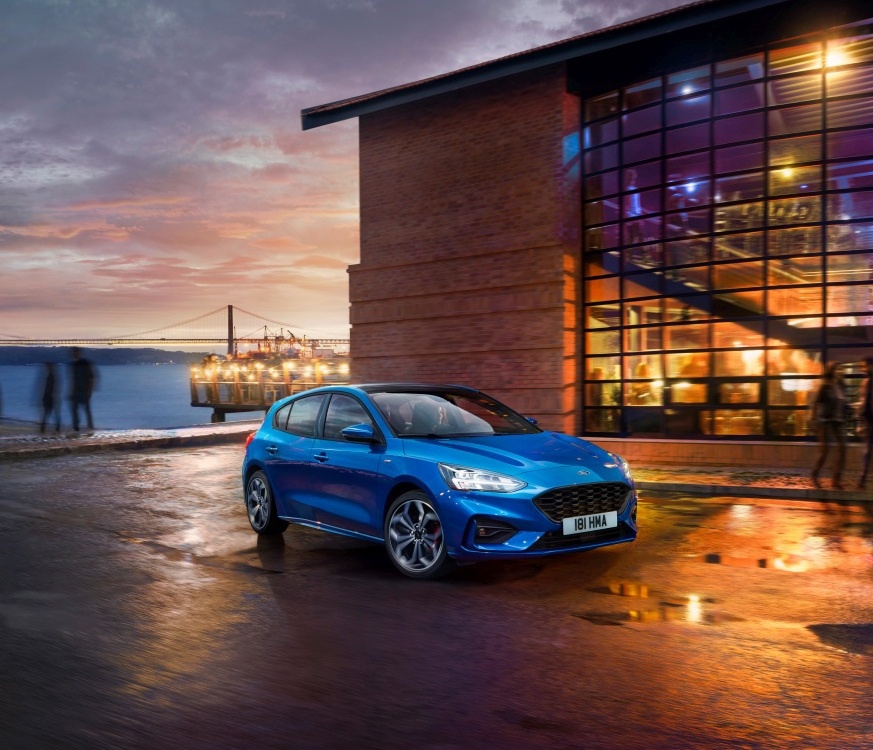
The Ford Focus IV Hatchback 1.0 EcoBoost (100 hp) represents an entry-level offering within the fourth generation of Ford’s globally successful Focus compact car. Introduced in September 2018 and continuing through 2021, this variant was primarily aimed at the European market, where fuel efficiency and affordability were key purchasing considerations. It occupied the lower end of the Focus IV powertrain lineup, offering a balance between running costs and everyday usability. While the Focus was sold in North America during this generation, the 1.0 EcoBoost engine was not a common offering, with larger engine options being favored by American consumers.
Technical Specifications
| Brand | Ford |
| Model | Focus |
| Generation | Focus IV Hatchback |
| Type (Engine) | 1.0 EcoBoost (100 Hp) |
| Start of production | September, 2018 |
| End of production | 2021 |
| Powertrain Architecture | Internal Combustion engine |
| Body type | Hatchback |
| Seats | 5 |
| Doors | 5 |
| Fuel consumption (urban) | 5.8-6.0 l/100 km (40.6 – 39.2 US mpg) |
| Fuel consumption (extra urban) | 4.1-4.3 l/100 km (57.4 – 54.7 US mpg) |
| Fuel consumption (combined) | 4.7-4.9 l/100 km (50 – 48 US mpg) |
| CO2 emissions | 107-110 g/km |
| Fuel Type | Petrol (Gasoline) |
| Acceleration 0 – 100 km/h | 12.1 sec |
| Acceleration 0 – 62 mph | 12.1 sec |
| Acceleration 0 – 60 mph | 11.5 sec |
| Maximum speed | 186 km/h (115.58 mph) |
| Emission standard | Euro 6 d |
| Weight-to-power ratio | 12.5 kg/Hp |
| Weight-to-torque ratio | 7.3 kg/Nm |
| Power | 100 Hp @ 4500-6000 rpm |
| Torque | 170 Nm @ 1400-4000 rpm (125.39 lb.-ft. @ 1400-4000 rpm) |
| Engine layout | Front, Transverse |
| Engine Model/Code | B3DA |
| Engine displacement | 999 cm3 (60.96 cu. in.) |
| Number of cylinders | 3 |
| Engine configuration | Inline |
| Cylinder Bore | 71.9 mm (2.83 in.) |
| Piston Stroke | 82 mm (3.23 in.) |
| Compression ratio | 10.5:1 |
| Number of valves per cylinder | 4 |
| Fuel injection system | Direct injection |
| Engine aspiration | Turbocharger, Intercooler |
| Valvetrain | DOHC |
| Engine oil capacity | 4.5 l (4.76 US qt | 3.96 UK qt) |
| Coolant | 5.5 l (5.81 US qt | 4.84 UK qt) |
| Kerb Weight | 1247 kg (2749.16 lbs.) |
| Max. weight | 1855 kg (4089.57 lbs.) |
| Max load | 608 kg (1340.41 lbs.) |
| Trunk (boot) space – minimum | 375 l (13.24 cu. ft.) |
| Trunk (boot) space – maximum | 1354 l (47.82 cu. ft.) |
| Fuel tank capacity | 52 l (13.74 US gal | 11.44 UK gal) |
| Max. roof load | 75 kg (165.35 lbs.) |
| Permitted trailer load with brakes (12%) | 1100 kg (2425.08 lbs.) |
| Permitted trailer load without brakes | 660 kg (1455.05 lbs.) |
| Permitted towbar download | 90 kg (198.42 lbs.) |
| Length | 4378 mm (172.36 in.) |
| Width | 1825 mm (71.85 in.) |
| Width with mirrors folded | 1848 mm (72.76 in.) |
| Width including mirrors | 1979 mm (77.91 in.) |
| Height | 1454 mm (57.24 in.) |
| Wheelbase | 2700 mm (106.3 in.) |
| Front track | 1572 mm (61.89 in.) |
| Rear (Back) track | 1553 mm (61.14 in.) |
| Front overhang | 909 mm (35.79 in.) |
| Rear overhang | 769 mm (30.28 in.) |
| Ride height (ground clearance) | 112-135 mm (4.41 – 5.31 in.) |
| Drag coefficient (Cd) | 0.27 |
| Minimum turning circle (turning diameter) | 11.0 m (36.09 ft.) |
| Drivetrain Architecture | Front wheel drive |
| Drive wheel | Front wheel drive |
| Number of gears and type of gearbox | 6 gears, manual transmission |
| Front brakes | Ventilated discs |
| Rear brakes | Disc |
| Assisting systems | ABS (Anti-lock braking system) |
| Steering type | Steering rack and pinion |
| Power steering | Electric Steering |
| Tires size | 195/65 R16; 205/60 R16; 215/50 R17; 235/40 R18 |
| Wheel rims size | 6.5J x 16; 7J x 17; 8J x 18 |
INTRODUCTION
The Ford Focus IV, launched in 2018, represented a significant evolution for the popular compact car. The 1.0 EcoBoost 100 hp variant was a key part of the range, particularly in Europe, where taxation and fuel costs heavily influence purchasing decisions. This engine and trim level was designed to offer a low cost of entry into the Focus IV lineup, appealing to buyers prioritizing economy and practicality. It sat below the 1.5 EcoBoost and diesel options in terms of performance and price, and was often equipped with a 6-speed manual transmission, though an automatic option was also available. The Focus IV platform (C2 platform) aimed to improve interior space, driving dynamics, and technology compared to its predecessor.
Powertrain & Engine Architecture
The heart of this Focus variant is the Ford 1.0 EcoBoost engine, specifically the B3DA code. This is a three-cylinder, 1.0-liter (999 cc) turbocharged gasoline engine. It utilizes direct fuel injection, a technology that improves fuel efficiency and reduces emissions by injecting fuel directly into the combustion chamber. The engine features a double overhead camshaft (DOHC) valvetrain with four valves per cylinder, optimizing airflow for improved performance. The turbocharger, coupled with an intercooler, forces more air into the engine, boosting power output despite the small displacement. The 100 hp version of the 1.0 EcoBoost differs from the 125 hp variant through revised engine mapping and potentially slightly different turbocharger specifications. The available automatic transmission was a six-speed torque converter automatic, chosen for its smoothness and relative affordability. While not as efficient as a dual-clutch transmission, it provided a comfortable driving experience for everyday use.
Driving Characteristics
The 1.0 EcoBoost 100 hp Focus delivers adequate performance for typical urban and highway driving. Acceleration from 0-60 mph takes around 11.5 seconds, and top speed is approximately 115.58 mph. However, it’s not a particularly sporty vehicle. The engine feels responsive at lower RPMs thanks to the turbocharger, providing sufficient torque for overtaking maneuvers. However, power does taper off at higher engine speeds. The automatic transmission generally shifts smoothly, but can sometimes feel hesitant when needing to downshift quickly. Compared to the more powerful 1.5 EcoBoost or diesel variants, this version feels noticeably slower, especially when fully loaded with passengers and luggage. The manual transmission version offers more driver engagement and slightly improved fuel economy.
Equipment & Trim Levels
The 1.0 EcoBoost 100 hp model typically came as a base or mid-range trim level, depending on the specific market. Standard equipment generally included air conditioning, power windows, a basic audio system with Bluetooth connectivity, and stability control. Higher trim levels added features such as alloy wheels, a touchscreen infotainment system with navigation, parking sensors, and automatic headlights and wipers. Interior upholstery was typically cloth, with options for upgraded materials on higher trims. Optional extras included a panoramic sunroof, heated seats, and advanced driver-assistance systems like lane departure warning and automatic emergency braking.
Chassis & Braking
The Focus IV utilizes a MacPherson strut front suspension and a multi-link rear suspension, providing a good balance between ride comfort and handling. The 1.0 EcoBoost variant, being lighter than its more powerful siblings, generally offered a slightly more agile feel. Braking systems consisted of ventilated discs at the front and solid discs at the rear. Anti-lock Braking System (ABS) was standard. Stabilizer bars were fitted to both the front and rear axles to reduce body roll during cornering. The suspension tuning was generally geared towards comfort, but the Focus IV still offered a reasonably engaging driving experience.
Market Reception & Comparison
The 1.0 EcoBoost 100 hp Focus was generally well-received by critics as a practical and economical choice. It was praised for its fuel efficiency, low running costs, and comfortable ride. However, some reviewers noted its lack of outright performance compared to higher-powered variants. Compared to the 1.5 EcoBoost, the 1.0 offered significantly lower fuel consumption but also considerably less power. The diesel variants provided even better fuel economy but came with higher purchase prices and potential maintenance costs. The 1.0 EcoBoost appealed to buyers prioritizing affordability and efficiency over performance.
Legacy
The 1.0 EcoBoost engine has proven to be a relatively reliable powertrain, although some early models experienced issues with coolant leaks and timing belt failures. Regular maintenance, including oil changes and coolant checks, is crucial for long-term reliability. On the used car market, the 1.0 EcoBoost Focus IV represents a good value proposition for buyers seeking an economical and practical compact car. Its fuel efficiency and relatively low maintenance costs make it an attractive option for city driving and commuting. While not the most exciting vehicle to drive, it offers a comfortable and reliable transportation solution.