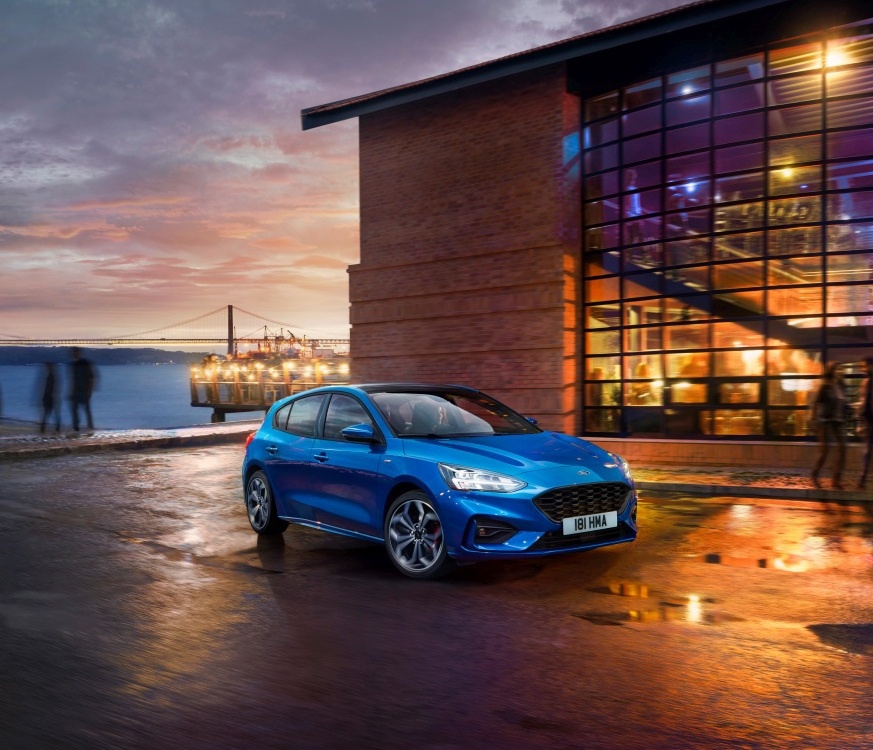
The Ford Focus IV Hatchback 1.5 EcoBlue (120 hp) Automatic, produced from September 2018 to 2021, represents a significant iteration in Ford’s globally successful Focus range. This variant occupied a middle-ground position within the fourth-generation Focus (Mk4) lineup, appealing to buyers seeking a balance between fuel efficiency, reasonable performance, and the convenience of an automatic transmission. It was primarily marketed in Europe, where compact hatchbacks are a dominant market segment, offering a diesel-powered option in a segment increasingly focused on gasoline and, later, electrification. The Focus Mk4 utilized Ford’s C2 platform, also known as the 1HX0/A3 platform, which aimed to improve rigidity and reduce weight compared to its predecessor.
Technical Specifications
| Brand | Ford |
| Model | Focus |
| Generation | Focus IV Hatchback |
| Type (Engine) | 1.5 EcoBlue (120 Hp) Automatic |
| Start of production | September, 2018 |
| End of production | 2021 |
| Powertrain Architecture | Internal Combustion engine |
| Body type | Hatchback |
| Seats | 5 |
| Doors | 5 |
| Fuel consumption (urban) | 4.7-5.0 l/100 km (50 – 47 US mpg, 60.1 – 56.5 UK mpg, 21.3 – 20 km/l) |
| Fuel consumption (extra urban) | 3.9-4.1 l/100 km (60.3 – 57.4 US mpg, 72.4 – 68.9 UK mpg, 25.6 – 24.4 km/l) |
| Fuel consumption (combined) | 4.2-4.4 l/100 km (56 – 53.5 US mpg, 67.3 – 64.2 UK mpg, 23.8 – 22.7 km/l) |
| CO2 emissions | 111-116 g/km |
| Fuel Type | Diesel |
| Acceleration 0 – 100 km/h | 10.2 sec |
| Acceleration 0 – 62 mph | 10.2 sec |
| Acceleration 0 – 60 mph | 9.7 sec |
| Maximum speed | 193 km/h (119.92 mph) |
| Emission standard | Euro 6 d |
| Weight-to-power ratio | 11 kg/Hp, 91 Hp/tonne |
| Weight-to-torque ratio | 4.4 kg/Nm, 227.4 Nm/tonne |
| Power | 120 Hp @ 3600 rpm |
| Power per litre | 80 Hp/l |
| Torque | 300 Nm @ 1750-2250 rpm (221.27 lb.-ft. @ 1750-2250 rpm) |
| Engine layout | Front, Transverse |
| Engine Model/Code | ZTDB |
| Engine displacement | 1500 cm3 (91.54 cu. in.) |
| Number of cylinders | 4 |
| Engine configuration | Inline |
| Cylinder Bore | 75 mm (2.95 in.) |
| Piston Stroke | 84.8 mm (3.34 in.) |
| Compression ratio | 16.4:1 |
| Number of valves per cylinder | 4 |
| Fuel injection system | Diesel Commonrail |
| Engine aspiration | Turbocharger, Intercooler |
| Valvetrain | DOHC |
| Engine oil capacity | 6.2 l (6.55 US qt | 5.46 UK qt) |
| Coolant | 7.85 l (8.3 US qt | 6.91 UK qt) |
| Kerb Weight | 1319 kg (2907.9 lbs.) |
| Max. weight | 1910 kg (4210.83 lbs.) |
| Max load | 591 kg (1302.93 lbs.) |
| Trunk (boot) space – minimum | 375 l (13.24 cu. ft.) |
| Trunk (boot) space – maximum | 1354 l (47.82 cu. ft.) |
| Fuel tank capacity | 47 l (12.42 US gal | 10.34 UK gal) |
| Max. roof load | 75 kg (165.35 lbs.) |
| Permitted trailer load with brakes (12%) | 1400 kg (3086.47 lbs.) |
| Permitted trailer load without brakes | 695 kg (1532.21 lbs.) |
| Permitted towbar download | 80 kg (176.37 lbs.) |
| Length | 4378-4387 mm (172.36 – 172.72 in.) |
| Width | 1825 mm (71.85 in.) |
| Width with mirrors folded | 1848 mm (72.76 in.) |
| Width including mirrors | 1979 mm (77.91 in.) |
| Height | 1439-1452 mm (56.65 – 57.17 in.) |
| Wheelbase | 2700 mm (106.3 in.) |
| Front track | 1572 mm (61.89 in.) |
| Rear (Back) track | 1553 mm (61.14 in.) |
| Front overhang | 909 mm (35.79 in.) |
| Rear overhang | 769 mm (30.28 in.) |
| Ride height (ground clearance) | 112-135 mm (4.41 – 5.31 in.) |
| Drag coefficient (Cd) | 0.27 |
| Minimum turning circle (turning diameter) | 11.0 m (36.09 ft.) |
| Drivetrain Architecture | The Internal combustion engine (ICE) drives the front wheels of the vehicle. |
| Drive wheel | Front wheel drive |
| Number of gears and type of gearbox | 8 gears, automatic transmission |
| Front brakes | Ventilated discs |
| Rear brakes | Disc |
| Assisting systems | ABS (Anti-lock braking system) |
| Steering type | Steering rack and pinion |
| Power steering | Electric Steering |
| Tires size | 195/65 R16; 205/60 R16; 215/50 R17; 235/40 R18 |
| Wheel rims size | 6.5J x 16; 7J x 17; 8J x 18 |
Powertrain & Engine Architecture
The heart of this Focus variant is the 1.5-liter EcoBlue turbocharged diesel engine, specifically the ZTDB code. This engine is part of Ford’s EcoBlue family, designed for improved efficiency and reduced emissions. The ZTDB features a common-rail direct fuel injection system, operating at a high pressure to optimize combustion. It utilizes a single turbocharger with an intercooler to enhance power output and torque. The engine boasts a relatively high compression ratio of 16.4:1, contributing to its thermal efficiency. The engine employs a Dual Overhead Camshaft (DOHC) valvetrain with four valves per cylinder, optimizing gas flow. Paired with the engine is an eight-speed automatic transmission, providing smooth gear changes and contributing to the vehicle’s overall refinement. This transmission was a key upgrade from the six-speed automatic found in earlier Focus generations.
Driving Characteristics
The 120 hp EcoBlue engine, coupled with the eight-speed automatic, delivers adequate performance for everyday driving. Acceleration from 0-60 mph takes approximately 9.7 seconds, and 0-100 km/h in 10.2 seconds. While not particularly sporty, the engine provides sufficient torque (300 Nm / 221 lb-ft) from low engine speeds, making it suitable for overtaking and navigating urban environments. The automatic transmission is well-programmed, offering smooth shifts and responsive behavior. Compared to the manual transmission versions of the same engine, the automatic sacrifices some fuel economy and a degree of driver engagement. Higher-output versions of the 1.5 EcoBlue (150 hp) and the 1.0 EcoBoost gasoline engine offered significantly more spirited performance, but at the cost of increased fuel consumption.
Equipment & Trim Levels
The 1.5 EcoBlue 120 hp Automatic typically came equipped as a mid-range trim level, often designated as ‘SE’ or ‘Titanium’ depending on the specific market. Standard features generally included air conditioning, a touchscreen infotainment system with Bluetooth connectivity, alloy wheels, and a suite of safety features such as ABS, ESP, and multiple airbags. Optional extras commonly included a rear parking sensor, heated seats, a panoramic sunroof, and Ford’s SYNC 3 infotainment system with navigation. Interior upholstery was typically cloth, with higher trims offering partial leather options. Dashboard configuration was consistent across the range, featuring a modern and functional design.
Chassis & Braking
The Focus Mk4 utilizes a MacPherson strut front suspension and a multi-link rear suspension, providing a comfortable and controlled ride. The 1.5 EcoBlue Automatic variant typically featured ventilated front disc brakes and solid rear disc brakes. Stabilizer bars were fitted to both the front and rear axles to reduce body roll during cornering. The suspension setup was tuned to balance comfort and handling, offering a good compromise for everyday driving. The electric power steering provides light and precise steering feel.
Market Reception & Comparison
The Ford Focus IV, including the 1.5 EcoBlue Automatic variant, received generally positive reviews from automotive critics. The engine was praised for its fuel efficiency and refinement, while the automatic transmission was noted for its smooth operation. However, some critics found the performance to be somewhat underwhelming, particularly when compared to more powerful engine options. In terms of fuel economy, the 1.5 EcoBlue Automatic consistently outperformed the gasoline-powered variants, offering a significant advantage for drivers covering long distances. Reliability reports suggest that the EcoBlue engine is generally robust, although diesel particulate filter (DPF) issues can occur with frequent short journeys.
Legacy
The 1.5 EcoBlue engine has proven to be a reliable and efficient powerplant in the Ford Focus IV. On the used car market, this variant represents a good value proposition for buyers seeking a fuel-efficient and comfortable hatchback. While the diesel engine is facing increasing scrutiny due to emissions concerns, the 1.5 EcoBlue remains a viable option for those prioritizing economy and long-distance cruising. The eight-speed automatic transmission has also proven to be durable and dependable, contributing to the overall longevity of the vehicle. As Ford transitions towards electrification, the 1.5 EcoBlue Automatic will likely be remembered as a key component of the successful fourth-generation Focus lineup.