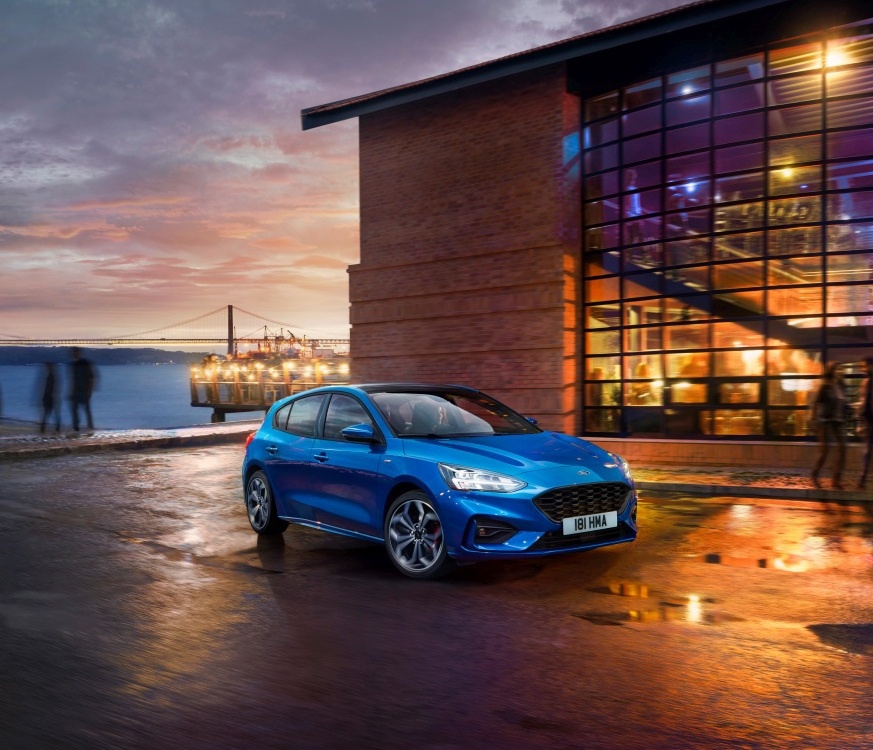
The Ford Focus IV Hatchback 1.5 EcoBoost (150 hp) Automatic, produced from September 2018 to 2021, represents a significant iteration of Ford’s globally successful compact car. This variant occupied a mid-range position within the fourth-generation Focus lineup (2018-2022), offering a balance between fuel efficiency, performance, and convenience. Built on the C2 platform (also known as the 1HX0/A3 platform shared with other Ford models), the 1.5 EcoBoost Automatic aimed to appeal to buyers seeking a modern, well-equipped hatchback with an automatic transmission. It was primarily marketed in Europe and other global markets, with a focus on providing a comfortable and practical driving experience.
Technical Specifications
| Brand | Ford |
| Model | Focus |
| Generation | Focus IV Hatchback |
| Type (Engine) | 1.5 EcoBoost (150 Hp) Automatic |
| Start of production | September, 2018 |
| End of production | 2021 |
| Powertrain Architecture | Internal Combustion engine |
| Body type | Hatchback |
| Seats | 5 |
| Doors | 5 |
| Fuel consumption (urban) | 7.6-7.8 l/100 km (30.9 – 30.2 US mpg) |
| Fuel consumption (extra urban) | 4.9-5.1 l/100 km (48 – 46.1 US mpg) |
| Fuel consumption (combined) | 5.9-6.1 l/100 km (39.9 – 38.6 US mpg) |
| CO2 emissions | 133-138 g/km |
| Fuel Type | Petrol (Gasoline) |
| Acceleration 0 – 100 km/h | 8.9 sec |
| Acceleration 0 – 62 mph | 8.9 sec |
| Acceleration 0 – 60 mph | 8.5 sec |
| Maximum speed | 208 km/h (129.25 mph) |
| Emission standard | Euro 6 d |
| Weight-to-power ratio | 8.9 kg/Hp |
| Weight-to-torque ratio | 5.5 kg/Nm |
| Power | 150 Hp @ 6000 rpm |
| Torque | 240 Nm @ 1600 rpm (177.01 lb.-ft. @ 1600 rpm) |
| Engine layout | Front, Transverse |
| Engine Model/Code | YZDA |
| Engine displacement | 1497 cm3 (91.35 cu. in.) |
| Number of cylinders | 3 |
| Engine configuration | Inline |
| Cylinder Bore | 84 mm (3.31 in.) |
| Piston Stroke | 90 mm (3.54 in.) |
| Compression ratio | 11:1 |
| Number of valves per cylinder | 4 |
| Fuel injection system | Direct injection |
| Engine aspiration | Turbocharger, Intercooler |
| Valvetrain | DOHC |
| Engine oil capacity | 5.05 l (5.34 US qt | 4.44 UK qt) |
| Coolant | 5.8 l (6.13 US qt | 5.1 UK qt) |
| Kerb Weight | 1329 kg (2929.94 lbs.) |
| Max. weight | 1905 kg (4199.81 lbs.) |
| Max load | 576 kg (1269.86 lbs.) |
| Trunk (boot) space – minimum | 375 l (13.24 cu. ft.) |
| Trunk (boot) space – maximum | 1354 l (47.82 cu. ft.) |
| Fuel tank capacity | 52 l (13.74 US gal | 11.44 UK gal) |
| Max. roof load | 75 kg (165.35 lbs.) |
| Permitted trailer load with brakes (12%) | 1500 kg (3306.93 lbs.) |
| Permitted trailer load without brakes | 700 kg (1543.24 lbs.) |
| Permitted towbar download | 75 kg (165.35 lbs.) |
| Length | 4378-4387 mm (172.36 – 172.72 in.) |
| Width | 1825 mm (71.85 in.) |
| Width with mirrors folded | 1848 mm (72.76 in.) |
| Width including mirrors | 1979 mm (77.91 in.) |
| Height | 1439-1452 mm (56.65 – 57.17 in.) |
| Wheelbase | 2700 mm (106.3 in.) |
| Front track | 1572 mm (61.89 in.) |
| Rear (Back) track | 1553 mm (61.14 in.) |
| Front overhang | 909 mm (35.79 in.) |
| Rear overhang | 769 mm (30.28 in.) |
| Ride height (ground clearance) | 112-135 mm (4.41 – 5.31 in.) |
| Drag coefficient (Cd) | 0.27 |
| Minimum turning circle (turning diameter) | 11.0 m (36.09 ft.) |
| Drivetrain Architecture | The Internal combustion engine (ICE) drives the front wheels of the vehicle. |
| Drive wheel | Front wheel drive |
| Number of gears and type of gearbox | 8 gears, automatic transmission |
| Front brakes | Ventilated discs |
| Rear brakes | Disc |
| Assisting systems | ABS (Anti-lock braking system) |
| Steering type | Steering rack and pinion |
| Power steering | Electric Steering |
| Tires size | 195/65 R16; 205/60 R16; 215/50 R17; 235/40 R18 |
| Wheel rims size | 6.5J x 16; 7J x 17; 8J x 18 |
Powertrain & Engine Architecture
The heart of this Focus variant is the 1.5-liter EcoBoost inline-3 cylinder engine, designated with the code YZDA. This engine is part of Ford’s EcoBoost family, known for combining turbocharging with direct fuel injection to deliver a balance of power and efficiency. The 1.5L engine utilizes a single scroll turbocharger and intercooler to boost output. Direct injection allows for precise fuel delivery, optimizing combustion and reducing emissions. The engine features a double overhead camshaft (DOHC) valvetrain with four valves per cylinder, enhancing breathing and contributing to its power output. The engine is transversely mounted at the front of the vehicle. Paired with this engine is an 8-speed automatic transmission, providing smooth and efficient gear changes. This transmission was chosen for its ability to improve fuel economy and offer a more relaxed driving experience compared to a manual gearbox.
Driving Characteristics
The 150 hp and 240 Nm (177 lb-ft) of torque produced by the 1.5 EcoBoost engine, when coupled with the 8-speed automatic, resulted in a respectable, though not particularly sporty, driving experience. Acceleration from 0-60 mph took approximately 8.5 seconds, and top speed was around 129 mph. The automatic transmission was tuned for comfort and efficiency, with gear changes generally smooth and unobtrusive. While the engine provided adequate power for everyday driving and highway cruising, it lacked the punch of higher-output versions of the Focus, such as those equipped with the 1.5 EcoBoost in a higher state of tune or the older 2.0L variants. The 8-speed transmission helped to keep the engine in its optimal power band, but downshifts could sometimes be hesitant when quick acceleration was needed. The gear ratios were optimized for fuel economy, prioritizing efficiency over outright performance.
Equipment & Trim Levels
The 1.5 EcoBoost Automatic typically came equipped with a solid range of standard features. These included air conditioning, power windows and mirrors, a basic infotainment system with a touchscreen display, Bluetooth connectivity, and alloy wheels. Higher trim levels offered additional features such as a more advanced infotainment system with navigation, a rearview camera, parking sensors, automatic headlights and wipers, and upgraded interior upholstery. Optional extras included a panoramic sunroof, heated seats, and a premium sound system. Interior trim generally featured cloth upholstery, with higher trims offering partial leather options.
Chassis & Braking
The Focus IV utilized an independent front suspension with MacPherson struts and a multi-link rear suspension. This setup provided a good balance of ride comfort and handling. The 1.5 EcoBoost Automatic variant typically featured ventilated front disc brakes and solid rear disc brakes. Anti-lock Braking System (ABS) was standard. The suspension was tuned to prioritize comfort, resulting in a slightly softer ride compared to sportier Focus models. Stabilizer bars were fitted to both the front and rear axles to reduce body roll during cornering.
Market Reception & Comparison
The Ford Focus IV 1.5 EcoBoost Automatic was generally well-received by automotive critics. It was praised for its comfortable ride, fuel efficiency, and well-equipped interior. However, some reviewers noted that the engine lacked the excitement of more powerful alternatives. Compared to the 1.0 EcoBoost variants, the 1.5 offered noticeably more power and refinement. Against diesel-powered Focus models (like the 1.5 TDCi), the 1.5 EcoBoost offered a smoother and quieter driving experience, but typically at the expense of fuel economy. The automatic transmission was seen as a positive addition, making the Focus more accessible to a wider range of buyers.
Legacy
The 1.5 EcoBoost engine, while generally reliable, has been known to exhibit some issues with timing belt durability and potential for carbon buildup on the intake valves. Regular maintenance, including timely oil changes and the use of quality fuel, is crucial for ensuring long-term reliability. The 8-speed automatic transmission has proven to be relatively robust, but like any automatic, requires regular fluid changes. In the used car market, the Focus IV 1.5 EcoBoost Automatic represents a good value proposition, offering a well-rounded package of features, efficiency, and practicality. Its popularity ensures a good supply of parts and relatively affordable maintenance costs.