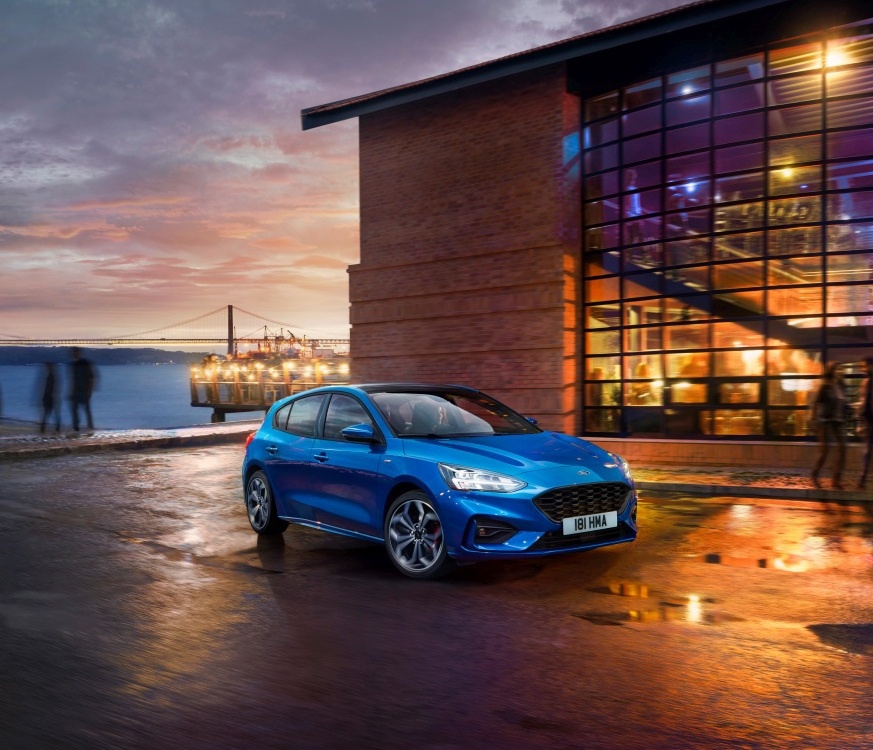
The Ford Focus IV Hatchback 2.0 EcoBlue (150 Hp) represents a significant iteration in Ford’s globally successful Focus line, produced from September 2018 to 2021. Positioned as a mid-range offering within the fourth generation (Mk4) Focus lineup, this variant aimed to balance fuel efficiency with respectable performance, catering to drivers seeking a practical and economical hatchback. It was primarily marketed in Europe and other regions outside of North America, where the Focus had already established a strong reputation. This model is built on the C2 platform, shared with other Ford global models.
Technical Specifications
| Brand | Ford |
| Model | Focus |
| Generation | Focus IV Hatchback |
| Type (Engine) | 2.0 EcoBlue (150 Hp) |
| Start of production | September, 2018 |
| End of production | 2021 |
| Powertrain Architecture | Internal Combustion engine |
| Body type | Hatchback |
| Seats | 5 |
| Doors | 5 |
| Fuel consumption (urban) | 5.6 l/100 km (42 US mpg, 50.4 UK mpg, 17.9 km/l) |
| Fuel consumption (extra urban) | 3.6-3.7 l/100 km (65.3 – 63.6 US mpg, 78.5 – 76.3 UK mpg, 27.8 – 27 km/l) |
| Fuel consumption (combined) | 4.4-4.5 l/100 km (53.5 – 52.3 US mpg, 64.2 – 62.8 UK mpg, 22.7 – 22.2 km/l) |
| CO2 emissions | 114-116 g/km |
| Fuel Type | Diesel |
| Acceleration 0 – 100 km/h | 8.5 sec |
| Acceleration 0 – 62 mph | 8.5 sec |
| Acceleration 0 – 60 mph | 8.1 sec |
| Maximum speed | 210 km/h (130.49 mph) |
| Emission standard | Euro 6 d |
| Weight-to-power ratio | 9.5 kg/Hp, 105.8 Hp/tonne |
| Weight-to-torque ratio | 3.8 kg/Nm, 260.9 Nm/tonne |
| Power | 150 Hp @ 3500 rpm |
| Power per litre | 75.2 Hp/l |
| Torque | 370 Nm @ 2000-2500 rpm (272.9 lb.-ft. @ 2000-2500 rpm) |
| Engine layout | Front, Transverse |
| Engine Model/Code | YLDA |
| Engine displacement | 1996 cm3 (121.8 cu. in.) |
| Number of cylinders | 4 |
| Engine configuration | Inline |
| Cylinder Bore | 84 mm (3.31 in.) |
| Piston Stroke | 90 mm (3.54 in.) |
| Compression ratio | 15.8:1 |
| Number of valves per cylinder | 4 |
| Fuel injection system | Diesel Commonrail |
| Engine aspiration | Turbocharger, Intercooler |
| Valvetrain | DOHC |
| Engine oil capacity | 6.4 l (6.76 US qt | 5.63 UK qt) |
| Coolant | 12.6 l (13.31 US qt | 11.09 UK qt) |
| Kerb Weight | 1418 kg (3126.15 lbs.) |
| Max. weight | 2020 kg (4453.34 lbs.) |
| Max load | 602 kg (1327.18 lbs.) |
| Trunk (boot) space – minimum | 375 l (13.24 cu. ft.) |
| Trunk (boot) space – maximum | 1354 l (47.82 cu. ft.) |
| Fuel tank capacity | 47 l (12.42 US gal | 10.34 UK gal) |
| Max. roof load | 75 kg (165.35 lbs.) |
| Permitted trailer load with brakes (12%) | 1800 kg (3968.32 lbs.) |
| Permitted trailer load without brakes | 745 kg (1642.44 lbs.) |
| Permitted towbar download | 90 kg (198.42 lbs.) |
| Length | 4378-4387 mm (172.36 – 172.72 in.) |
| Width | 1825 mm (71.85 in.) |
| Width with mirrors folded | 1848 mm (72.76 in.) |
| Width including mirrors | 1979 mm (77.91 in.) |
| Height | 1439-1452 mm (56.65 – 57.17 in.) |
| Wheelbase | 2700 mm (106.3 in.) |
| Front track | 1572 mm (61.89 in.) |
| Rear (Back) track | 1553 mm (61.14 in.) |
| Front overhang | 909 mm (35.79 in.) |
| Rear overhang | 769 mm (30.28 in.) |
| Ride height (ground clearance) | 112-135 mm (4.41 – 5.31 in.) |
| Drag coefficient (Cd) | 0.27 |
| Minimum turning circle (turning diameter) | 11.0 m (36.09 ft.) |
| Drivetrain Architecture | The Internal combustion engine (ICE) drives the front wheels of the vehicle. |
| Drive wheel | Front wheel drive |
| Number of gears and type of gearbox | 6 gears, manual transmission |
| Front brakes | Ventilated discs |
| Rear brakes | Disc |
| Assisting systems | ABS (Anti-lock braking system) |
| Steering type | Steering rack and pinion |
| Power steering | Electric Steering |
| Tires size | 195/65 R16; 205/60 R16; 215/50 R17; 235/40 R18 |
| Wheel rims size | 6.5J x 16; 7J x 17; 8J x 18 |
INTRODUCTION
The Ford Focus IV 2.0 EcoBlue (150 Hp) was introduced as part of the fourth-generation Focus range, launched in 2018. This model aimed to provide a balance between performance and economy, utilizing Ford’s EcoBlue diesel engine technology. It occupied a middle ground in the lineup, offering more power and torque than the lower-spec 1.5 EcoBlue variants, but remaining more accessible than the higher-performance ST models. The fourth-generation Focus represented a significant overhaul, featuring improved interior quality, enhanced technology, and a more sophisticated chassis compared to its predecessor.
Powertrain & Engine Architecture
At the heart of this variant lies the 2.0-liter EcoBlue diesel engine, designated with the code YLDA. This engine is a four-cylinder, inline configuration, employing a turbocharger with intercooling to boost power and efficiency. The EcoBlue series engines are characterized by their advanced combustion technology, including high-pressure fuel injection (Commonrail) and a sophisticated exhaust gas recirculation (EGR) system to reduce emissions. The engine produces 150 horsepower at 3500 rpm and a substantial 370 Nm (272.9 lb-ft) of torque between 2000 and 2500 rpm. This torque output provides strong mid-range acceleration, making it well-suited for everyday driving and highway cruising. The engine features a double overhead camshaft (DOHC) valvetrain with four valves per cylinder, optimizing gas flow for improved performance. The 6-speed manual transmission was standard, providing precise gear changes and contributing to the vehicle’s overall efficiency.
Driving Characteristics
The 2.0 EcoBlue 150 Hp Focus offers a composed and refined driving experience. The engine’s strong torque delivery means that brisk acceleration is readily available without needing to rev the engine excessively. The 6-speed manual gearbox is well-matched to the engine’s characteristics, offering smooth and precise shifts. While not a sports-oriented model, the Focus IV chassis provides a good balance between comfort and handling. Compared to the lower-powered 1.5 EcoBlue variants, the 2.0-liter engine provides noticeably more effortless performance, particularly when fully loaded or tackling inclines. Against higher-output versions, such as the ST, it lacks the ultimate performance, but offers a more economical and practical driving experience. The steering is accurate and well-weighted, providing good feedback to the driver.
Equipment & Trim Levels
The 2.0 EcoBlue 150 Hp variant typically came equipped with a reasonable level of standard features. These generally included air conditioning, power windows, power mirrors, a basic infotainment system with Bluetooth connectivity, and alloy wheels. Higher trim levels, such as Titanium or ST-Line, added features like a larger touchscreen display, navigation system, automatic climate control, parking sensors, and a more premium interior trim. Optional extras could include a panoramic sunroof, leather upholstery, and advanced driver-assistance systems such as adaptive cruise control and lane-keeping assist.
Chassis & Braking
The Focus IV utilizes a MacPherson strut front suspension and a multi-link rear suspension, providing a comfortable ride and good handling characteristics. The 2.0 EcoBlue variant, due to its increased weight compared to lower-spec models, typically featured slightly stiffer suspension components to maintain stability and control. Braking duties are handled by ventilated discs at the front and solid discs at the rear, providing adequate stopping power. Anti-lock Braking System (ABS) is standard, enhancing safety during emergency braking situations. The electric power steering system provides a responsive and precise steering feel.
Market Reception & Comparison
The Ford Focus IV 2.0 EcoBlue (150 Hp) was generally well-received by automotive critics. It was praised for its fuel efficiency, comfortable ride, and refined driving experience. However, some reviewers noted that the interior, while improved over the previous generation, still lacked the premium feel of some competitors. Compared to the 1.5 EcoBlue variants, the 2.0-liter engine offered a significant performance upgrade, making it a more appealing option for drivers who frequently travel long distances or carry passengers. In terms of fuel economy, it offered a competitive advantage over petrol-powered alternatives, while providing comparable performance to other 2.0-liter diesel engines in its class.
Legacy
The 2.0 EcoBlue engine has proven to be a relatively reliable unit, although, like all diesel engines, it is susceptible to issues related to the diesel particulate filter (DPF) if not properly maintained. Regular servicing and the use of high-quality diesel fuel are essential to ensure long-term reliability. On the used car market, the Focus IV 2.0 EcoBlue (150 Hp) represents a good value proposition, offering a blend of practicality, economy, and performance. Its strong torque output and comfortable ride make it a suitable choice for both urban commuting and long-distance journeys. The availability of spare parts and a well-established dealer network further contribute to its appeal as a used car purchase.