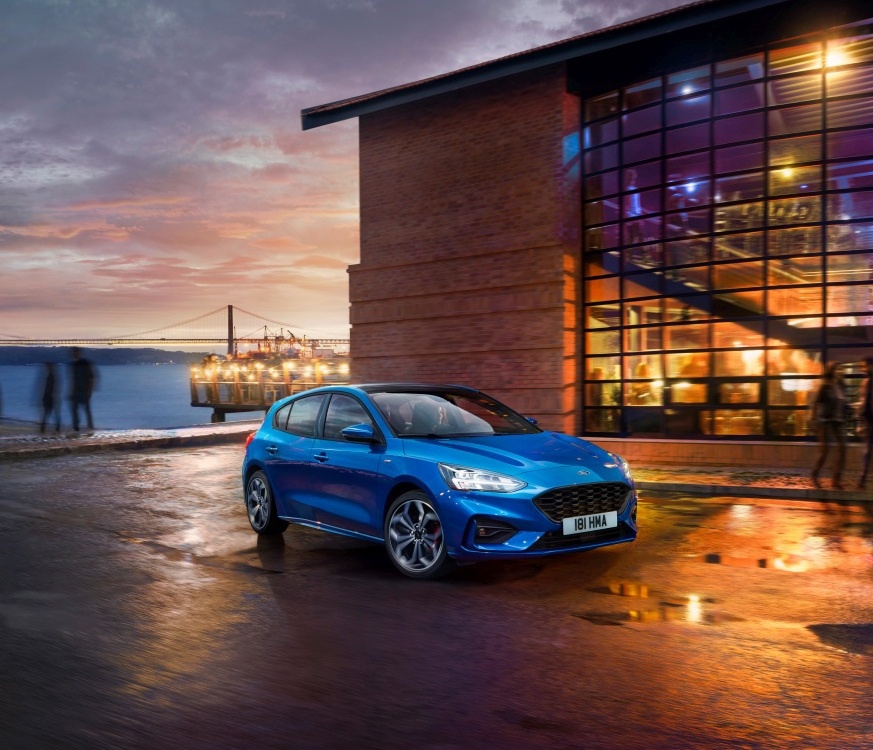
The Ford Focus IV Hatchback 2.0 EcoBlue (150 Hp) Automatic, produced from September 2018 to 2021, represents a significant iteration in Ford’s globally successful Focus line. This variant occupied a mid-range position within the fourth-generation Focus (Mk4) lineup, offering a balance between fuel efficiency, performance, and comfort. Built on the C2 platform, shared with the Ford Kuga/Escape, it aimed to appeal to drivers seeking a practical and refined hatchback with diesel power. The 2.0 EcoBlue engine, coupled with an eight-speed automatic transmission, was designed to meet stringent Euro 6d emission standards while providing a comfortable driving experience for both urban commutes and longer journeys.
Technical Specifications
| Brand | Ford |
| Model | Focus |
| Generation | Focus IV Hatchback |
| Type (Engine) | 2.0 EcoBlue (150 Hp) Automatic |
| Start of production | September, 2018 |
| End of production | 2021 |
| Powertrain Architecture | Internal Combustion engine |
| Body type | Hatchback |
| Seats | 5 |
| Doors | 5 |
| Fuel consumption (urban) | 5.3-5.6 l/100 km (44.4 – 42 US mpg) |
| Fuel consumption (extra urban) | 3.9-4.1 l/100 km (60.3 – 57.4 US mpg) |
| Fuel consumption (combined) | 4.4-4.6 l/100 km (53.5 – 51.1 US mpg) |
| CO2 emissions | 114-121 g/km |
| Fuel Type | Diesel |
| Acceleration 0 – 100 km/h | 9.3 sec |
| Acceleration 0 – 62 mph | 9.3 sec |
| Acceleration 0 – 60 mph | 8.8 sec |
| Maximum speed | 207 km/h (128.62 mph) |
| Emission standard | Euro 6 d |
| Weight-to-power ratio | 9.6 kg/Hp |
| Weight-to-torque ratio | 3.9 kg/Nm |
| Power | 150 Hp @ 3500 rpm |
| Torque | 370 Nm @ 2000-2500 rpm (272.9 lb.-ft. @ 2000-2500 rpm) |
| Engine layout | Front, Transverse |
| Engine Model/Code | YLDA |
| Engine displacement | 1996 cm3 (121.8 cu. in.) |
| Number of cylinders | 4 |
| Engine configuration | Inline |
| Cylinder Bore | 84 mm (3.31 in.) |
| Piston Stroke | 90 mm (3.54 in.) |
| Compression ratio | 15.8:1 |
| Number of valves per cylinder | 4 |
| Fuel injection system | Diesel Commonrail |
| Engine aspiration | Turbocharger, Intercooler |
| Valvetrain | DOHC |
| Engine oil capacity | 6.4 l (6.76 US qt | 5.63 UK qt) |
| Coolant | 11.6 l (12.26 US qt | 10.21 UK qt) |
| Kerb Weight | 1443 kg (3181.27 lbs.) |
| Max. weight | 2045 kg (4508.45 lbs.) |
| Max load | 602 kg (1327.18 lbs.) |
| Trunk (boot) space – minimum | 375 l (13.24 cu. ft.) |
| Trunk (boot) space – maximum | 1354 l (47.82 cu. ft.) |
| Fuel tank capacity | 47 l (12.42 US gal | 10.34 UK gal) |
| Max. roof load | 75 kg (165.35 lbs.) |
| Permitted trailer load with brakes (12%) | 1600 kg (3527.4 lbs.) |
| Permitted trailer load without brakes | 750 kg (1653.47 lbs.) |
| Permitted towbar download | 90 kg (198.42 lbs.) |
| Length | 4378-4387 mm (172.36 – 172.72 in.) |
| Width | 1825 mm (71.85 in.) |
| Width with mirrors folded | 1848 mm (72.76 in.) |
| Width including mirrors | 1979 mm (77.91 in.) |
| Height | 1439-1452 mm (56.65 – 57.17 in.) |
| Wheelbase | 2700 mm (106.3 in.) |
| Front track | 1572 mm (61.89 in.) |
| Rear (Back) track | 1553 mm (61.14 in.) |
| Front overhang | 909 mm (35.79 in.) |
| Rear overhang | 769 mm (30.28 in.) |
| Ride height (ground clearance) | 112-135 mm (4.41 – 5.31 in.) |
| Drag coefficient (Cd) | 0.27 |
| Minimum turning circle (turning diameter) | 11.0 m (36.09 ft.) |
| Drivetrain Architecture | The Internal combustion engine (ICE) drives the front wheels of the vehicle. |
| Drive wheel | Front wheel drive |
| Number of gears and type of gearbox | 8 gears, automatic transmission |
| Front brakes | Ventilated discs |
| Rear brakes | Disc |
| Assisting systems | ABS (Anti-lock braking system) |
| Steering type | Steering rack and pinion |
| Power steering | Electric Steering |
| Tires size | 195/65 R16; 205/60 R16; 215/50 R17; 235/40 R18 |
| Wheel rims size | 6.5J x 16; 7J x 17; 8J x 18 |
Powertrain & Engine Architecture
The heart of this Focus variant is the 2.0-liter EcoBlue diesel engine, specifically the YLDA code. This engine is a four-cylinder, inline configuration, utilizing a common-rail direct fuel injection system. The EcoBlue series represented Ford’s advancements in diesel technology, focusing on reducing emissions and improving fuel economy. Key features included a redesigned combustion chamber, high-pressure fuel injection (2,500 bar), and a variable geometry turbocharger. The DOHC valvetrain, with four valves per cylinder, further optimized airflow for improved performance. The eight-speed automatic transmission, sourced from Aisin, was chosen for its smooth shifting and efficiency. This transmission offered a wider gear ratio spread compared to a traditional six-speed automatic, contributing to both fuel economy and responsiveness.
Driving Characteristics
The 150 hp and 370 Nm of torque delivered by the 2.0 EcoBlue engine, when paired with the eight-speed automatic, provided a comfortable and capable driving experience. Acceleration from 0-60 mph took approximately 8.8 seconds, and 0-100 km/h in 9.3 seconds. While not a performance-oriented setup, the engine offered ample torque for everyday driving and overtaking maneuvers. The automatic transmission generally shifted smoothly, although some drivers noted a slight hesitation during kickdown. Compared to the manual transmission versions of the same engine, the automatic offered greater convenience, particularly in urban traffic. However, the manual versions typically achieved slightly better fuel economy and offered a more engaging driving experience. Higher-output versions, such as the 180 hp EcoBlue, provided noticeably quicker acceleration but at the expense of fuel efficiency.
Equipment & Trim Levels
The 2.0 EcoBlue 150 hp Automatic typically came equipped as a mid-range trim level, often designated as ‘Titanium’ or similar. Standard features included air conditioning, a touchscreen infotainment system with Apple CarPlay and Android Auto compatibility, alloy wheels, and a suite of safety features such as ABS, ESP, and multiple airbags. Interior upholstery was typically cloth, with options for leather upgrades. Optional extras included a panoramic sunroof, heated seats, a premium sound system, and advanced driver-assistance systems like adaptive cruise control and lane-keeping assist. The dashboard layout was modern and functional, with a focus on ergonomics and ease of use.
Chassis & Braking
The Focus IV utilized an independent front suspension with MacPherson struts and a multi-link rear suspension. This setup provided a good balance between ride comfort and handling. The 2.0 EcoBlue Automatic variant typically featured ventilated front disc brakes and solid rear disc brakes. ABS (Anti-lock Braking System) and ESP (Electronic Stability Program) were standard safety features. Stabilizer bars were fitted to both the front and rear axles to reduce body roll during cornering. The suspension tuning was generally geared towards comfort, but the Focus still offered a reasonably engaging driving experience.
Market Reception & Comparison
The Ford Focus IV, including the 2.0 EcoBlue Automatic variant, received generally positive reviews from automotive critics. The engine was praised for its fuel efficiency and refinement, while the automatic transmission was noted for its smooth operation. However, some critics found the styling to be somewhat conservative. Compared to rivals like the Volkswagen Golf and Opel/Vauxhall Astra, the Focus offered a competitive package in terms of price, features, and driving dynamics. The 2.0 EcoBlue Automatic offered a compelling alternative to the petrol-powered versions, particularly for drivers who covered long distances. The 1.5 EcoBlue variants were often seen as more economical, but lacked the outright power and refinement of the 2.0-liter engine.
Legacy
The 2.0 EcoBlue engine proved to be a relatively reliable powertrain, although, like all diesel engines, it required regular maintenance, including oil changes and diesel particulate filter (DPF) regeneration. The eight-speed automatic transmission also demonstrated good durability. In the used car market, the Focus IV 2.0 EcoBlue Automatic remains a popular choice, offering a good balance of practicality, fuel efficiency, and comfort. However, potential buyers should be aware of the potential costs associated with DPF maintenance and ensure that the vehicle has been properly serviced. The Focus IV generation, overall, is considered a well-rounded and capable hatchback that continues to hold its value.