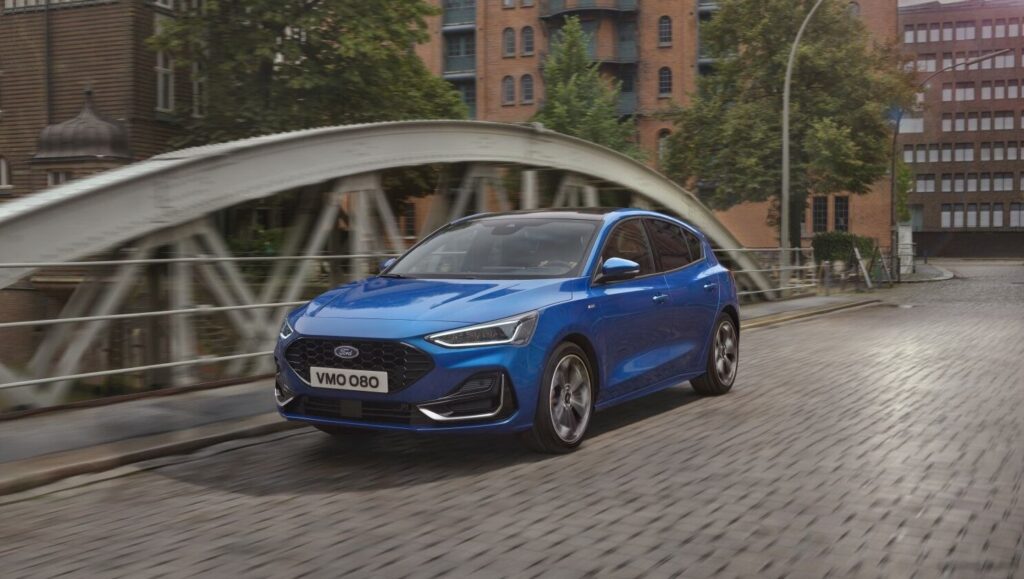
The Ford Focus IV, produced from 2018 to 2022, represented a significant evolution for Ford’s globally popular compact car. The facelifted model introduced in 2022 brought styling updates and revised technology. Among the engine options available, the 1.0 EcoBoost 125 horsepower variant, paired with a six-speed manual transmission, occupied a key position in the lineup as an efficient and accessible entry point. This version aimed to balance fuel economy with adequate performance for everyday driving, making it a popular choice in European markets where smaller displacement engines are favored. It was positioned as a step up from the base engine, offering more power without the higher cost of the more potent EcoBoost or diesel options.
Technical Specifications
| Brand | Ford |
| Model | Focus |
| Generation | Focus IV Hatchback (facelift 2022) |
| Type (Engine) | 1.0 EcoBoost (125 Hp) |
| Start of production | January, 2022 |
| Powertrain Architecture | Internal Combustion engine |
| Body type | Hatchback |
| Seats | 5 |
| Doors | 5 |
| Fuel consumption at Low speed (WLTP) | 6.6-7.5 l/100 km (35.6 – 31.4 US mpg, 42.8 – 37.7 UK mpg, 15.2 – 13.3 km/l) |
| Fuel consumption at Medium speed (WLTP) | 5.2-6.3 l/100 km (45.2 – 37.3 US mpg, 54.3 – 44.8 UK mpg, 19.2 – 15.9 km/l) |
| Fuel consumption at high speed (WLTP) | 4.6-5.7 l/100 km (51.1 – 41.3 US mpg, 61.4 – 49.6 UK mpg, 21.7 – 17.5 km/l) |
| Fuel consumption at very high speed (WLTP) | 5.6-6.8 l/100 km (42 – 34.6 US mpg, 50.4 – 41.5 UK mpg, 17.9 – 14.7 km/l) |
| Combined fuel consumption (WLTP) | 5.4-6.4 l/100 km (43.6 – 36.8 US mpg, 52.3 – 44.1 UK mpg, 18.5 – 15.6 km/l) |
| CO2 emissions (WLTP) | 121-146 g/km |
| Fuel Type | Petrol (Gasoline) |
| Acceleration 0 – 100 km/h | 10.2 sec |
| Acceleration 0 – 62 mph | 10.2 sec |
| Acceleration 0 – 60 mph | 9.7 sec |
| Maximum speed | 200 km/h (124.27 mph) |
| Emission standard | Euro 6d-ISC-FCM |
| Weight-to-power ratio | 10 kg/Hp, 99.6 Hp/tonne |
| Weight-to-torque ratio | 7.4 kg/Nm, 135.5 Nm/tonne |
| Power | 125 Hp @ 6000 rpm |
| Power per litre | 125.1 Hp/l |
| Torque | 170 Nm @ 1400-4500 rpm (125.39 lb.-ft. @ 1400-4500 rpm) |
| Engine layout | Front, Transverse |
| Engine Model/Code | B7DA |
| Engine displacement | 999 cm3 (60.96 cu. in.) |
| Number of cylinders | 3 |
| Engine configuration | Inline |
| Cylinder Bore | 71.9 mm (2.83 in.) |
| Piston Stroke | 82 mm (3.23 in.) |
| Compression ratio | 10.5:1 |
| Number of valves per cylinder | 4 |
| Fuel injection system | Direct injection |
| Engine aspiration | Turbocharger, Intercooler |
| Valvetrain | DOHC, Ti-VCT |
| Engine oil capacity | 4.5 l (4.76 US qt | 3.96 UK qt) |
| Coolant | 5.5 l (5.81 US qt | 4.84 UK qt) |
| Kerb Weight | 1255 kg (2766.8 lbs.) |
| Max. weight | 1895 kg (4177.76 lbs.) |
| Max load | 640 kg (1410.96 lbs.) |
| Trunk (boot) space – minimum | 392 l (13.84 cu. ft.) |
| Trunk (boot) space – maximum | 1354 l (47.82 cu. ft.) |
| Fuel tank capacity | 52 l (13.74 US gal | 11.44 UK gal) |
| Max. roof load | 75 kg (165.35 lbs.) |
| Permitted trailer load with brakes (12%) | 1100 kg (2425.08 lbs.) |
| Permitted trailer load without brakes | 665 kg (1466.07 lbs.) |
| Permitted towbar download | 90 kg (198.42 lbs.) |
| Length | 4382-4392 mm (172.52 – 172.91 in.) |
| Width | 1825 mm (71.85 in.) |
| Width with mirrors folded | 1848 mm (72.76 in.) |
| Width including mirrors | 1979 mm (77.91 in.) |
| Height | 1459-1471 mm (57.44 – 57.91 in.) |
| Wheelbase | 2700 mm (106.3 in.) |
| Front overhang | 913 mm (35.94 in.) |
| Rear overhang | 769-779 mm (30.28 – 30.67 in.) |
| Ride height (ground clearance) | 123-135 mm (4.84 – 5.31 in.) |
| Minimum turning circle (turning diameter) | 11 m (36.09 ft.) |
| Drivetrain Architecture | The Internal combustion engine (ICE) drives the front wheels of the vehicle. |
| Drive wheel | Front wheel drive |
| Number of gears and type of gearbox | 6 gears, manual transmission |
| Front suspension | Independent type McPherson |
| Rear suspension | Independent multi-link suspension |
| Front brakes | Ventilated discs, 282×27 mm |
| Rear brakes | Disc, 282×27 mm |
| Assisting systems | ABS (Anti-lock braking system) |
| Steering type | Steering rack and pinion |
| Power steering | Electric Steering |
| Tires size | 205/60 R16; 215/50 R17 |
| Wheel rims size | 6.5J x 16; 7J x 17 |
Powertrain & Engine Architecture
The heart of this Focus variant is the 1.0 EcoBoost engine, specifically the B7DA code. This is a three-cylinder, 1.0-liter turbocharged gasoline engine. It utilizes direct fuel injection, a technology that improves efficiency and power output by injecting fuel directly into the combustion chamber. The engine also features a twin-independent variable camshaft timing (Ti-VCT) system, allowing for optimized valve control throughout the engine’s operating range. The turbocharger, coupled with an intercooler, forces more air into the engine, boosting power despite the small displacement. The six-speed manual transmission provides precise gear changes and contributes to the car’s overall responsiveness. The engine’s compact size and lightweight construction contribute to a favorable front-to-rear weight distribution.
Driving Characteristics
The 1.0 EcoBoost 125 hp engine delivers adequate performance for typical daily driving. While not a sports car, it provides sufficient acceleration for merging onto highways and overtaking slower traffic. The turbocharger provides a noticeable boost in power, but it’s not as dramatic as in higher-output EcoBoost variants. The six-speed manual transmission allows drivers to keep the engine in its optimal power band. Compared to the higher-powered 1.5 EcoBoost, this version feels less urgent, but it offers better fuel economy. The gear ratios are well-matched for everyday driving, providing a balance between acceleration and fuel efficiency. The engine is relatively quiet at cruising speeds, but the three-cylinder character is noticeable at idle and during hard acceleration.
Equipment & Trim Levels
The 1.0 EcoBoost 125 hp model typically came equipped with a reasonable level of standard features. These often included air conditioning, power windows and mirrors, a basic infotainment system with Bluetooth connectivity, and alloy wheels. Higher trim levels added features such as a larger touchscreen display, navigation, automatic climate control, and advanced driver-assistance systems like lane-keeping assist and automatic emergency braking. Interior upholstery was typically cloth, with options for upgraded materials on higher trims. Optional extras included a sunroof, premium sound system, and parking sensors.
Chassis & Braking
The Focus IV utilizes an independent McPherson strut suspension at the front and an independent multi-link suspension at the rear. This setup provides a good balance between ride comfort and handling. The chassis is relatively lightweight, contributing to the car’s agility. Brakes are typically ventilated discs at the front and solid discs at the rear. Anti-lock braking system (ABS) is standard. The steering is electric power-assisted, providing a light and precise feel. Stabilizer bars are fitted to both the front and rear axles to reduce body roll during cornering.
Market Reception & Comparison
The 1.0 EcoBoost 125 hp Focus was generally well-received by automotive critics as a practical and efficient option. It was praised for its fuel economy and surprisingly lively performance. However, some reviewers noted that the three-cylinder engine could feel strained under heavy load. Compared to the 1.5 EcoBoost, it offered less power but significantly better fuel economy. Against diesel alternatives, it provided a smoother and quieter driving experience, although diesel models often offered even greater fuel efficiency. The manual transmission was favored by many drivers for its engaging feel and precise control.
Legacy
The 1.0 EcoBoost engine has proven to be a reliable and durable powertrain when properly maintained. While early versions of the engine experienced some issues with coolant loss, these were largely addressed in later iterations. The Focus IV 1.0 EcoBoost 125 hp remains a popular choice in the used car market, offering a good balance of affordability, fuel efficiency, and practicality. Its relatively simple mechanical design makes it easier and less expensive to maintain compared to more complex powertrains. The engine’s continued presence in the used car market is a testament to its overall reliability and enduring appeal.