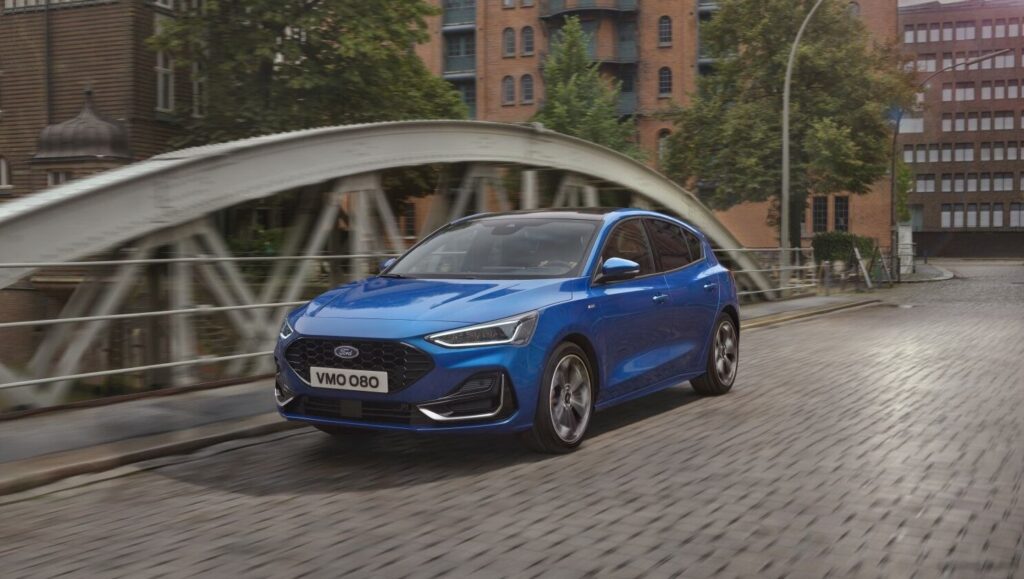
The Ford Focus IV, produced from 2018 to 2022, represented a significant evolution for Ford’s globally popular compact hatchback. The 2022 facelift brought updated styling and technology, and within the range, the 1.0 EcoBoost 125 hp Mild Hybrid variant occupied a key position as an efficient and accessible entry point into the Focus lineup. This version, introduced in January 2022, aimed to balance fuel economy with reasonable performance, appealing to buyers prioritizing practicality and running costs. It was offered exclusively as a five-door hatchback, aligning with the broader European market preference and increasingly, North American trends.
Technical Specifications
| Brand | Ford |
| Model | Focus |
| Generation | Focus IV Hatchback (facelift 2022) |
| Type (Engine) | 1.0 EcoBoost (125 Hp) Mild Hybrid |
| Start of production | January, 2022 |
| Powertrain Architecture | MHEV (Mild Hybrid Electric Vehicle) |
| Body type | Hatchback |
| Seats | 5 |
| Doors | 5 |
| Fuel consumption at Low speed (WLTP) | 6.2-6.9 l/100 km (37.9 – 34.1 US mpg) |
| Fuel consumption at Medium speed (WLTP) | 5-5.8 l/100 km (47 – 40.6 US mpg) |
| Fuel consumption at high speed (WLTP) | 4.5-5.4 l/100 km (52.3 – 43.6 US mpg) |
| Fuel consumption at very high speed (WLTP) | 5.4-6.6 l/100 km (43.6 – 35.6 US mpg) |
| Combined fuel consumption (WLTP) | 5.2-6.1 l/100 km (45.2 – 38.6 US mpg) |
| CO2 emissions (WLTP) | 117-138 g/km |
| Fuel Type | Petrol (Gasoline) |
| Acceleration 0 – 100 km/h | 10.2 sec |
| Acceleration 0 – 62 mph | 10.2 sec |
| Acceleration 0 – 60 mph | 9.7 sec |
| Maximum speed | 200 km/h (124.27 mph) |
| Emission standard | Euro 6d-ISC-FCM |
| Weight-to-power ratio | 10.2 kg/Hp |
| Weight-to-torque ratio | 7.5 kg/Nm |
| Electric motor power | 16 Hp |
| Power | 125 Hp @ 6000 rpm |
| Torque | 170 Nm @ 1400-4500 rpm (125.39 lb.-ft. @ 1400-4500 rpm) |
| Engine layout | Front, Transverse |
| Engine Model/Code | B7DC |
| Engine displacement | 999 cm3 (60.96 cu. in.) |
| Number of cylinders | 3 |
| Engine configuration | Inline |
| Cylinder Bore | 71.9 mm (2.83 in.) |
| Piston Stroke | 82 mm (3.23 in.) |
| Compression ratio | 10.5:1 |
| Number of valves per cylinder | 4 |
| Fuel injection system | Direct injection |
| Engine aspiration | Turbocharger, Intercooler |
| Valvetrain | DOHC, Ti-VCT |
| Engine oil capacity | 4.5 l (4.76 US qt | 3.96 UK qt) |
| Coolant | 5.5 l (5.81 US qt | 4.84 UK qt) |
| Kerb Weight | 1274 kg (2808.69 lbs.) |
| Max. weight | 1895 kg (4177.76 lbs.) |
| Max load | 621 kg (1369.07 lbs.) |
| Trunk (boot) space – minimum | 392 l (13.84 cu. ft.) |
| Trunk (boot) space – maximum | 1354 l (47.82 cu. ft.) |
| Fuel tank capacity | 52 l (13.74 US gal | 11.44 UK gal) |
| Max. roof load | 75 kg (165.35 lbs.) |
| Permitted trailer load with brakes (12%) | 1100 kg (2425.08 lbs.) |
| Permitted trailer load without brakes | 670 kg (1477.1 lbs.) |
| Permitted towbar download | 90 kg (198.42 lbs.) |
| Length | 4382-4392 mm (172.52 – 172.91 in.) |
| Width | 1825 mm (71.85 in.) |
| Width with mirrors folded | 1848 mm (72.76 in.) |
| Width including mirrors | 1979 mm (77.91 in.) |
| Height | 1459-1471 mm (57.44 – 57.91 in.) |
| Wheelbase | 2700 mm (106.3 in.) |
| Front overhang | 913 mm (35.94 in.) |
| Rear overhang | 769-779 mm (30.28 – 30.67 in.) |
| Ride height (ground clearance) | 123-135 mm (4.84 – 5.31 in.) |
| Minimum turning circle (turning diameter) | 11 m (36.09 ft.) |
| Drivetrain Architecture | ICE and electric motor drive front wheels |
| Drive wheel | Front wheel drive |
| Number of gears and type of gearbox | 6 gears, manual transmission |
| Front suspension | Independent type McPherson |
| Rear suspension | Independent multi-link suspension |
| Front brakes | Ventilated discs, 282×27 mm |
| Rear brakes | Disc, 282×27 mm |
| Tires size | 205/60 R16; 215/50 R17 |
| Wheel rims size | 6.5J x 16; 7J x 17 |
INTRODUCTION
The Ford Focus IV facelift, launched in 2022, continued the fourth generation of Ford’s popular C-segment hatchback. The 1.0 EcoBoost 125 hp Mild Hybrid variant was positioned as a fuel-efficient and affordable option within the range, slotting below the more powerful EcoBoost trims and the diesel options. Built on the C2 platform (1HX0/A3), this version aimed to appeal to buyers seeking a practical, economical, and reasonably equipped family car. The mild hybrid system was a key feature, designed to improve fuel economy and reduce emissions without the complexity or cost of a full hybrid powertrain.
Powertrain & Engine Architecture
At the heart of this Focus variant lies the 1.0 EcoBoost engine, specifically the B7DC code. This is a three-cylinder, 999cc turbocharged gasoline engine featuring direct fuel injection and a DOHC Ti-VCT (Twin Independent Variable Camshaft Timing) valvetrain. The addition of a 48-volt mild hybrid system incorporates a belt-driven integrated starter generator (BiSG) which assists the engine during acceleration and allows for extended engine-off coasting periods. This system recovers energy during braking, storing it in a small battery to provide a power boost when needed. The engine produces 125 horsepower at 6000 rpm and 170 Nm (125.39 lb.-ft.) of torque between 1400 and 4500 rpm. The engine’s compact size and turbocharging contribute to its efficiency and responsiveness. The transmission is a 6-speed manual gearbox, chosen for its efficiency and driver engagement, although an automatic transmission was also available as an option.
Driving Characteristics
The 1.0 EcoBoost 125 hp powertrain delivers adequate performance for everyday driving. Acceleration from 0-60 mph takes approximately 9.7 seconds, and top speed is rated at 124.27 mph. While not a performance-oriented setup, the turbocharger provides a noticeable boost in power, making overtaking and merging onto highways manageable. The mild hybrid system contributes to smoother acceleration from a standstill and helps to reduce turbo lag. The 6-speed manual transmission offers precise shifts and allows drivers to maintain optimal engine speed for efficiency or performance. Compared to the higher-output EcoBoost variants, this version feels less eager to rev, but it offers a more relaxed and fuel-efficient driving experience. The manual gearbox also provides more driver control than the optional automatic.
Equipment & Trim Levels
The 1.0 EcoBoost 125 hp Mild Hybrid typically came equipped with a respectable level of standard features. These generally included air conditioning, a touchscreen infotainment system with Apple CarPlay and Android Auto compatibility, Ford’s SYNC 3 system, Bluetooth connectivity, and a suite of driver-assistance technologies such as lane-keeping assist and automatic emergency braking. Interior upholstery was typically cloth, with options for upgraded materials available. Higher trim levels added features like heated seats, a larger touchscreen display, a premium sound system, and parking sensors. Exterior features included alloy wheels, body-colored door handles and mirrors, and automatic headlights.
Chassis & Braking
The Focus IV utilizes an independent McPherson strut suspension at the front and an independent multi-link suspension at the rear, providing a comfortable and controlled ride. The suspension tuning is geared towards balancing comfort and handling. Braking duties are handled by ventilated discs at the front and solid discs at the rear, providing adequate stopping power for the vehicle’s weight and performance. Anti-lock braking system (ABS) and electronic stability control (ESC) are standard features. The steering is electric power-assisted, offering a light and precise feel.
Market Reception & Comparison
The 1.0 EcoBoost 125 hp Mild Hybrid Focus was generally well-received by critics for its fuel efficiency and affordability. It offered a compelling alternative to diesel-powered rivals, particularly for drivers who primarily commute in urban environments. Compared to the more powerful EcoBoost variants, this version offered lower running costs but sacrificed some performance. The diesel models provided superior fuel economy on longer journeys, but the EcoBoost offered a smoother and quieter driving experience. The mild hybrid system was praised for its contribution to fuel savings and reduced emissions. However, some reviewers noted that the three-cylinder engine could feel strained under heavy load.
Legacy
The 1.0 EcoBoost engine has proven to be a reliable and durable powertrain, although some early versions experienced issues with coolant leaks. The mild hybrid system has also demonstrated good long-term reliability. In the used car market, the 1.0 EcoBoost 125 hp Mild Hybrid Focus represents a good value proposition, offering a blend of practicality, efficiency, and affordability. Its relatively low running costs and decent equipment levels make it an attractive option for budget-conscious buyers. The Focus IV, in general, is considered a well-rounded and capable compact hatchback, and this variant continues to be a popular choice among used car buyers.