Technical Specifications
| Brand | Ford |
| Model | Focus |
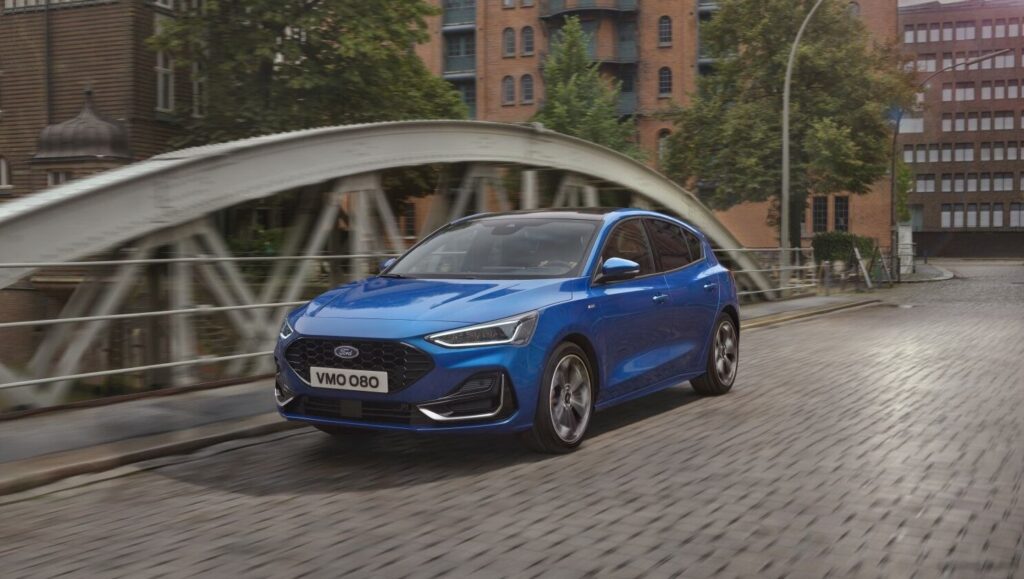
| Generation | Focus IV Hatchback (facelift 2022) |
| Type (Engine) | 1.5 EcoBlue (120 Hp) Automatic |
| Start of production | January, 2022 |
| Powertrain Architecture | Internal Combustion engine |
| Body type | Hatchback |
| Seats | 5 |
| Doors | 5 |
| Fuel consumption at Low speed (WLTP) | 5.7-6.5 l/100 km (41.3 – 36.2 US mpg, 49.6 – 43.5 UK mpg, 17.5 – 15.4 km/l) |
| Fuel consumption at Medium speed (WLTP) | 4.6-5.2 l/100 km (51.1 – 45.2 US mpg, 61.4 – 54.3 UK mpg, 21.7 – 19.2 km/l) |
| Fuel consumption at high speed (WLTP) | 3.9-4.6 l/100 km (60.3 – 51.1 US mpg, 72.4 – 61.4 UK mpg, 25.6 – 21.7 km/l) |
| Fuel consumption at very high speed (WLTP) | 4.7-5.5 l/100 km (50 – 42.8 US mpg, 60.1 – 51.4 UK mpg, 21.3 – 18.2 km/l) |
| Combined fuel consumption (WLTP) | 4.6-5.3 l/100 km (51.1 – 44.4 US mpg, 61.4 – 53.3 UK mpg, 21.7 – 18.9 km/l) |
| CO2 emissions (WLTP) | 120-139 g/km |
| Fuel Type | Diesel |
| Acceleration 0 – 100 km/h | 10.6 sec |
| Acceleration 0 – 62 mph | 10.6 sec |
| Acceleration 0 – 60 mph | 10.1 sec |
| Maximum speed | 193 km/h (119.92 mph) |
| Emission standard | Euro 6d-ISC-FCM |
| Weight-to-power ratio | 11.2 kg/Hp, 89.6 Hp/tonne |
| Weight-to-torque ratio | 4.5 kg/Nm, 223.9 Nm/tonne |
| Power | 120 Hp @ 4000 rpm |
| Power per litre | 80 Hp/l |
| Torque | 300 Nm @ 1750-2250 rpm (221.27 lb.-ft. @ 1750-2250 rpm) |
| Engine layout | Front, Transverse |
| Engine Model/Code | ZTDB |
| Engine displacement | 1500 cm3 (91.54 cu. in.) |
| Number of cylinders | 4 |
| Engine configuration | Inline |
| Cylinder Bore | 75 mm (2.95 in.) |
| Piston Stroke | 84.8 mm (3.34 in.) |
| Compression ratio | 16.4:1 |
| Number of valves per cylinder | 4 |
| Fuel injection system | Diesel Commonrail |
| Engine aspiration | Turbocharger, Intercooler |
| Valvetrain | DOHC |
| Engine oil capacity | 6.2 l (6.55 US qt | 5.46 UK qt) |
| Coolant | 7.85 l (8.3 US qt | 6.91 UK qt) |
| Kerb Weight | 1340 kg (2954.19 lbs.) |
| Max. weight | 1910 kg (4210.83 lbs.) |
| Max load | 570 kg (1256.63 lbs.) |
| Trunk (boot) space – minimum | 392 l (13.84 cu. ft.) |
| Trunk (boot) space – maximum | 1354 l (47.82 cu. ft.) |
| Fuel tank capacity | 47 l (12.42 US gal | 10.34 UK gal) |
| Max. roof load | 75 kg (165.35 lbs.) |
| Permitted trailer load with brakes (12%) | 1400 kg (3086.47 lbs.) |
| Permitted trailer load without brakes | 705 kg (1554.26 lbs.) |
| Permitted towbar download | 60 kg (132.28 lbs.) |
| Length | 4382-4392 mm (172.52 – 172.91 in.) |
| Width | 1825 mm (71.85 in.) |
| Width with mirrors folded | 1848 mm (72.76 in.) |
| Width including mirrors | 1979 mm (77.91 in.) |
| Height | 1459-1471 mm (57.44 – 57.91 in.) |
| Wheelbase | 2700 mm (106.3 in.) |
| Front overhang | 913 mm (35.94 in.) |
| Rear overhang | 769-779 mm (30.28 – 30.67 in.) |
| Ride height (ground clearance) | 123-135 mm (4.84 – 5.31 in.) |
| Minimum turning circle (turning diameter) | 11 m (36.09 ft.) |
| Drivetrain Architecture | The Internal combustion engine (ICE) drives the front wheels of the vehicle. |
| Drive wheel | Front wheel drive |
| Number of gears and type of gearbox | 8 gears, automatic transmission |
| Front suspension | Independent type McPherson |
| Rear suspension | Independent multi-link suspension |
| Front brakes | Ventilated discs, 282×27 mm |
| Rear brakes | Disc, 282×27 mm |
| Assisting systems | ABS (Anti-lock braking system) |
| Steering type | Steering rack and pinion |
| Power steering | Electric Steering |
| Tires size | 205/60 R16; 215/50 R17 |
| Wheel rims size | 6.5J x 16; 7J x 17 |
Introduction
The Ford Focus IV, produced from 2018 to 2022, marked a significant step forward for Ford’s globally successful compact car. The facelifted model introduced in 2022 brought with it styling refinements and a revised engine lineup. Among these options, the 1.5 EcoBlue 120 horsepower automatic variant occupied a crucial position, targeting buyers who prioritized fuel efficiency and driving ease over outright performance. Production of this specific configuration commenced in January 2022 and continued until the end of the Focus IV’s production run. It was primarily marketed in Europe and other regions where diesel engines remained popular, offering a practical and cost-effective solution within the competitive C-segment hatchback market.
Powertrain & Engine Architecture
At the core of this Focus variant lies the 1.5-liter EcoBlue turbocharged diesel engine, identified by the code ZTDB. This engine is a member of Ford’s EcoBlue family, renowned for its emphasis on efficiency and reduced emissions. The 1.5L EcoBlue employs a common-rail direct fuel injection system, operating at exceptionally high pressures to maximize combustion efficiency. The engine features a single turbocharger coupled with an intercooler, striking a balance between power delivery and responsiveness. The valvetrain utilizes a double overhead camshaft (DOHC) configuration with four valves per cylinder, enhancing airflow and contributing to improved performance. This engine is paired with an eight-speed automatic transmission, engineered to deliver smooth gear changes and optimize fuel economy. This transmission represented a notable improvement over the six-speed units found in earlier Focus generations.
Driving Characteristics
The 1.5 EcoBlue 120 hp automatic Focus provides a comfortable and refined driving experience. While not designed for high-performance driving, the engine delivers sufficient power for everyday scenarios. The 300 Nm (221 lb-ft) of torque, readily available between 1750 and 2250 rpm, provides strong low-end pull, making acceleration from a standstill and overtaking maneuvers relatively effortless. The eight-speed automatic transmission contributes to relaxed cruising, maintaining lower engine speeds at highway velocities. Compared to the manual transmission versions, the automatic offers increased convenience, especially in urban traffic. However, it results in a slightly slower 0-60 mph acceleration time of approximately 10.1 seconds. When compared to higher-output versions, such as the 1.5 EcoBlue 150 hp, this variant feels less powerful, but it compensates with superior fuel economy.
Equipment & Trim Levels
The 1.5 EcoBlue 120 hp automatic typically came equipped in mid-range trim levels, such as ‘Trend’ or ‘Titanium’ depending on the specific market. Standard features generally included air conditioning, a touchscreen infotainment system with Bluetooth connectivity, alloy wheels, and a comprehensive suite of safety technologies like ABS, ESP, and multiple airbags. Higher trim levels offered additional amenities such as a larger touchscreen display, a navigation system, parking sensors, automatic headlights and windshield wipers, and upgraded interior upholstery. Optional extras included a panoramic sunroof, heated front seats, and a premium sound system.
Chassis & Braking
The Focus IV features an independent McPherson strut suspension at the front and an independent multi-link suspension at the rear, providing a well-balanced combination of ride comfort and handling. The 1.5 EcoBlue models generally came equipped with ventilated discs on the front wheels and solid discs on the rear. The braking system is enhanced by ABS and Electronic Stability Program (ESP). Stabilizer bars are fitted to both the front and rear axles to minimize body roll during cornering. The suspension tuning prioritizes comfort, while still delivering a reasonably engaging driving experience.
Market Reception & Comparison
The 1.5 EcoBlue 120 hp automatic Focus was generally well-received by automotive critics for its fuel efficiency and comfortable ride quality. It was considered a practical and economical choice for drivers who frequently cover long distances or primarily use the car for commuting. Compared to the more powerful 1.5 EcoBlue 150 hp variant, it offered lower running costs but sacrificed some performance. In comparison to petrol-powered Focus models, the diesel variant provided significantly better fuel economy, but carried the potential for higher maintenance costs associated with the diesel particulate filter (DPF).
Legacy
The 1.5 EcoBlue engine has proven to be a reliable powertrain, although, like all modern diesel engines, it is susceptible to issues with the diesel particulate filter if not regularly driven on longer journeys. The eight-speed automatic transmission has also demonstrated durability. In the used car market, these Focus models represent a good value proposition for buyers seeking an economical and practical hatchback. However, prospective buyers should be aware of the potential costs associated with DPF maintenance and ensure the vehicle has been properly serviced. The Focus IV, and this variant in particular, continues to be a popular choice for those seeking a well-rounded and fuel-efficient compact car.