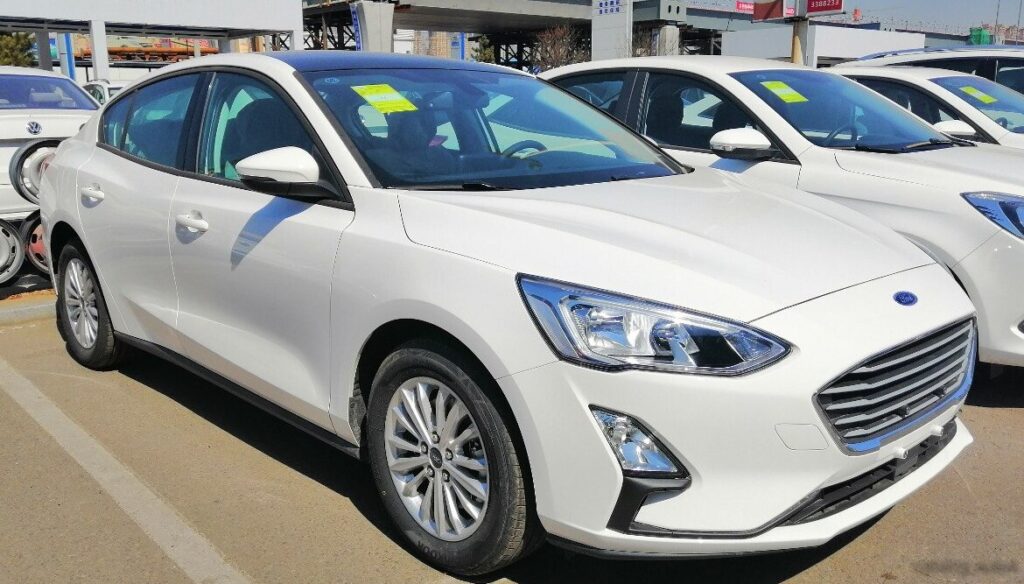
The Ford Focus IV Sedan 1.0 EcoBoost (123 hp) represents a significant entry point into the fourth generation of Ford’s globally successful Focus line. Introduced for the 2018 model year and continuing through 2021, this variant was primarily aimed at the North American market, where sedan body styles maintain considerable popularity. Positioned as a fuel-efficient and affordable option, it occupied the lower-mid range of the Focus IV Sedan lineup, slotting below the more powerful 1.5L EcoBoost and ST trims. It was built on the C2 platform, shared with other Ford global models, and represented a move towards smaller displacement, turbocharged engines for improved fuel economy.
Technical Specifications
| Brand | Ford |
| Model | Focus |
| Generation | Focus IV Sedan |
| Type (Engine) | 1.0 EcoBoost (123 Hp) |
| Start of production | 2018 |
| End of production | 2021 |
| Powertrain Architecture | Internal Combustion engine |
| Body type | Sedan |
| Seats | 5 |
| Doors | 4 |
| Fuel consumption (urban) | 7.8 l/100 km (30.2 US mpg) |
| Fuel consumption (extra urban) | 5.6 l/100 km (42 US mpg) |
| Fuel consumption (combined) | 6.7 l/100 km (35.1 US mpg) |
| Fuel Type | Petrol (Gasoline) |
| Weight-to-power ratio | 10.8 kg/Hp |
| Weight-to-torque ratio | 7.9 kg/Nm |
| Power | 123 Hp @ 6000 rpm |
| Power per litre | 123.1 Hp/l |
| Torque | 169 Nm @ 3500 rpm (124.65 lb.-ft. @ 3500 rpm) |
| Engine layout | Front, Transverse |
| Engine Model/Code | B7DA |
| Engine displacement | 999 cm3 (60.96 cu. in.) |
| Number of cylinders | 3 |
| Engine configuration | Inline |
| Number of valves per cylinder | 4 |
| Fuel injection system | Direct injection |
| Engine aspiration | Turbocharger, Intercooler |
| Engine oil capacity | 4.5 l (4.76 US qt | 3.96 UK qt) |
| Coolant capacity | 5.5 l (5.81 US qt | 4.84 UK qt) |
| Kerb Weight | 1331 kg (2934.35 lbs) |
| Trunk (boot) space (minimum) | 374 l (13.21 cu. ft) |
| Fuel tank capacity | 47 l (12.42 US gal | 10.34 UK gal) |
| Length | 4539 mm (178.7 in) |
| Width with mirrors folded | 1882 mm (74.09 in) |
| Height | 1468 mm (57.8 in) |
| Wheelbase | 2649 mm (104.29 in) |
| Front track | 1554 mm (61.18 in) |
| Rear track | 1534 mm (60.39 in) |
| Drivetrain Architecture | Front wheel drive |
| Number of gears and type of gearbox | 6 gears, manual transmission |
| Front brakes | Disc |
| Rear brakes | Drum |
| Assisting systems | ABS (Anti-lock braking system) |
| Steering type | Steering rack and pinion |
| Power steering | Electric Steering |
| Tires size | 205/60 R16 92H; 215/50 R17 91H; 235/40 ZR18 91W |
| Wheel rims size | 6.5J x 16; 7J x 17; 8J x 18 |
Powertrain & Engine Architecture
The heart of this Focus variant is the Ford 1.0 EcoBoost engine, specifically the B7DA code. This is a three-cylinder, inline gasoline engine utilizing direct fuel injection and a single turbocharger with an intercooler. The engine’s compact size and lightweight construction contribute to the vehicle’s overall efficiency. The 1.0 EcoBoost engine employs a timing belt for valve operation and features variable valve timing on both the intake and exhaust sides to optimize performance and fuel economy across the rev range. Paired with this engine is a six-speed manual transmission, chosen for its efficiency and driver engagement. While an automatic transmission was offered in other Focus IV markets, the North American 1.0 EcoBoost sedan was exclusively available with the manual gearbox.
Driving Characteristics
The 123 hp output, combined with the six-speed manual transmission, provides adequate performance for daily commuting and general driving. Acceleration is not brisk, with 0-60 mph times estimated around 9.5-10.5 seconds. The engine’s torque peak of 169 Nm (124.65 lb-ft) at 3500 rpm provides reasonable responsiveness in everyday driving situations. The manual transmission’s gear ratios are tuned for fuel efficiency, meaning that frequent downshifts are required for quicker acceleration. Compared to the higher-output 1.5L EcoBoost, the 1.0L feels noticeably less powerful, particularly when fully loaded or climbing hills. However, the lighter engine weight contributes to a more nimble and balanced feel in corners.
Equipment & Trim Levels
The 1.0 EcoBoost trim typically came standard with features such as air conditioning, a basic infotainment system with a touchscreen display, Bluetooth connectivity, and power windows and locks. Safety features included ABS, electronic stability control, and a suite of airbags. Higher trim levels, such as the SEL, added features like alloy wheels, a more advanced infotainment system with Apple CarPlay and Android Auto compatibility, and upgraded interior materials. Optional extras included a sunroof, heated front seats, and a premium sound system.
Chassis & Braking
The Focus IV Sedan utilizes a MacPherson strut front suspension and a multi-link rear suspension. The 1.0 EcoBoost variant typically featured a slightly softer suspension setup compared to the higher-performance trims, prioritizing ride comfort over ultimate handling precision. Braking duties are handled by disc brakes at the front and drum brakes at the rear. The drum brakes on the rear were a cost-saving measure for the base models. Electric power steering provides light and responsive steering feel.
Market Reception & Comparison
The 1.0 EcoBoost Focus Sedan was generally well-received by critics for its fuel efficiency and affordability. However, some reviewers noted the engine’s lack of outright power, particularly when compared to competitors offering larger displacement engines. Fuel economy figures consistently hovered around 35 mpg combined, making it a competitive option in its class. Compared to the 1.5L EcoBoost variant, the 1.0L offered a lower price point but sacrificed performance. The 1.5L provided a more refined driving experience and quicker acceleration, but at a higher cost. Reliability reports have been mixed, with some owners reporting issues with the turbocharger and fuel injection system, while others have experienced few problems.
Legacy
The 1.0 EcoBoost engine, despite some reported reliability concerns, proved to be a popular choice for Ford in the global market. Its combination of fuel efficiency and reasonable performance made it an attractive option for budget-conscious buyers. On the used car market, the 1.0 EcoBoost Focus Sedan remains an affordable and practical option. However, potential buyers should be aware of the potential for turbocharger and fuel injection issues and ensure that the vehicle has been properly maintained. The Focus IV generation, as a whole, marked a significant step forward for Ford in terms of technology and refinement, and the 1.0 EcoBoost variant played a key role in making that technology accessible to a wider range of customers.