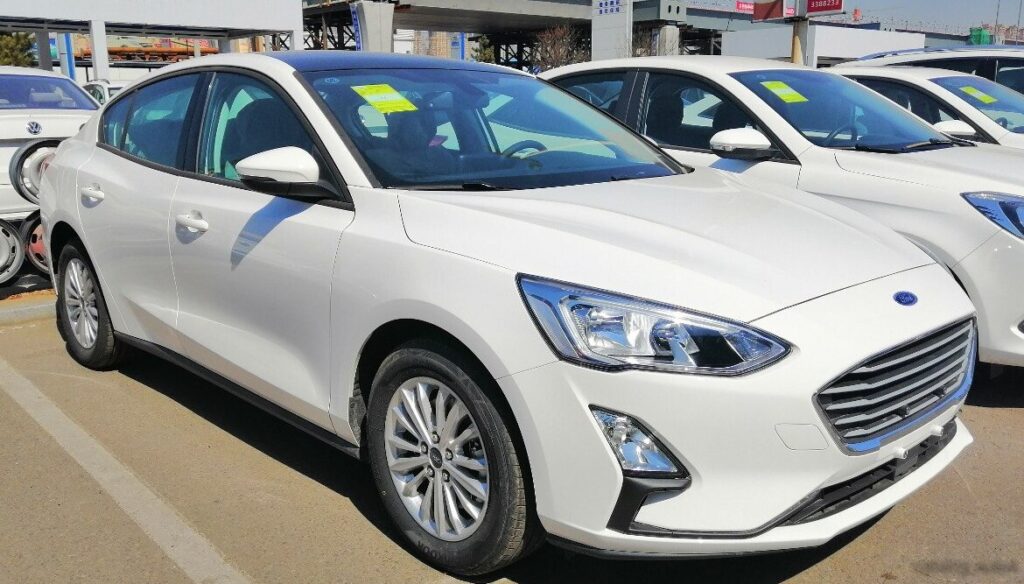
The Ford Focus IV Sedan 2.0 Ti-VCT GDI, producing 160 horsepower, was a key variant in the fourth generation of Ford’s globally successful Focus lineup. Introduced for the 2018 model year and continuing through 2021, this sedan aimed to provide a balance of fuel efficiency, performance, and practicality for the North American market. It occupied a mid-range position within the Focus Sedan offerings, slotting above the base 1.0L EcoBoost engine and below potential performance-oriented trims (which were not widely available in the US). This generation of Focus, built on the C2 platform, represented a significant evolution in design and technology for the compact car.
Technical Specifications
| Brand | Ford |
| Model | Focus |
| Generation | Focus IV Sedan |
| Type (Engine) | 2.0 Ti-VCT GDI (160 Hp) |
| Start of production | 2018 year |
| End of production | 2021 year |
| Powertrain Architecture | Internal Combustion engine |
| Body type | Sedan |
| Seats | 5 |
| Doors | 4 |
| Fuel consumption (economy) – urban | 9 l/100 km (26.1 US mpg) |
| Fuel consumption (economy) – extra urban | 6.5 l/100 km (36.2 US mpg) |
| Fuel consumption (economy) – combined | 7.8 l/100 km (30.2 US mpg) |
| Fuel Type | Petrol (Gasoline) |
| Weight-to-power ratio | 8.3 kg/Hp, 120.2 Hp/tonne |
| Weight-to-torque ratio | 6.7 kg/Nm, 148.8 Nm/tonne |
| Power | 160 Hp @ 6500 rpm |
| Torque | 198 Nm @ 4500 rpm (146.04 lb.-ft. @ 4500 rpm) |
| Engine layout | Front, Transverse |
| Number of cylinders | 4 |
| Engine configuration | Inline |
| Number of valves per cylinder | 4 |
| Fuel injection system | Direct injection |
| Engine aspiration | Turbocharger, Intercooler |
| Kerb Weight | 1331 kg (2934.35 lbs) |
| Trunk (boot) space – minimum | 374 l (13.21 cu. ft) |
| Fuel tank capacity | 47 l (12.42 US gal | 10.34 UK gal) |
| Length | 4539 mm (178.7 in) |
| Width with mirrors folded | 1882 mm (74.09 in) |
| Height | 1468 mm (57.8 in) |
| Wheelbase | 2649 mm (104.29 in) |
| Front track | 1554 mm (61.18 in) |
| Rear (Back) track | 1534 mm (60.39 in) |
| Drivetrain Architecture | The Internal combustion engine (ICE) drives the front wheels of the vehicle. |
| Drive wheel | Front wheel drive |
| Number of gears and type of gearbox | 5 gears, manual transmission |
| Front brakes | Disc |
| Rear brakes | Drum |
| Assisting systems | ABS (Anti-lock braking system) |
| Steering type | Steering rack and pinion |
| Power steering | Electric Steering |
| Tires size | 205/60 R16 92H; 215/50 R17 91H; 235/40 ZR18 91W |
| Wheel rims size | 6.5J x 16; 7J x 17; 8J x 18 |
Powertrain & Engine Architecture
The heart of this Focus variant is the 2.0-liter Ti-VCT GDI (Gasoline Direct Injection) four-cylinder engine. This engine, part of Ford’s EcoBoost family, utilizes a twin-scroll turbocharger and intercooler to enhance both power and efficiency. The Ti-VCT (Twin Independent Variable Camshaft Timing) system allows for precise control of valve timing, optimizing performance across the rev range. The engine’s direct injection system delivers fuel directly into the combustion chamber, improving combustion efficiency and reducing emissions. The 5-speed manual transmission was the standard offering, providing drivers with a more engaging driving experience. The engine code is specific to the region and application, but generally falls within the broader EcoBoost engine family designations.
Driving Characteristics
The 160 horsepower and 146 lb-ft of torque provided by the 2.0L engine offered a noticeable step up in performance compared to the base 1.0L EcoBoost. Acceleration was adequate for everyday driving, with the car feeling responsive in most situations. The 5-speed manual transmission allowed for good control over the engine’s power band. While not a sports car, the Focus Sedan 2.0 Ti-VCT GDI offered a reasonably enjoyable driving experience. Compared to higher-output versions available in other markets, this configuration prioritized fuel economy and affordability over outright performance. The gear ratios were tuned for a balance between acceleration and highway cruising, with fifth gear providing a comfortable and efficient experience at higher speeds.
Equipment & Trim Levels
The 2.0 Ti-VCT GDI trim typically included standard features such as air conditioning, power windows and locks, a basic infotainment system with a touchscreen display, and Bluetooth connectivity. Higher trim levels, such as the SEL and Titanium, added features like leather upholstery, a premium sound system, automatic climate control, and advanced safety technologies like blind-spot monitoring and rear cross-traffic alert. Interior upholstery was typically cloth on the base trims, with leather options available on higher-end models. Dashboard configurations were relatively consistent across the range, with a focus on a clean and modern design.
Chassis & Braking
The Focus IV Sedan utilized a MacPherson strut front suspension and a multi-link rear suspension, providing a comfortable ride and good handling characteristics. The front brakes were disc brakes, offering adequate stopping power, while the rear brakes were drum brakes, a cost-saving measure for this trim level. ABS (Anti-lock Braking System) was standard. The electric power steering provided a light and responsive feel. Stabilizer bars were included both front and rear, contributing to reduced body roll during cornering. The suspension tuning was geared towards comfort and everyday usability, rather than aggressive performance.
Market Reception & Comparison
Critics generally praised the Focus IV Sedan for its handling, interior quality, and fuel efficiency. The 2.0 Ti-VCT GDI engine was considered a good compromise between performance and economy. However, some reviewers noted that the rear drum brakes were a drawback compared to the disc brakes offered on some competitors. Compared to other compact sedans in its class, such as the Honda Civic and Toyota Corolla, the Focus offered a more engaging driving experience but sometimes lagged behind in terms of long-term reliability ratings. Fuel economy figures of around 30 mpg combined were competitive for the segment.
Legacy
The Ford Focus IV Sedan 2.0 Ti-VCT GDI has become a relatively affordable option in the used car market. While the dual-clutch transmission versions of this generation Focus experienced some reliability issues, the 5-speed manual transmission paired with the 2.0L engine has proven to be generally reliable. Regular maintenance, including oil changes and timing belt replacements (if applicable), is crucial for ensuring the longevity of this powertrain. The Focus IV Sedan remains a popular choice for buyers seeking a practical, fuel-efficient, and reasonably enjoyable compact car.