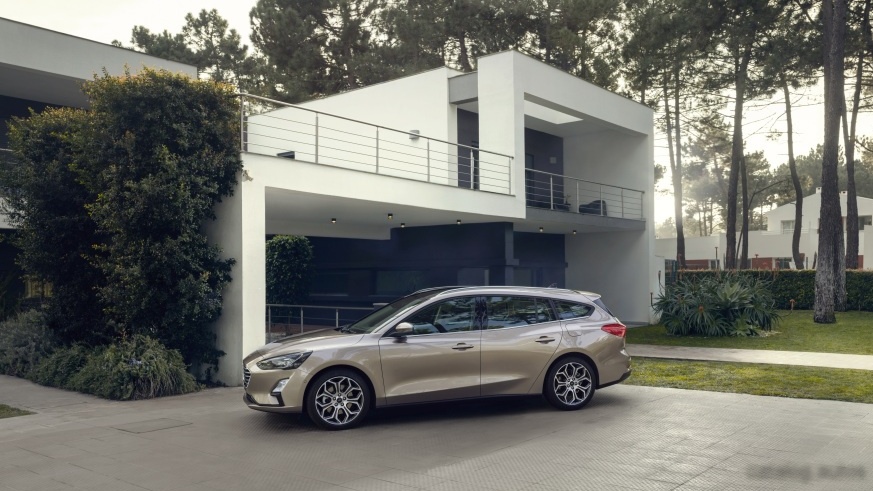
The Ford Focus IV Wagon 1.0 EcoBoost (125 hp) Mild Hybrid represents a specific configuration within the fourth generation of Ford’s globally successful Focus compact. Introduced in April 2020 and remaining in production through 2021, this variant aimed to balance fuel efficiency with practicality, offering a station wagon (estate) body style with a downsized, turbocharged engine augmented by mild hybrid technology. It occupied a mid-range position in the Focus IV Wagon lineup, slotting below the more powerful EcoBoost variants and the diesel options. This model was primarily aimed at the European market, where the demand for fuel-efficient wagons remained strong, though limited numbers were also available in other regions.
Technical Specifications
| Brand | Ford |
| Model | Focus |
| Generation | Focus IV Wagon |
| Type (Engine) | 1.0 EcoBoost (125 Hp) Mild Hybrid |
| Start of production | April, 2020 |
| End of production | 2021 |
| Powertrain Architecture | MHEV (Mild Hybrid Electric Vehicle) |
| Body type | Station wagon (estate) |
| Seats | 5 |
| Doors | 5 |
| Fuel consumption at Low speed (WLTP) | 6.5 l/100 km (36.2 US mpg, 43.5 UK mpg) |
| Fuel consumption at Medium speed (WLTP) | 5 l/100 km (47 US mpg, 56.5 UK mpg) |
| Fuel consumption at high speed (WLTP) | 4.3 l/100 km (54.7 US mpg, 65.7 UK mpg) |
| Fuel consumption at very high speed (WLTP) | 5.4 l/100 km (43.6 US mpg, 52.3 UK mpg) |
| Combined fuel consumption (WLTP) | 5.1 l/100 km (46.1 US mpg, 55.4 UK mpg) |
| CO2 emissions (WLTP) | 116 g/km |
| Fuel consumption (economy) – urban (NEDC) | 4.8-4.9 l/100 km (49 – 48 US mpg, 58.9 – 57.6 UK mpg) |
| Fuel consumption (economy) – extra urban (NEDC) | 3.6-3.8 l/100 km (65.3 – 61.9 US mpg, 78.5 – 74.3 UK mpg) |
| Fuel consumption (economy) – combined (NEDC) | 4.1-4.4 l/100 km (57.4 – 53.5 US mpg, 68.9 – 64.2 UK mpg) |
| CO2 emissions (NEDC) | 95-100 g/km |
| Fuel Type | Petrol (Gasoline) |
| Acceleration 0 – 100 km/h | 10.3 sec |
| Acceleration 0 – 62 mph | 10.3 sec |
| Acceleration 0 – 60 mph | 9.8 sec |
| Maximum speed | 198 km/h (123.03 mph) |
| Emission standard | Euro 6d-ISC-FCM |
| Weight-to-power ratio | 10.5 kg/Hp |
| Weight-to-torque ratio | 7.7 kg/Nm |
| Power | 125 Hp @ 6000 rpm |
| Torque | 170 Nm @ 1400-4500 rpm (125.39 lb.-ft. @ 1400-4500 rpm) |
| Engine layout | Front, Transverse |
| Engine Model/Code | B7DC |
| Engine displacement | 999 cm3 (60.96 cu. in.) |
| Number of cylinders | 3 |
| Engine configuration | Inline |
| Cylinder Bore | 71.9 mm (2.83 in.) |
| Piston Stroke | 82 mm (3.23 in.) |
| Number of valves per cylinder | 4 |
| Fuel injection system | Direct injection |
| Engine aspiration | Turbocharger, Intercooler |
| Valvetrain | DOHC |
| Engine oil capacity | 4.5 l (4.76 US qt | 3.96 UK qt) |
| Coolant | 5.5 l (5.81 US qt | 4.84 UK qt) |
| Kerb Weight | 1313 kg (2894.67 lbs.) |
| Max. weight | 1940 kg (4276.97 lbs.) |
| Max load | 627 kg (1382.3 lbs.) |
| Trunk (boot) space – minimum | 608 l (21.47 cu. ft.) |
| Trunk (boot) space – maximum | 1653 l (58.38 cu. ft.) |
| Fuel tank capacity | 52 l (13.74 US gal | 11.44 UK gal) |
| Max. roof load | 75 kg (165.35 lbs.) |
| Permitted trailer load with brakes (12%) | 1000 kg (2204.62 lbs.) |
| Permitted trailer load without brakes | 690 kg (1521.19 lbs.) |
| Permitted towbar download | 90 kg (198.42 lbs.) |
| Length | 4668 mm (183.78 in.) |
| Width | 1825 mm (71.85 in.) |
| Width with mirrors folded | 1848 mm (72.76 in.) |
| Width including mirrors | 1979 mm (77.91 in.) |
| Height | 1469 mm (57.83 in.) |
| Wheelbase | 2700 mm (106.3 in.) |
| Front track | 1572 mm (61.89 in.) |
| Rear (Back) track | 1566 mm (61.65 in.) |
| Front overhang | 909 mm (35.79 in.) |
| Rear overhang | 1059 mm (41.69 in.) |
| Ride height (ground clearance) | 115-134 mm (4.53 – 5.28 in.) |
| Drag coefficient (Cd) | 0.284 |
| Minimum turning circle (turning diameter) | 11 m (36.09 ft.) |
| Drivetrain Architecture | ICE and electric motor drive the front wheels |
| Drive wheel | Front wheel drive |
| Number of gears and type of gearbox | 6 gears, manual transmission |
| Front suspension | Independent type McPherson, Transverse stabilizer |
| Rear suspension | Independent multi-link suspension |
| Front brakes | Ventilated discs, 282×27 mm |
| Rear brakes | Disc, 271×12 mm |
Powertrain & Engine Architecture
At the heart of the Focus IV Wagon 1.0 EcoBoost Mild Hybrid lies the Ford B7DC engine, a 999cc, three-cylinder turbocharged gasoline engine. This engine is part of Ford’s EcoBoost family, known for its downsizing and turbocharging technologies aimed at improving fuel efficiency. The B7DC utilizes direct fuel injection and a double overhead camshaft (DOHC) valvetrain with four valves per cylinder. The turbocharger, coupled with an intercooler, provides a boost in power and torque despite the small displacement. The ‘Mild Hybrid’ aspect comes from a 48-volt belt-driven integrated starter generator (BiSG). This system allows for regenerative braking, capturing energy during deceleration and storing it in a small battery. This stored energy can then assist the engine during acceleration, reducing load and improving fuel economy. The engine produces 125 horsepower at 6000 rpm and 170 Nm (125.39 lb.-ft.) of torque between 1400 and 4500 rpm. The engine is transversely mounted at the front of the vehicle and is paired with a 6-speed manual transmission.
Driving Characteristics
The 1.0 EcoBoost 125 hp engine, when paired with the manual transmission, provides adequate performance for everyday driving. Acceleration from 0-60 mph takes approximately 9.8 seconds, and the top speed is around 123 mph. While not a particularly sporty setup, the engine delivers a usable amount of torque at low to mid-range revs, making it suitable for urban and highway driving. The mild hybrid system provides a subtle boost during acceleration, but the overall driving experience is more focused on efficiency than outright performance. Compared to the higher-output 1.5 EcoBoost variants, this engine feels less responsive, especially when fully loaded. However, it offers a noticeable improvement in fuel economy. The 6-speed manual transmission is well-matched to the engine, providing smooth gear changes and allowing the driver to keep the engine in its optimal power band.
Equipment & Trim Levels
The 1.0 EcoBoost 125 hp Mild Hybrid trim typically included standard features such as air conditioning, a touchscreen infotainment system with Bluetooth connectivity, alloy wheels, and a suite of safety features including ABS, electronic stability control, and multiple airbags. Higher trim levels offered additional features like a larger touchscreen, navigation system, automatic climate control, parking sensors, and a rearview camera. Interior upholstery was typically cloth, with options for partial leather trim on higher-spec models. The dashboard layout was consistent across the Focus IV range, featuring a clean and modern design.
Chassis & Braking
The Focus IV Wagon utilizes an independent McPherson strut suspension at the front and an independent multi-link suspension at the rear. This setup provides a good balance between ride comfort and handling. The front brakes are ventilated discs measuring 282x27mm, while the rear brakes are solid discs measuring 271x12mm. The steering is electric power-assisted, providing a light and responsive feel. Stabilizer bars are fitted to both the front and rear axles to reduce body roll during cornering. The chassis is designed to accommodate the weight of the mild hybrid system without compromising handling or stability.
Market Reception & Comparison
The Ford Focus IV Wagon 1.0 EcoBoost Mild Hybrid was generally well-received by critics for its fuel efficiency and practicality. It offered a compelling alternative to diesel-powered wagons, particularly for drivers who primarily cover shorter distances. However, some reviewers noted that the engine could feel strained when fully loaded or driving uphill. Compared to the 1.5 EcoBoost variants, this engine offered lower performance but significantly better fuel economy. The mild hybrid system was praised for its contribution to reducing emissions and improving overall efficiency. In terms of reliability, the 1.0 EcoBoost engine has had some reported issues with timing belt failures, but these were generally addressed through software updates and revised components.
Legacy
The Ford Focus IV Wagon 1.0 EcoBoost Mild Hybrid represents an important step in Ford’s efforts to improve fuel efficiency and reduce emissions. While the fourth-generation Focus was discontinued in North America, it remained a popular choice in Europe for several years. The 1.0 EcoBoost engine, despite some early reliability concerns, has proven to be a durable and efficient powerplant. On the used car market, these models offer a good balance of practicality, fuel economy, and affordability, making them an attractive option for buyers seeking a compact wagon.