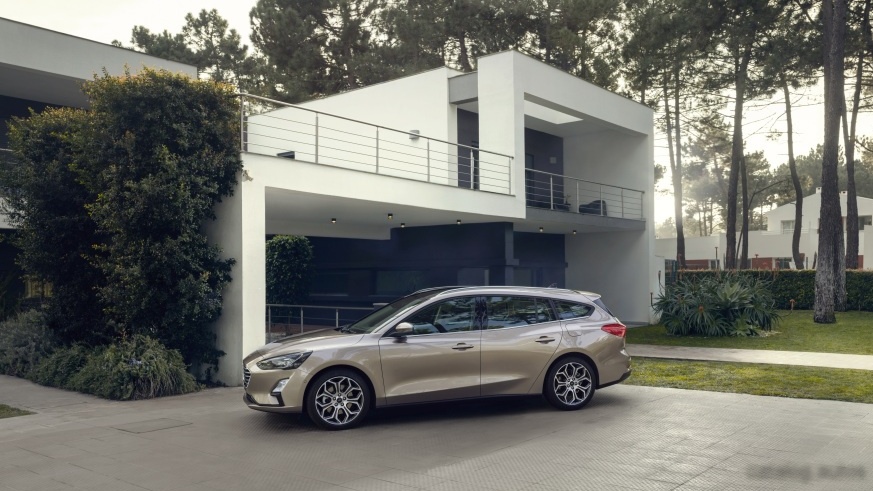
The Ford Focus IV Wagon 1.0 EcoBoost (155 hp) Mild Hybrid represents a significant iteration within the fourth generation of Ford’s globally successful Focus compact. Introduced in April 2020 and remaining in production through 2021, this variant aimed to blend fuel efficiency with practicality, catering to the growing demand for eco-conscious vehicles in the European market. Positioned as a mid-range offering within the Focus IV Wagon lineup, it bridged the gap between the more economical base models and the higher-performance ST trims. This model is part of the Mk4 Focus range (2018-2022), built on the C2 platform.
Technical Specifications
| Brand | Ford |
| Model | Focus |
| Generation | Focus IV Wagon |
| Type (Engine) | 1.0 EcoBoost (155 Hp) Mild Hybrid |
| Start of production | April, 2020 |
| End of production | 2021 |
| Powertrain Architecture | MHEV (Mild Hybrid Electric Vehicle) |
| Body type | Station wagon (estate) |
| Seats | 5 |
| Doors | 5 |
| Fuel consumption at Low speed (WLTP) | 6.3 l/100 km (37.3 US mpg) |
| Fuel consumption at Medium speed (WLTP) | 4.9 l/100 km (48 US mpg) |
| Fuel consumption at high speed (WLTP) | 4.4 l/100 km (53.5 US mpg) |
| Fuel consumption at very high speed (WLTP) | 5.6 l/100 km (42 US mpg) |
| Combined fuel consumption (WLTP) | 5.2 l/100 km (45.2 US mpg) |
| CO2 emissions (WLTP) | 117 g/km |
| Fuel consumption (economy) – urban (NEDC) | 4.7-5.1 l/100 km (50 – 46.1 US mpg) |
| Fuel consumption (economy) – extra urban (NEDC) | 3.6-3.9 l/100 km (65.3 – 60.3 US mpg) |
| Fuel consumption (economy) – combined (NEDC) | 4.1-4.5 l/100 km (57.4 – 52.3 US mpg) |
| CO2 emissions (NEDC) | 94-104 g/km |
| Fuel Type | Petrol (Gasoline) |
| Acceleration 0 – 100 km/h | 9.4 sec |
| Acceleration 0 – 62 mph | 9.4 sec |
| Acceleration 0 – 60 mph | 8.9 sec |
| Maximum speed | 209 km/h (129.87 mph) |
| Emission standard | Euro 6d-ISC-FCM |
| Weight-to-power ratio | 8.5 kg/Hp |
| Weight-to-torque ratio | 6.9 kg/Nm |
| Power | 155 Hp @ 6000 rpm |
| Torque | 190 Nm @ 1900-5500 rpm (140.14 lb.-ft.) |
| Engine layout | Front, Transverse |
| Engine Model/Code | M0DC |
| Engine displacement | 999 cm3 (60.96 cu. in.) |
| Number of cylinders | 3 |
| Engine configuration | Inline |
| Cylinder Bore | 71.9 mm (2.83 in.) |
| Piston Stroke | 82 mm (3.23 in.) |
| Number of valves per cylinder | 4 |
| Fuel injection system | Direct injection |
| Engine aspiration | Turbocharger, Intercooler |
| Valvetrain | DOHC |
| Engine oil capacity | 4.5 l (4.76 US qt | 3.96 UK qt) |
| Coolant | 5.5 l (5.81 US qt | 4.84 UK qt) |
| Kerb Weight | 1313 kg (2894.67 lbs.) |
| Max. weight | 1940 kg (4276.97 lbs.) |
| Max load | 627 kg (1382.3 lbs.) |
| Trunk (boot) space – minimum | 608 l (21.47 cu. ft.) |
| Trunk (boot) space – maximum | 1653 l (58.38 cu. ft.) |
| Fuel tank capacity | 52 l (13.74 US gal | 11.44 UK gal) |
| Max. roof load | 75 kg (165.35 lbs.) |
| Permitted trailer load with brakes (12%) | 1000 kg (2204.62 lbs.) |
| Permitted trailer load without brakes | 690 kg (1521.19 lbs.) |
| Permitted towbar download | 90 kg (198.42 lbs.) |
| Length | 4668 mm (183.78 in.) |
| Width | 1825 mm (71.85 in.) |
| Width with mirrors folded | 1848 mm (72.76 in.) |
| Width including mirrors | 1979 mm (77.91 in.) |
| Height | 1469 mm (57.83 in.) |
| Wheelbase | 2700 mm (106.3 in.) |
| Front track | 1572 mm (61.89 in.) |
| Rear (Back) track | 1566 mm (61.65 in.) |
| Front overhang | 909 mm (35.79 in.) |
| Rear overhang | 1059 mm (41.69 in.) |
| Ride height (ground clearance) | 115-134 mm (4.53 – 5.28 in.) |
| Drag coefficient (Cd) | 0.284 |
| Minimum turning circle (turning diameter) | 11 m (36.09 ft.) |
| Drivetrain Architecture | Front wheel drive, MHEV |
| Number of gears and type of gearbox | 6 gears, manual transmission |
| Front suspension | Independent type McPherson, Transverse stabilizer |
| Rear suspension | Independent multi-link suspension |
| Front brakes | Ventilated discs, 282×27 mm |
| Rear brakes | Disc, 271×12 mm |
| Tires size | 205/60 R 16 |
| Wheel rims size | 6.5 J x 16 |
INTRODUCTION
The Ford Focus IV Wagon 1.0 EcoBoost (155 hp) Mild Hybrid, produced from 2020-2021, is a station wagon variant of the fourth-generation Focus, designed primarily for the European market. It represents Ford’s move towards incorporating mild-hybrid technology into its mainstream models to improve fuel economy and reduce emissions. Built on the C2 platform (also known as the 1HX0/A3 platform), this version offered a practical and relatively efficient option for families and individuals needing a versatile vehicle. The wagon body style was particularly popular in Europe, where estate cars continue to hold a significant market share.
Powertrain & Engine Architecture
At the heart of this Focus variant lies the 1.0 EcoBoost engine, specifically the M0DC code. This is a three-cylinder, 1.0-liter turbocharged gasoline engine, benefiting from direct fuel injection and a double overhead camshaft (DOHC) valvetrain. The addition of a 48-volt mild-hybrid system enhances efficiency. This system utilizes a belt-driven integrated starter generator (BiSG) which recovers energy during braking and assists the engine during acceleration, allowing for extended periods of engine-off coasting. The engine produces 155 horsepower at 6000 rpm and 190 Nm (140.14 lb.-ft.) of torque between 1900 and 5500 rpm. The engine’s compact size and turbocharging contribute to its responsiveness. The transmission is a 6-speed manual gearbox, chosen for its efficiency and driver engagement.
Driving Characteristics
The 1.0 EcoBoost 155 hp engine, paired with the manual transmission, delivers a respectable driving experience. While not overtly sporty, it provides sufficient power for everyday driving and highway cruising. Acceleration from 0 to 60 mph takes approximately 8.9 seconds, and the top speed is around 129.87 mph. The mild-hybrid system is largely transparent to the driver, providing a subtle boost during acceleration and contributing to smoother engine restarts. The gear ratios are well-chosen to maximize fuel efficiency without sacrificing drivability. Compared to the higher-output 1.5 EcoBoost variants, this engine offers a more economical driving experience, but with a noticeable difference in outright performance. The manual transmission allows for greater driver control, unlike the optional automatic transmissions available on other Focus IV models.
Equipment & Trim Levels
The 1.0 EcoBoost 155 hp Mild Hybrid typically came equipped with a solid range of standard features. These included air conditioning, Ford’s SYNC 3 infotainment system with an 8-inch touchscreen, Bluetooth connectivity, and a suite of driver-assistance technologies such as lane-keeping assist and pre-collision assist. Interior upholstery was generally cloth, with options for upgraded materials available. Higher trim levels added features like heated seats, a panoramic sunroof, and a premium sound system. Exterior styling cues were relatively understated, with subtle badging indicating the mild-hybrid powertrain.
Chassis & Braking
The Focus IV Wagon features an independent McPherson strut suspension at the front and an independent multi-link suspension at the rear, providing a comfortable and controlled ride. The suspension setup is tuned to balance handling and comfort, making it suitable for a variety of road conditions. Braking duties are handled by ventilated discs at the front (282x27mm) and solid discs at the rear (271x12mm). Anti-lock braking system (ABS) is standard. The chassis is designed to minimize weight while maximizing rigidity, contributing to improved handling and safety.
Market Reception & Comparison
The Ford Focus IV Wagon 1.0 EcoBoost (155 hp) Mild Hybrid was generally well-received by automotive critics. It was praised for its fuel efficiency, comfortable ride, and practical interior space. However, some reviewers noted that the three-cylinder engine could feel strained under heavy load. Compared to the 1.5 EcoBoost models, this variant offered better fuel economy but less power. Against diesel-powered rivals, it provided a cleaner alternative, although diesel engines often offered superior torque and fuel efficiency on long journeys. The mild-hybrid system was seen as a positive step towards reducing emissions, but its impact on real-world fuel economy was relatively modest.
Legacy
The 1.0 EcoBoost engine has proven to be a reliable and durable powertrain, although some early versions experienced issues with timing belt durability. The mild-hybrid system has also demonstrated good long-term reliability. In the used car market, the Focus IV Wagon 1.0 EcoBoost (155 hp) Mild Hybrid represents a sensible and affordable option for buyers seeking a practical and fuel-efficient estate car. Its combination of reasonable performance, good fuel economy, and a comfortable interior makes it a compelling choice in its segment. The availability of Ford’s SYNC 3 infotainment system and driver-assistance technologies adds to its appeal.