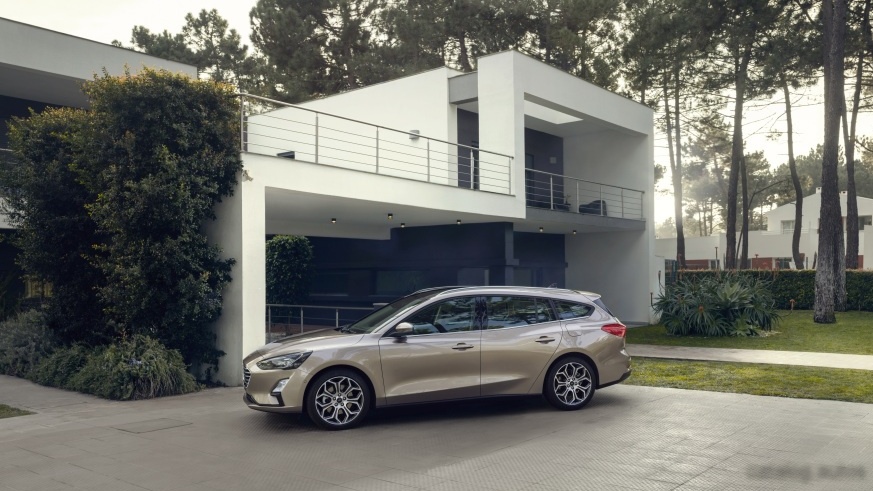
The Ford Focus IV Wagon 2.0 EcoBlue (150 hp) represents a significant offering within the fourth generation of the globally popular Ford Focus. Produced from September 2018 to 2021, this variant combined the practicality of a station wagon (estate) body style with a modern, efficient diesel engine. It occupied a mid-range position in the Focus IV lineup, appealing to buyers seeking a balance between fuel economy, performance, and cargo capacity. The Focus IV, built on the C2 platform, aimed to deliver a more refined and technologically advanced experience compared to its predecessors, and the 2.0 EcoBlue model was a key component of that strategy, particularly in European markets where diesel engines remained prevalent.
Technical Specifications
| Brand | Ford |
| Model | Focus |
| Generation | Focus IV Wagon |
| Type (Engine) | 2.0 EcoBlue (150 Hp) |
| Start of production | September, 2018 |
| End of production | 2021 |
| Powertrain Architecture | Internal Combustion engine |
| Body type | Station wagon (estate) |
| Seats | 5 |
| Doors | 5 |
| Fuel consumption (urban) | 5.7 l/100 km (41.3 US mpg, 49.6 UK mpg, 17.5 km/l) |
| Fuel consumption (extra urban) | 3.8-3.9 l/100 km (61.9 – 60.3 US mpg, 74.3 – 72.4 UK mpg, 26.3 – 25.6 km/l) |
| Fuel consumption (combined) | 4.5-4.6 l/100 km (52.3 – 51.1 US mpg, 62.8 – 61.4 UK mpg, 22.2 – 21.7 km/l) |
| CO2 emissions | 117-119 g/km |
| Fuel Type | Diesel |
| Acceleration 0 – 100 km/h | 8.7 sec |
| Acceleration 0 – 62 mph | 8.7 sec |
| Acceleration 0 – 60 mph | 8.3 sec |
| Maximum speed | 208 km/h (129.25 mph) |
| Emission standard | Euro 6 d |
| Weight-to-power ratio | 9.9 kg/Hp, 101.5 Hp/tonne |
| Weight-to-torque ratio | 4 kg/Nm, 250.3 Nm/tonne |
| Power | 150 Hp @ 3500 rpm |
| Power per litre | 75.2 Hp/l |
| Torque | 370 Nm @ 2000-2500 rpm (272.9 lb.-ft. @ 2000-2500 rpm) |
| Engine layout | Front, Transverse |
| Engine Model/Code | YLDA |
| Engine displacement | 1996 cm3 (121.8 cu. in.) |
| Number of cylinders | 4 |
| Engine configuration | Inline |
| Cylinder Bore | 84 mm (3.31 in.) |
| Piston Stroke | 90 mm (3.54 in.) |
| Compression ratio | 15.8:1 |
| Number of valves per cylinder | 4 |
| Fuel injection system | Diesel Commonrail |
| Engine aspiration | Turbocharger, Intercooler |
| Valvetrain | DOHC |
| Engine oil capacity | 6.4 l (6.76 US qt | 5.63 UK qt) |
| Coolant | 12.6 l (13.31 US qt | 11.09 UK qt) |
| Kerb Weight | 1478 kg (3258.43 lbs.) |
| Max. weight | 2080 kg (4585.62 lbs.) |
| Max load | 602 kg (1327.18 lbs.) |
| Trunk (boot) space – minimum | 608 l (21.47 cu. ft.) |
| Trunk (boot) space – maximum | 1653 l (58.38 cu. ft.) |
| Fuel tank capacity | 47 l (12.42 US gal | 10.34 UK gal) |
| Max. roof load | 75 kg (165.35 lbs.) |
| Permitted trailer load with brakes (12%) | 1800 kg (3968.32 lbs.) |
| Permitted trailer load without brakes | 750 kg (1653.47 lbs.) |
| Permitted towbar download | 90 kg (198.42 lbs.) |
| Length | 4667-4672 mm (183.74 – 183.94 in.) |
| Width | 1825 mm (71.85 in.) |
| Width with mirrors folded | 1848 mm (72.76 in.) |
| Width including mirrors | 1979 mm (77.91 in.) |
| Height | 1459-1469 mm (57.44 – 57.83 in.) |
| Wheelbase | 2700 mm (106.3 in.) |
| Front track | 1572 mm (61.89 in.) |
| Rear (Back) track | 1566 mm (61.65 in.) |
| Front overhang | 909 mm (35.79 in.) |
| Rear overhang | 1059 mm (41.69 in.) |
| Ride height (ground clearance) | 115-134 mm (4.53 – 5.28 in.) |
| Drag coefficient (Cd) | 0.28 |
| Minimum turning circle (turning diameter) | 11.0 m (36.09 ft.) |
| Drivetrain Architecture | The Internal combustion engine (ICE) drives the front wheels of the vehicle. |
| Drive wheel | Front wheel drive |
| Number of gears and type of gearbox | 6 gears, manual transmission |
| Front brakes | Ventilated discs |
| Rear brakes | Disc |
| Assisting systems | ABS (Anti-lock braking system) |
| Steering type | Steering rack and pinion |
| Power steering | Electric Steering |
| Tires size | 195/65 R16; 205/60 R16; 215/50 R17; 235/40 R18 |
| Wheel rims size | 6.5J x 16; 7J x 17; 8J x 18 |
Powertrain & Engine Architecture
The heart of this Focus variant is the 2.0 EcoBlue diesel engine, identified by the code YLDA. This engine is part of Ford’s EcoBlue family, designed for improved efficiency and reduced emissions. It features a cast iron block and aluminum cylinder head, incorporating a sophisticated turbocharger and intercooler system to optimize power and torque delivery. The engine utilizes a common-rail direct fuel injection system, operating at a high pressure to ensure fine atomization of the fuel for cleaner combustion. The DOHC (Double Overhead Camshaft) valvetrain, with four valves per cylinder, further enhances breathing and contributes to the engine’s overall performance. The 6-speed manual transmission was standard, chosen for its balance of efficiency and driver engagement.
Driving Characteristics
The 150 hp and 370 Nm (272.9 lb-ft) of torque provided by the 2.0 EcoBlue engine delivered a respectable driving experience. While not overtly sporty, the engine offered ample power for everyday driving and comfortable highway cruising. The torque curve was relatively flat, providing good responsiveness from low engine speeds. The 6-speed manual transmission allowed drivers to effectively manage the engine’s power, although the gear ratios were tuned more for fuel efficiency than outright acceleration. Compared to higher-output versions of the Focus IV, such as those with the 1.5 EcoBoost petrol engine, the 2.0 EcoBlue prioritized fuel economy and low-end torque over peak horsepower. Against other diesel variants, like the 1.5 EcoBlue, the 2.0 offered a noticeable step up in performance, albeit at a slightly higher price point.
Equipment & Trim Levels
The 2.0 EcoBlue 150 hp variant typically came equipped with a solid set of standard features. These included air conditioning, power windows and mirrors, a basic infotainment system with Bluetooth connectivity, and alloy wheels. Higher trim levels, such as Titanium and ST-Line, added features like a larger touchscreen display, navigation system, automatic climate control, parking sensors, and upgraded interior upholstery. Optional extras included a panoramic sunroof, adaptive cruise control, and a premium sound system. Interior materials were generally of good quality, with a focus on durability and practicality.
Chassis & Braking
The Focus IV Wagon featured a fully independent front suspension with MacPherson struts and a multi-link rear suspension. This setup provided a comfortable ride and good handling characteristics. The 2.0 EcoBlue variant typically came with ventilated front disc brakes and solid rear disc brakes, providing adequate stopping power for its weight and performance. ABS (Anti-lock Braking System) was standard, enhancing safety. The electric power steering offered a light and precise feel, making it easy to maneuver in urban environments.
Market Reception & Comparison
The Ford Focus IV Wagon 2.0 EcoBlue (150 hp) was generally well-received by automotive critics. It was praised for its fuel efficiency, comfortable ride, and spacious interior. However, some reviewers noted that the engine could be somewhat noisy under hard acceleration. Compared to petrol-powered Focus models, the 2.0 EcoBlue offered significantly better fuel economy, making it a popular choice for drivers who covered long distances. In terms of reliability, the EcoBlue engines have had a mixed reputation, with some reports of issues related to the diesel particulate filter (DPF) and EGR valve. However, these issues were not exclusive to the 2.0 EcoBlue and were often addressed through software updates and improved maintenance practices.
Legacy
The Ford Focus IV Wagon 2.0 EcoBlue (150 hp) remains a relatively common sight on used car markets. Its reputation for fuel efficiency and practicality continues to attract buyers. While the diesel engine’s long-term reliability can be a concern, regular maintenance and careful driving can help to mitigate potential issues. The Focus IV generation, as a whole, is considered a well-rounded and capable family car, and the 2.0 EcoBlue variant represents a sensible and economical choice for those seeking a versatile station wagon.