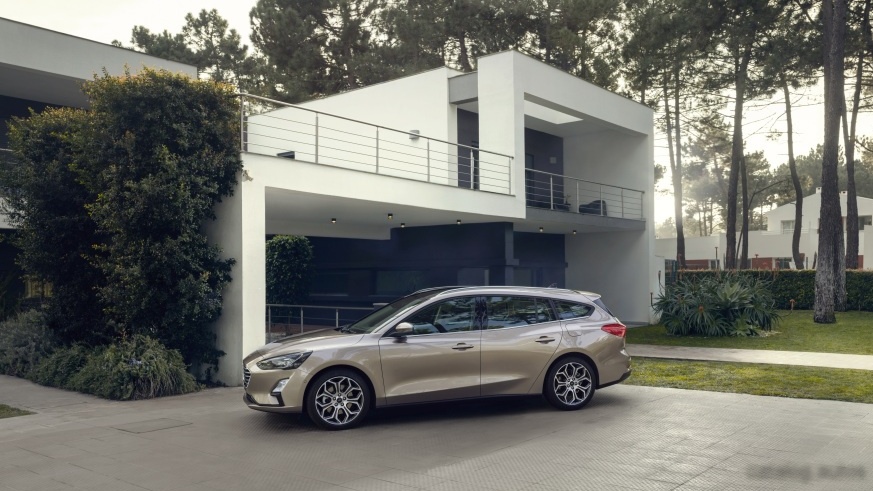
The Ford Focus IV Wagon 2.0 EcoBlue (150 hp) Automatic, produced from September 2018 to 2021, represents a significant offering within the fourth generation of the globally successful Focus compact. Positioned as a mid-range trim, this variant combined the fuel efficiency of Ford’s EcoBlue diesel engine with the convenience of an eight-speed automatic transmission, packaged in the practical station wagon (estate) body style. It was primarily aimed at European markets, where wagons remain a popular choice, offering a balance between running costs, practicality, and comfortable driving. This model falls within the C-segment of vehicles, competing with other compact wagons like the Volkswagen Golf Estate, Opel Astra Sports Tourer, and Skoda Octavia Combi.
Technical Specifications
| Brand | Ford |
| Model | Focus |
| Generation | Focus IV Wagon |
| Type (Engine) | 2.0 EcoBlue (150 Hp) Automatic |
| Start of production | September, 2018 |
| End of production | 2021 |
| Powertrain Architecture | Internal Combustion engine |
| Body type | Station wagon (estate) |
| Seats | 5 |
| Doors | 5 |
| Fuel consumption (urban) | 5.3-5.6 l/100 km (44.4 – 42 US mpg) |
| Fuel consumption (extra urban) | 3.9-4.2 l/100 km (60.3 – 56 US mpg) |
| Fuel consumption (combined) | 4.4-4.7 l/100 km (53.5 – 50 US mpg) |
| CO2 emissions | 116-122 g/km |
| Fuel Type | Diesel |
| Acceleration 0 – 100 km/h | 9.5 sec |
| Acceleration 0 – 62 mph | 9.5 sec |
| Acceleration 0 – 60 mph | 9 sec |
| Maximum speed | 205 km/h (127.38 mph) |
| Emission standard | Euro 6 d |
| Weight-to-power ratio | 9.9 kg/Hp |
| Weight-to-torque ratio | 4 kg/Nm |
| Power | 150 Hp @ 3500 rpm |
| Torque | 370 Nm @ 2000-2500 rpm (272.9 lb.-ft. @ 2000-2500 rpm) |
| Engine layout | Front, Transverse |
| Engine Model/Code | YLDA |
| Engine displacement | 1996 cm3 (121.8 cu. in.) |
| Number of cylinders | 4 |
| Engine configuration | Inline |
| Cylinder Bore | 84 mm (3.31 in.) |
| Piston Stroke | 90 mm (3.54 in.) |
| Compression ratio | 15.8:1 |
| Number of valves per cylinder | 4 |
| Fuel injection system | Diesel Commonrail |
| Engine aspiration | Turbocharger, Intercooler |
| Valvetrain | DOHC |
| Engine oil capacity | 6.4 l (6.76 US qt | 5.63 UK qt) |
| Coolant | 11.6 l (12.26 US qt | 10.21 UK qt) |
| Kerb Weight | 1484 kg (3271.66 lbs.) |
| Max. weight | 2105 kg (4640.73 lbs.) |
| Max load | 621 kg (1369.07 lbs.) |
| Trunk (boot) space – minimum | 608 l (21.47 cu. ft.) |
| Trunk (boot) space – maximum | 1653 l (58.38 cu. ft.) |
| Fuel tank capacity | 47 l (12.42 US gal | 10.34 UK gal) |
| Max. roof load | 75 kg (165.35 lbs.) |
| Permitted trailer load with brakes (12%) | 1600 kg (3527.4 lbs.) |
| Permitted trailer load without brakes | 750 kg (1653.47 lbs.) |
| Permitted towbar download | 90 kg (198.42 lbs.) |
| Length | 4667-4672 mm (183.74 – 183.94 in.) |
| Width | 1825 mm (71.85 in.) |
| Width with mirrors folded | 1848 mm (72.76 in.) |
| Width including mirrors | 1979 mm (77.91 in.) |
| Height | 1459-1469 mm (57.44 – 57.83 in.) |
| Wheelbase | 2700 mm (106.3 in.) |
| Front track | 1572 mm (61.89 in.) |
| Rear (Back) track | 1566 mm (61.65 in.) |
| Front overhang | 909 mm (35.79 in.) |
| Rear overhang | 1059 mm (41.69 in.) |
| Ride height (ground clearance) | 115-134 mm (4.53 – 5.28 in.) |
| Drag coefficient (Cd) | 0.28 |
| Minimum turning circle (turning diameter) | 11.0 m (36.09 ft.) |
| Drivetrain Architecture | The Internal combustion engine (ICE) drives the front wheels of the vehicle. |
| Drive wheel | Front wheel drive |
| Number of gears and type of gearbox | 8 gears, automatic transmission |
| Front brakes | Ventilated discs |
| Rear brakes | Disc |
| Assisting systems | ABS (Anti-lock braking system) |
| Steering type | Steering rack and pinion |
| Power steering | Electric Steering |
| Tires size | 195/65 R16; 205/60 R16; 215/50 R17; 235/40 R18 |
| Wheel rims size | 6.5J x 16; 7J x 17; 8J x 18 |
INTRODUCTION
The Ford Focus IV Wagon 2.0 EcoBlue (150 hp) Automatic, launched in 2018, was a key component of Ford’s strategy to offer a diverse range of options within the fourth-generation Focus lineup. Built on the C2 platform (also known as the 1HX0/A3 platform), this wagon variant aimed to provide a practical and efficient vehicle for families and individuals needing ample cargo space. The 2.0 EcoBlue engine was part of Ford’s advanced diesel engine family, designed to meet stringent Euro 6d emission standards. The inclusion of an eight-speed automatic transmission broadened the appeal of the Focus Wagon, offering a more relaxed driving experience compared to the standard manual gearbox.
Powertrain & Engine Architecture
At the heart of this Focus variant lies the 2.0-liter EcoBlue diesel engine, designated with the code YLDA. This engine is a four-cylinder, inline configuration, utilizing a sophisticated common-rail direct fuel injection system. Peak power of 150 hp is achieved at 3500 rpm, while a substantial 370 Nm (272.9 lb-ft) of torque is available between 2000 and 2500 rpm. The EcoBlue technology incorporates a number of features designed to improve efficiency and reduce emissions, including a low-pressure exhaust gas recirculation (EGR) system, a diesel particulate filter (DPF), and optimized combustion chamber design. The engine also features a turbocharger with an intercooler to enhance performance. The eight-speed automatic transmission, sourced from Aisin, provides smooth and efficient gear changes. Its gear ratios are tuned to maximize fuel economy and provide adequate acceleration, with a focus on delivering torque in the lower and mid-range for everyday driving.
Driving Characteristics
The 2.0 EcoBlue Automatic Focus Wagon delivers a comfortable and refined driving experience. While not a performance-oriented model, the 150 hp engine and eight-speed transmission provide adequate power for most driving situations. Acceleration from 0-60 mph takes approximately 9 seconds, and the car can reach a top speed of 127.38 mph. The automatic transmission shifts smoothly and responsively, contributing to a relaxed driving experience, particularly on long journeys. Compared to the manual transmission versions, the automatic offers greater convenience, especially in urban traffic. However, the manual variants generally offer slightly better fuel economy and a more engaging driving feel. Compared to higher-output versions of the EcoBlue engine (like the 185 hp variant), this 150 hp model provides a more balanced approach, prioritizing fuel efficiency and affordability over outright performance.
Equipment & Trim Levels
The 2.0 EcoBlue Automatic typically came equipped with a respectable level of standard features. These included air conditioning, a touchscreen infotainment system with Bluetooth connectivity, alloy wheels, and a suite of safety features such as ABS, electronic stability control, and multiple airbags. Higher trim levels offered additional features like heated seats, a larger touchscreen display, navigation system, parking sensors, and automatic headlights and wipers. Interior upholstery was typically cloth, with options for leather upgrades. The dashboard layout was modern and functional, with a focus on ergonomics and ease of use.
Chassis & Braking
The Focus IV Wagon utilizes an independent front suspension with MacPherson struts and a multi-link rear suspension. This setup provides a good balance between ride comfort and handling. The front brakes are ventilated discs, while the rear brakes are solid discs. ABS (Anti-lock Braking System) is standard, along with Electronic Stability Control (ESC) to enhance safety. The suspension tuning is geared towards comfort, but the car still offers decent handling characteristics. Stabilizer bars are fitted to both the front and rear axles to reduce body roll during cornering.
Market Reception & Comparison
The Ford Focus IV Wagon 2.0 EcoBlue Automatic was generally well-received by automotive critics. It was praised for its fuel efficiency, comfortable ride, and spacious interior. However, some reviewers noted that the engine could feel slightly underpowered when fully loaded or when tackling steep hills. Compared to other trims in the Focus lineup, this variant offered a compelling balance between cost and practicality. The 1.0 EcoBoost petrol engine offered lower upfront cost but less torque, while the higher-output diesel variants came with a premium price tag. Fuel economy figures of 4.4-4.7 l/100 km (53.5 – 50 US mpg) were competitive within its class.
Legacy
The 2.0 EcoBlue engine, while generally reliable, has been known to exhibit issues with the DPF system if not driven on longer journeys regularly. Proper maintenance, including regular oil changes and DPF regeneration, is crucial for long-term reliability. In the used car market, this variant of the Focus Wagon represents a good value proposition, offering a practical and efficient vehicle at a reasonable price. Its combination of fuel economy, space, and comfort continues to make it an attractive option for buyers seeking a versatile family car.