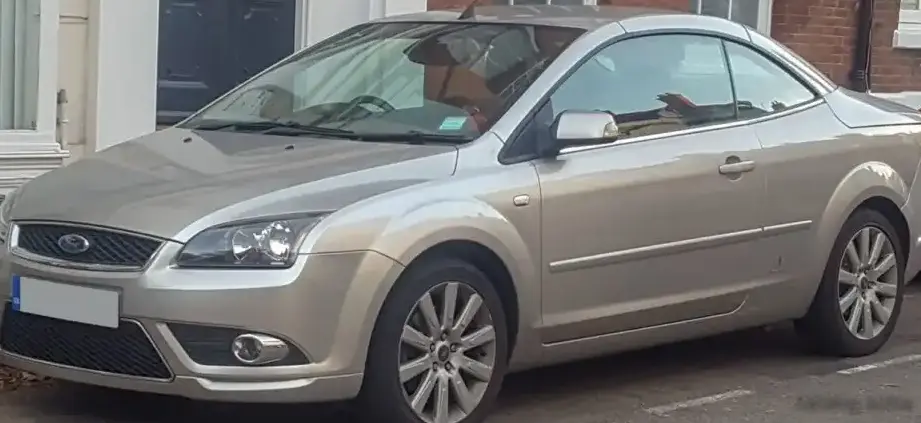
The Ford Focus IV Wagon (facelift 2022) 1.0 EcoBoost 125 hp Mild Hybrid PowerShift represents a significant iteration within the fourth generation of Ford’s globally successful Focus compact. Introduced in January 2022 as part of the facelift for the Mk4 Focus, this variant aimed to balance fuel efficiency with reasonable performance, catering to buyers seeking a practical and economical family vehicle. Positioned as a mid-range offering, it slotted between the base 1.0 EcoBoost non-hybrid models and the more powerful, though less fuel-efficient, trims. The Focus IV, built on the C2 platform (also known as the 1HX0/A3 platform shared with other Ford models), continued the Focus’s reputation for strong driving dynamics and a spacious interior, while incorporating updated technology and styling.
Technical Specifications
| Brand | Ford |
| Model | Focus |
| Generation | Focus IV Wagon (facelift 2022) |
| Type (Engine) | 1.0 EcoBoost (125 Hp) Mild Hybrid PowerShift |
| Start of production | January, 2022 |
| Powertrain Architecture | MHEV (Mild Hybrid Electric Vehicle) |
| Body type | Station wagon (estate) |
| Seats | 5 |
| Doors | 5 |
| Fuel consumption at Low speed (WLTP) | 7.2-7.8 l/100 km (32.7 – 30.2 US mpg) |
| Fuel consumption at Medium speed (WLTP) | 5.2-6.1 l/100 km (45.2 – 38.6 US mpg) |
| Fuel consumption at high speed (WLTP) | 4.7-5.6 l/100 km (50 – 42 US mpg) |
| Fuel consumption at very high speed (WLTP) | 5.8-7.3 l/100 km (40.6 – 32.2 US mpg) |
| Combined fuel consumption (WLTP) | 5.5-6.6 l/100 km (42.8 – 35.6 US mpg) |
| CO2 emissions (WLTP) | 125-149 g/km |
| Fuel Type | Petrol (Gasoline) |
| Acceleration 0 – 100 km/h | 10.4 sec |
| Acceleration 0 – 62 mph | 10.4 sec |
| Acceleration 0 – 60 mph | 9.9 sec |
| Maximum speed | 193 km/h (119.92 mph) |
| Emission standard | Euro 6d-ISC-FCM |
| Weight-to-power ratio | 11 kg/Hp |
| Weight-to-torque ratio | 8.1 kg/Nm |
| Electric motor power | 16 Hp |
| Power | 125 Hp @ 6000 rpm |
| Torque | 170-1400-4500 Nm (125.39 – 1032.59 lb.-ft.) |
| Engine layout | Front, Transverse |
| Engine Model/Code | B7DC |
| Engine displacement | 999 cm3 (60.96 cu. in.) |
| Number of cylinders | 3 |
| Engine configuration | Inline |
| Cylinder Bore | 71.9 mm (2.83 in.) |
| Piston Stroke | 82 mm (3.23 in.) |
| Compression ratio | 10.5:1 |
| Number of valves per cylinder | 4 |
| Fuel injection system | Direct injection |
| Engine aspiration | Turbocharger, Intercooler |
| Valvetrain | DOHC, Ti-VCT |
| Engine oil capacity | 4.5 l (4.76 US qt | 3.96 UK qt) |
| Coolant | 5.8 l (6.13 US qt | 5.1 UK qt) |
| Kerb Weight | 1376 kg (3033.56 lbs.) |
| Max. weight | 2005 kg (4420.27 lbs.) |
| Max load | 629 kg (1386.71 lbs.) |
| Trunk (boot) space – minimum | 635 l (22.42 cu. ft.) |
| Trunk (boot) space – maximum | 1653 l (58.38 cu. ft.) |
| Fuel tank capacity | 52 l (13.74 US gal | 11.44 UK gal) |
| Max. roof load | 75 kg (165.35 lbs.) |
| Permitted trailer load with brakes (12%) | 1500 kg (3306.93 lbs.) |
| Permitted trailer load without brakes | 725 kg (1598.35 lbs.) |
| Permitted towbar download | 90 kg (198.42 lbs.) |
| Length | 4672 mm (183.94 in.) |
| Width | 1825 mm (71.85 in.) |
| Width with mirrors folded | 1848 mm (72.76 in.) |
| Width including mirrors | 1979 mm (77.91 in.) |
| Height | 1487-1497 mm (58.54 – 58.94 in.) |
| Wheelbase | 2700 mm (106.3 in.) |
| Drive wheel | Front wheel drive |
| Number of gears and type of gearbox | 7 gears, automatic transmission PowerShift |
| Front suspension | Independent type McPherson |
| Rear suspension | Independent multi-link suspension |
| Front brakes | Ventilated discs, 282×27 mm |
| Rear brakes | Disc, 282×27 mm |
Powertrain & Engine Architecture
At the heart of this Focus variant lies the 1.0 EcoBoost B7DC engine, a three-cylinder turbocharged gasoline engine. This engine is part of Ford’s EcoBoost family, known for its downsizing and turbocharging technology aimed at improving fuel economy without sacrificing performance. The 125 hp output is achieved through direct fuel injection, a twin-scroll turbocharger, and variable valve timing (Ti-VCT). The mild-hybrid system incorporates a 48-volt belt-driven integrated starter generator (BiSG) which provides a small power boost during acceleration and enables smoother start-stop functionality. The PowerShift 7-speed dual-clutch automatic transmission (DCT) was paired with this engine. This transmission is known for its quick shifts and efficiency, though earlier iterations of the PowerShift had experienced reliability concerns which Ford addressed in later versions.
Driving Characteristics
The 1.0 EcoBoost 125 hp PowerShift Focus Wagon offers a comfortable and generally capable driving experience. Acceleration from 0-60 mph takes around 9.9 seconds, which is adequate for everyday driving but doesn’t provide particularly sporty performance. The PowerShift transmission contributes to smooth gear changes, but can sometimes exhibit slight hesitation at low speeds. The mild-hybrid system provides a subtle boost during acceleration, improving responsiveness. Compared to the higher-output 1.5 EcoBoost versions, this variant feels less powerful, particularly when fully loaded or tackling steep inclines. However, it offers significantly better fuel economy, making it a more economical choice for those prioritizing efficiency.
Equipment & Trim Levels
The 1.0 EcoBoost 125 hp Mild Hybrid PowerShift typically came equipped with features such as air conditioning, a touchscreen infotainment system with Apple CarPlay and Android Auto compatibility, Ford’s Co-Pilot360 suite of driver-assistance technologies (including lane-keeping assist, automatic emergency braking, and blind-spot monitoring), and alloy wheels. Higher trim levels offered additional features like heated seats, a panoramic sunroof, and upgraded interior materials. Interior upholstery was generally cloth, with options for leather upgrades. The dashboard layout was modern and functional, with a focus on ease of use.
Chassis & Braking
The Focus IV Wagon utilizes an independent McPherson strut front suspension and an independent multi-link rear suspension, providing a good balance of ride comfort and handling. The chassis is relatively lightweight, contributing to the car’s agility. Braking duties are handled by ventilated discs at the front and solid discs at the rear. ABS (Anti-lock Braking System) and Electronic Stability Control (ESC) are standard features. The steering is electric power-assisted, offering a responsive and precise feel.
Market Reception & Comparison
The 1.0 EcoBoost 125 hp Mild Hybrid PowerShift Focus Wagon was generally well-received by critics as a practical and economical choice. Its fuel economy was a major selling point, particularly in Europe where fuel prices are high. Compared to the 1.5 EcoBoost variants, it offered lower running costs but less performance. The PowerShift transmission, while improved over earlier versions, still faced some scrutiny due to its past reliability issues. Against competitors like the Volkswagen Golf, Opel Astra, and Peugeot 308, the Focus offered a compelling combination of value, practicality, and driving dynamics.
Legacy
The 1.0 EcoBoost engine has proven to be a relatively reliable powertrain, although regular maintenance is crucial. The PowerShift transmission remains a potential area of concern, and prospective buyers should ensure that any used examples have a documented service history. The Focus IV Wagon 1.0 EcoBoost 125 hp Mild Hybrid PowerShift remains a popular choice in the used car market, offering a good balance of fuel efficiency, practicality, and affordability. Its continued presence on roads today is a testament to Ford’s engineering and the enduring appeal of the Focus nameplate.