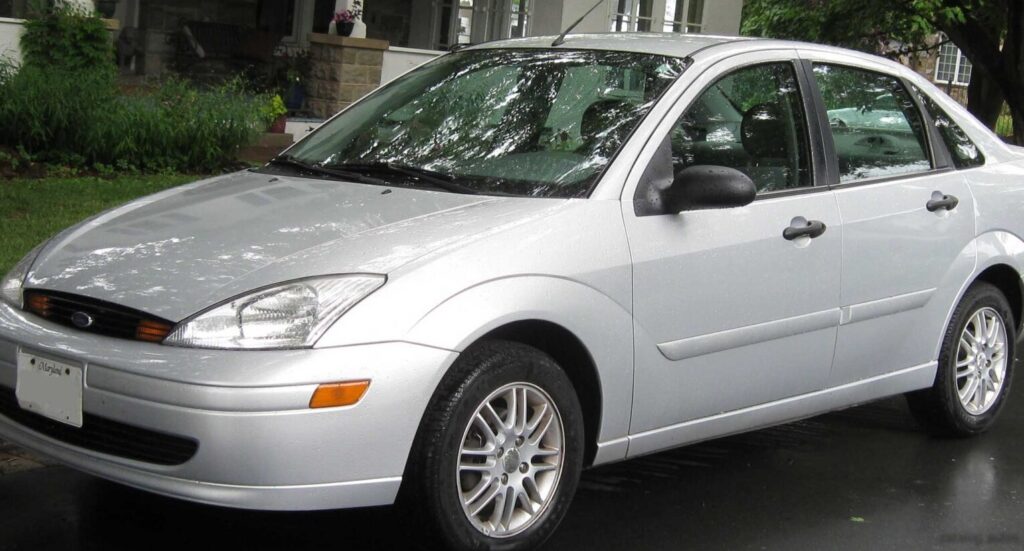
The Ford Focus Sedan, introduced to the North American market in 1999, represented a significant step for Ford in offering a modern, European-designed compact car. The 2.0i LX/SE variant, producing 111 horsepower, was a mainstay of the initial Focus lineup, positioned as a practical and affordable option for buyers seeking a fuel-efficient and reliable sedan. Produced through the 2004 model year, this version of the Focus played a crucial role in establishing the nameplate in the United States and challenging established competitors like the Honda Civic and Toyota Corolla.
Technical Specifications
| Brand | Ford |
| Model | Focus |
| Generation | Focus Sedan (USA) |
| Type (Engine) | 2.0 i LX/SE (111 Hp) |
| Start of production | 1999 |
| End of production | 2004 |
| Powertrain Architecture | Internal Combustion engine |
| Body type | Sedan |
| Seats | 5 |
| Doors | 4 |
| Fuel consumption (urban) | 8.4 l/100 km (28 US mpg) |
| Fuel consumption (extra urban) | 6.5 l/100 km (36.2 US mpg) |
| Fuel Type | Petrol (Gasoline) |
| Acceleration 0 – 100 km/h | 11 sec |
| Acceleration 0 – 62 mph | 11 sec |
| Acceleration 0 – 60 mph | 10.5 sec |
| Maximum speed | 180 km/h (111.85 mph) |
| Weight-to-power ratio | 10.7 kg/Hp |
| Weight-to-torque ratio | 7 kg/Nm |
| Power | 111 Hp @ 5000 rpm |
| Torque | 169 Nm @ 3750 rpm (124.65 lb.-ft. @ 3750 rpm) |
| Engine layout | Front, Transverse |
| Engine Model/Code | SPI |
| Engine displacement | 1988 cm3 (121.32 cu. in.) |
| Number of cylinders | 4 |
| Engine configuration | Inline |
| Cylinder Bore | 84.8 mm (3.34 in.) |
| Piston Stroke | 88 mm (3.46 in.) |
| Compression ratio | 9.4:1 |
| Number of valves per cylinder | 2 |
| Fuel injection system | Multi-port manifold injection |
| Engine aspiration | Naturally aspirated |
| Engine oil capacity | 3.78 l (3.99 US qt | 3.33 UK qt) |
| Coolant capacity | 5.75 l (6.08 US qt | 5.06 UK qt) |
| Kerb Weight | 1190 kg (2623.5 lbs.) |
| Trunk (boot) space | 365 l (12.89 cu. ft.) |
| Fuel tank capacity | 50 l (13.21 US gal | 11 UK gal) |
| Length | 4442 mm (174.88 in.) |
| Width | 1699 mm (66.89 in.) |
| Height | 1430 mm (56.3 in.) |
| Wheelbase | 2616 mm (102.99 in.) |
| Front track | 1491 mm (58.7 in.) |
| Rear track | 1486 mm (58.5 in.) |
| Drivetrain | Front wheel drive |
| Number of gears | 5 |
| Gearbox type | Manual transmission |
| Front suspension | Coil spring |
| Rear suspension | Transverse stabilizer |
| Front brakes | Disc |
| Rear brakes | Drum |
| Assisting systems | ABS (Anti-lock braking system) |
| Steering type | Steering rack and pinion |
| Power steering | Hydraulic |
| Tires size | 185/65 R14 |
Powertrain & Engine Architecture
The 2.0i LX/SE Focus utilized Ford’s SPI (Sequential Multi-Port Fuel Injection) engine, a 1.998-liter inline-four cylinder powerplant. This engine, while not particularly sophisticated, was known for its durability and relatively simple maintenance requirements. The SPI system delivered fuel to each cylinder via individual injectors, improving efficiency and reducing emissions compared to earlier throttle-body injection systems. The engine featured a single overhead camshaft (SOHC) design with two valves per cylinder. The 111 horsepower output was achieved at 5000 rpm, with peak torque of 124.65 lb-ft arriving at 3750 rpm. The engine was transversely mounted, driving the front wheels through a standard five-speed manual transmission. An optional four-speed automatic transmission was also available, though it impacted acceleration and fuel economy.
Driving Characteristics
The 2.0i LX/SE with the five-speed manual offered adequate performance for everyday driving. Acceleration to 60 mph took around 10.5 seconds, making it competitive with other compact sedans of the era. The manual transmission provided a more engaging driving experience, allowing drivers to better utilize the engine’s available power. The automatic transmission, while offering convenience, noticeably dulled acceleration and resulted in a less responsive feel. The Focus’s suspension provided a comfortable ride, though it wasn’t particularly sporty. Steering was light and precise, making it easy to maneuver in urban environments. Compared to the higher-performance Focus models equipped with the Zetec engine, the 2.0i LX/SE felt noticeably slower, but it offered a more economical and refined driving experience.
Equipment & Trim Levels
The LX and SE trims represented the entry and mid-level offerings in the Focus Sedan range. Standard equipment on the 2.0i LX/SE typically included air conditioning, power steering, an AM/FM radio, and cloth upholstery. The SE trim added features such as power windows and locks, keyless entry, and upgraded interior trim. Optional extras included a CD player, cruise control, and alloy wheels. Interior design was functional and straightforward, prioritizing practicality over luxury. The dashboard layout was clean and easy to use, with clearly labeled controls.
Chassis & Braking
The North American Focus Sedan utilized a MacPherson strut front suspension and a twist-beam rear suspension. This setup provided a good balance of ride comfort and handling. The front brakes were ventilated discs, while the rear brakes were drums. Anti-lock Braking System (ABS) was standard, enhancing safety. The chassis was relatively lightweight, contributing to the car’s fuel efficiency and agility. Stabilizer bars were included to reduce body roll during cornering, though they were thinner than those found on the sportier Focus models.
Market Reception & Comparison
The 2.0i LX/SE Focus was generally well-received by automotive critics as a competent and affordable compact sedan. It was praised for its comfortable ride, spacious interior, and good fuel economy. However, some reviewers noted that the engine lacked power, particularly when paired with the automatic transmission. Compared to the more powerful Zetec-equipped Focus models, the 2.0i LX/SE offered a more economical alternative, appealing to buyers who prioritized fuel efficiency and affordability over performance. Its fuel economy figures of around 28 mpg city and 36 mpg highway were competitive for its class.
Legacy
The 2.0i LX/SE Focus has proven to be a reliable and durable vehicle, with many examples still on the road today. The SPI engine is known for its longevity, and maintenance costs are generally reasonable. While not a particularly collectible model, the 2.0i LX/SE represents an important chapter in the Ford Focus story, establishing the nameplate as a viable competitor in the North American compact car market. In the used car market, these models are often sought after for their affordability and simplicity, making them a good choice for first-time car buyers or those seeking a dependable and economical daily driver.