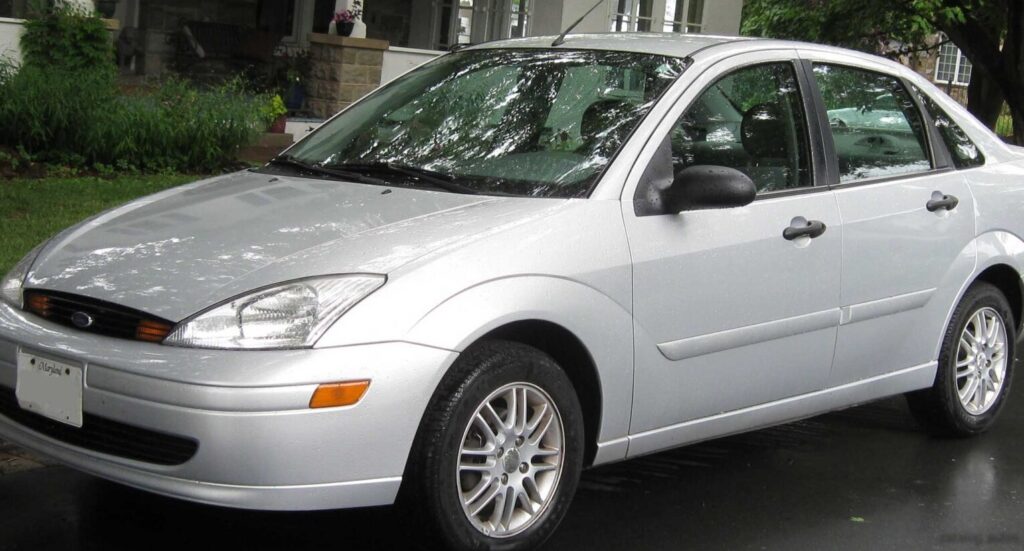
The Ford Focus Sedan, introduced to the North American market in 1999, represented a significant step for Ford in offering a globally-designed, compact vehicle. The 2.0i 16V ZTS variant, producing 131 horsepower, was a mainstay of the lineup from 1999 through 2004. Positioned as a mid-range offering, it aimed to balance performance and affordability for American buyers accustomed to larger vehicles. This first-generation Focus (internally designated as the C20HDEZ) was built on Ford’s C170 platform, a derivative of the global Focus platform, and was intended to compete with established rivals like the Honda Civic and Toyota Corolla.
Technical Specifications
| Brand | Ford |
| Model | Focus |
| Generation | Focus Sedan (USA) |
| Type (Engine) | 2.0i 16V ZTS (131 Hp) |
| Start of production | 1999 |
| End of production | 2004 |
| Powertrain Architecture | Internal Combustion engine |
| Body type | Sedan |
| Seats | 5 |
| Doors | 4 |
| Fuel consumption (urban) | 9.4 l/100 km (25 US mpg) |
| Fuel consumption (extra urban) | 7.1 l/100 km (33.1 US mpg) |
| Fuel Type | Petrol (Gasoline) |
| Acceleration 0 – 100 km/h | 9.6 sec |
| Acceleration 0 – 62 mph | 9.6 sec |
| Acceleration 0 – 60 mph | 9.1 sec |
| Maximum speed | 180 km/h (111.85 mph) |
| Weight-to-power ratio | 9.5 kg/Hp |
| Weight-to-torque ratio | 6.8 kg/Nm |
| Power | 131 Hp @ 5300 rpm |
| Torque | 183 Nm @ 4500 rpm (134.97 lb.-ft. @ 4500 rpm) |
| Engine layout | Front, Transverse |
| Engine Model/Code | Zetec / C20HDEZ |
| Engine displacement | 1988 cm3 (121.32 cu. in.) |
| Number of cylinders | 4 |
| Engine configuration | Inline |
| Cylinder Bore | 84.8 mm (3.34 in.) |
| Piston Stroke | 88 mm (3.46 in.) |
| Compression ratio | 9.6:1 |
| Number of valves per cylinder | 4 |
| Fuel injection system | Multi-port manifold injection |
| Engine aspiration | Naturally aspirated |
| Engine oil capacity | 4.25 l (4.49 US qt | 3.74 UK qt) |
| Coolant capacity | 5.75 l (6.08 US qt | 5.06 UK qt) |
| Kerb Weight | 1250 kg (2755.78 lbs.) |
| Trunk (boot) space | 365 l (12.89 cu. ft.) |
| Fuel tank capacity | 50 l (13.21 US gal | 11 UK gal) |
| Length | 4442 mm (174.88 in.) |
| Width | 1699 mm (66.89 in.) |
| Height | 1430 mm (56.3 in.) |
| Wheelbase | 2616 mm (102.99 in.) |
| Front track | 1491 mm (58.7 in.) |
| Rear track | 1486 mm (58.5 in.) |
| Drivetrain | Front wheel drive |
| Number of gears | 5 |
| Gearbox type | Manual transmission |
| Front suspension | Coil spring |
| Rear suspension | Transverse stabilizer |
| Front brakes | Disc |
| Rear brakes | Drum |
| Assisting systems | ABS (Anti-lock braking system) |
| Steering type | Steering rack and pinion |
| Power steering | Hydraulic |
| Tires size | 205/60 R16 |
| Wheel rims size | 16 |
Powertrain & Engine Architecture
The heart of the 2.0i ZTS Focus was the Zetec engine, specifically the C20HDEZ variant. This 1.998-liter inline-four cylinder engine featured a cast iron block and an aluminum cylinder head. It utilized a multi-port fuel injection system, delivering fuel to each cylinder individually for optimized combustion. The engine boasted 16 valves (four per cylinder) operated by a single overhead camshaft, contributing to its relatively high output for its displacement. The 5-speed manual transmission was a key component, offering a balance between fuel efficiency and driver engagement. The transmission’s gear ratios were tuned for everyday driving, prioritizing acceleration in the lower gears and comfortable cruising at highway speeds.
Driving Characteristics
The 131 horsepower and 135 lb-ft of torque provided by the 2.0i ZTS engine delivered adequate, though not exhilarating, performance. Acceleration from 0-60 mph took approximately 9.1 seconds, making it competitive within its class but noticeably slower than higher-output versions of the Focus available in Europe. The manual transmission allowed for precise control, but the engine’s peak torque arriving at 4500 rpm meant drivers needed to rev the engine to access its full potential. Compared to the later Duratec 2.0L engine, the Zetec felt a bit rougher and less refined, but it was known for its durability. The 5-speed manual transmission provided a decent spread of gears, but some drivers found the shift linkage to be slightly notchy.
Equipment & Trim Levels
The 2.0i ZTS trim typically included standard features such as air conditioning, power windows and locks, and an AM/FM stereo. Interior upholstery was typically cloth, with a relatively simple dashboard layout. Optional extras included a power sunroof, upgraded audio systems, and alloy wheels. The ZTS trim sat above the base LX model, offering a step up in features and perceived value. It was positioned below the higher-spec Zetec trim, which offered sportier styling and additional features like a rear spoiler and upgraded suspension.
Chassis & Braking
The North American Focus Sedan utilized an independent front suspension with MacPherson struts and a twist-beam rear suspension. This setup provided a comfortable ride, though it wasn’t particularly sporty. The front brakes were ventilated discs, while the rear brakes were drums. ABS (Anti-lock Braking System) was standard, enhancing safety. The suspension was tuned for comfort, prioritizing ride quality over handling precision. The relatively lightweight construction of the Focus helped to offset the limitations of the suspension, resulting in a reasonably agile vehicle.
Market Reception & Comparison
Critics generally praised the Focus Sedan for its handling and interior space, but some found the engine to be underpowered, especially when compared to competitors like the Honda Civic. The 2.0i ZTS variant offered a good balance of price and features, making it a popular choice for buyers seeking a practical and reliable compact car. Fuel economy was respectable, averaging around 25 mpg in the city and 33 mpg on the highway. Compared to the base 2.0L S trim, the ZTS offered a noticeable improvement in performance and features. However, the European-market Focus models with the 1.8L Zetec engine or the 2.0L Duratec engine offered superior performance and refinement.
Legacy
The Ford Focus Sedan, particularly the 2.0i ZTS variant, has proven to be a relatively reliable vehicle. The Zetec engine, while not the most technologically advanced, is known for its durability. Common issues include minor oil leaks and occasional sensor failures. In the used car market, these Focus Sedans are often sought after for their affordability and practicality. They represent a significant turning point for Ford, demonstrating the company’s ability to produce a competitive compact car for the North American market. While not a performance icon, the 2.0i ZTS Focus Sedan remains a solid and dependable choice for budget-conscious buyers.