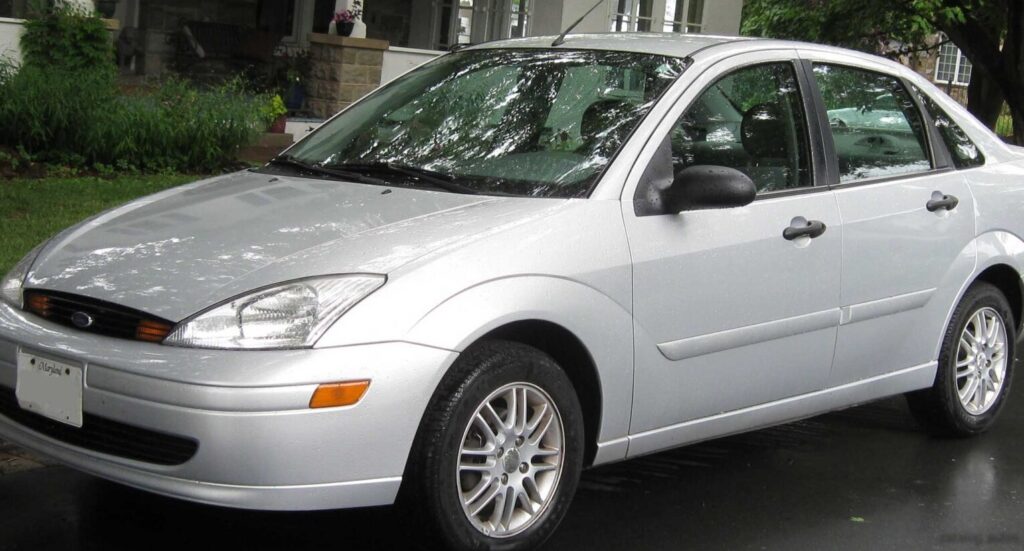
The Ford Focus Sedan, introduced to the North American market in 1999, represented Ford’s entry into the compact car segment with a focus on European-inspired handling and design. The 2.3 i 16V ST variant, produced from 1999 to 2004, served as the performance-oriented trim level for the first generation (Mk1) Focus sedan sold in the United States. Positioned above the base LX and SE models, the ST offered a more powerful engine, sport-tuned suspension, and a generally more engaging driving experience. It was a key model in establishing the Focus as a viable alternative to established competitors like the Honda Civic and Toyota Corolla.
Technical Specifications
| Brand | Ford |
| Model | Focus |
| Generation | Focus Sedan (USA) |
| Type (Engine) | 2.3 i 16V ST (153 Hp) |
| Start of production | 1999 |
| End of production | 2004 |
| Powertrain Architecture | Internal Combustion engine |
| Body type | Sedan |
| Seats | 5 |
| Doors | 4 |
| Fuel consumption (urban) | 10.7 l/100 km (22 US mpg) |
| Fuel consumption (extra urban) | 7.6 l/100 km (30.9 US mpg) |
| Fuel Type | Petrol (Gasoline) |
| Acceleration 0 – 100 km/h | 7.9 sec |
| Acceleration 0 – 62 mph | 7.9 sec |
| Acceleration 0 – 60 mph | 7.5 sec |
| Maximum speed | 193 km/h (119.92 mph) |
| Weight-to-power ratio | 8.4 kg/Hp |
| Weight-to-torque ratio | 6.1 kg/Nm |
| Power | 153 Hp @ 5750 rpm |
| Power per litre | 67.7 Hp/l |
| Torque | 209 Nm @ 4250 rpm (154.15 lb.-ft. @ 4250 rpm) |
| Engine layout | Front, Transverse |
| Engine displacement | 2261 cm3 (137.97 cu. in.) |
| Number of cylinders | 4 |
| Engine configuration | Inline |
| Cylinder Bore | 87.5 mm (3.44 in.) |
| Piston Stroke | 94 mm (3.7 in.) |
| Compression ratio | 9.7:1 |
| Number of valves per cylinder | 4 |
| Fuel injection system | Multi-port manifold injection |
| Engine aspiration | Naturally aspirated |
| Engine oil capacity | 4.3 l (4.54 US qt | 3.78 UK qt) |
| Coolant capacity | 5.75 l (6.08 US qt | 5.06 UK qt) |
| Kerb Weight | 1280 kg (2821.92 lbs.) |
| Trunk (boot) space – maximum | 396 l (13.98 cu. ft.) |
| Fuel tank capacity | 53 l (14 US gal | 11.66 UK gal) |
| Length | 4450 mm (175.2 in.) |
| Width | 1699 mm (66.89 in.) |
| Height | 1430 mm (56.3 in.) |
| Wheelbase | 2615 mm (102.95 in.) |
| Front track | 1494 mm (58.82 in.) |
| Rear track | 1486 mm (58.5 in.) |
| Drivetrain Architecture | Front wheel drive |
| Number of gears | 5 |
| Gearbox type | Manual transmission |
| Front suspension | Independent, McPherson with coil spring and anti-roll bar |
| Rear suspension | Independent multi-link with stabilizer |
| Front brakes | Disc |
| Rear brakes | Drum |
| Assisting systems | ABS (Anti-lock braking system) |
| Steering type | Steering rack and pinion |
| Tires size | 205/50 R16 |
Powertrain & Engine Architecture
The heart of the Focus ST was the 2.3-liter, inline-four cylinder engine. This engine, internally designated as the 2.3L Duratec, was a significant upgrade over the base 2.0-liter engine offered in lower Focus trims. It featured a dual overhead camshaft (DOHC) design with four valves per cylinder, contributing to its improved breathing and power output. The engine utilized a multi-port fuel injection system, delivering fuel directly into the intake ports. The 9.7:1 compression ratio was a balance between performance and reliability, allowing the engine to run on readily available 87 octane gasoline. The five-speed manual transmission was the only transmission option available with the ST trim, providing drivers with full control over the engine’s power. This transmission was chosen to complement the sporty nature of the vehicle.
Driving Characteristics
The 2.3L engine in the Focus ST delivered a noticeable performance boost compared to the standard engine. The 153 horsepower and 154 lb-ft of torque provided brisk acceleration, with 0-60 mph times consistently in the mid-7 second range. While not a sports car by any means, the ST offered a more engaging driving experience than its siblings. The five-speed manual transmission allowed for precise gear changes, and the relatively short gearing contributed to its lively feel. Compared to the base LX or SE models, the ST felt significantly more responsive, particularly during highway merging and overtaking maneuvers. The suspension tuning, while firm, didn’t compromise ride comfort excessively, making it a suitable daily driver.
Equipment & Trim Levels
The Focus ST trim came standard with a number of features designed to enhance the driving experience and provide a more premium feel. These included sport seats with enhanced bolstering, a leather-wrapped steering wheel, and upgraded interior trim. Air conditioning, power windows and locks, and an AM/FM stereo with a CD player were also standard. Optional extras included a sunroof, upgraded audio system, and alloy wheels. The ST trim was positioned as the top-of-the-line Focus sedan, offering a more comprehensive feature set than the LX and SE models.
Chassis & Braking
The Focus ST featured an independent front suspension with McPherson struts and a multi-link independent rear suspension. This suspension setup provided a good balance of handling and ride comfort. A thicker front stabilizer bar was included as part of the ST package, further reducing body roll during cornering. The braking system consisted of disc brakes on the front wheels and drum brakes on the rear. Anti-lock Braking System (ABS) was standard, enhancing safety and control during emergency braking situations. The chassis was reinforced in key areas to improve rigidity and handling precision.
Market Reception & Comparison
The Ford Focus ST was generally well-received by automotive critics. It was praised for its European-inspired handling, responsive engine, and overall value. However, some critics noted the interior materials were not as refined as those found in some of its Japanese competitors. Compared to the base Focus models, the ST offered a significant performance upgrade, but it came at a higher price. Fuel economy was respectable, averaging around 22 mpg in the city and 31 mpg on the highway. The ST’s reliability was generally good, although some owners reported minor issues with the fuel injection system and the cooling system.
Legacy
The first-generation Ford Focus ST, including the 2.3L variant, holds a respectable position in the used car market today. Its combination of affordability, practicality, and engaging driving dynamics makes it an attractive option for enthusiasts and budget-conscious buyers. The 2.3L Duratec engine is known for its durability and relatively simple maintenance requirements. While finding a well-maintained example can be challenging, the Focus ST remains a popular choice for those seeking a fun-to-drive and reliable compact sedan. It laid the groundwork for future performance-oriented Focus models, solidifying the Focus’s reputation as a capable and enjoyable vehicle.