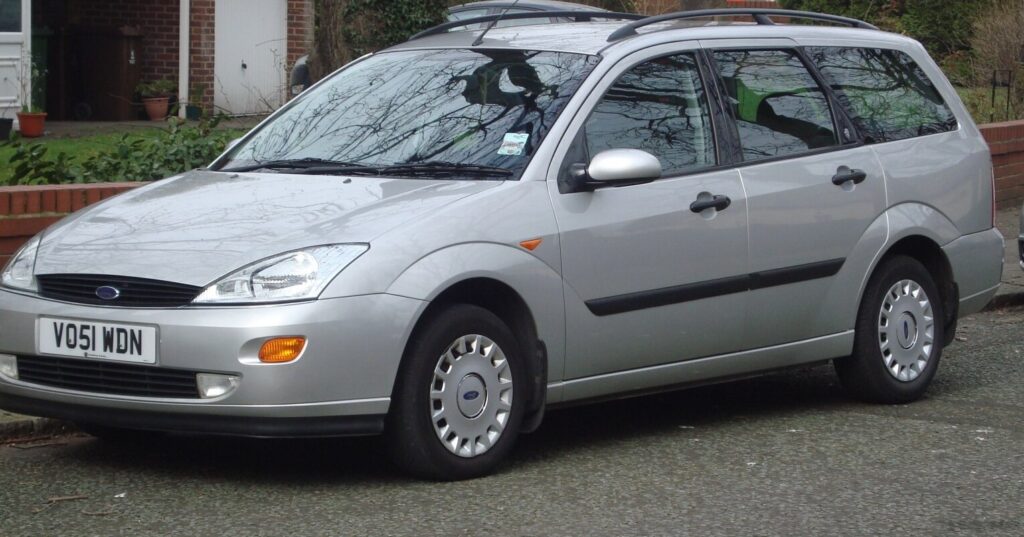
The Ford Focus Turnier I 1.6 16V, produced between 1999 and 2005, represents a practical and popular choice within the first generation Focus range. As a station wagon (estate) variant, the Turnier offered increased cargo capacity compared to the hatchback, appealing to families and those requiring versatile load-lugging capabilities. This particular 1.6-liter, 100 horsepower configuration occupied a mid-range position in the lineup, offering a balance between affordability, fuel economy, and usability. It served as a stepping stone between the base models and the more performance-oriented trims.
Technical Specifications
| Brand | Ford |
| Model | Focus |
| Generation | Focus Turnier I |
| Type (Engine) | 1.6 16V (100 Hp) |
| Start of production | 1999 |
| End of production | 2005 |
| Powertrain Architecture | Internal Combustion engine |
| Body type | Station wagon (estate) |
| Seats | 5 |
| Doors | 5 |
| Fuel consumption (urban) | 9.3 l/100 km (25.3 US mpg) |
| Fuel consumption (extra urban) | 5.5 l/100 km (42.8 US mpg) |
| Fuel consumption (combined) | 7 l/100 km (33.6 US mpg) |
| Fuel Type | Petrol (Gasoline) |
| Acceleration 0 – 100 km/h | 11 sec |
| Acceleration 0 – 62 mph | 11 sec |
| Acceleration 0 – 60 mph | 10.5 sec |
| Maximum speed | 185 km/h (114.95 mph) |
| Weight-to-power ratio | 11.8 kg/Hp |
| Weight-to-torque ratio | 8.3 kg/Nm |
| Power | 100 Hp @ 6000 rpm |
| Power per litre | 62.7 Hp/l |
| Torque | 143 Nm @ 4000 rpm (105.47 lb.-ft. @ 4000 rpm) |
| Engine layout | Front, Transverse |
| Engine Model/Code | FYDA, FYDC, FYDB, FYDD, FYDH |
| Engine displacement | 1596 cm3 (97.39 cu. in.) |
| Number of cylinders | 4 |
| Engine configuration | Inline |
| Cylinder Bore | 79 mm (3.11 in.) |
| Piston Stroke | 81.4 mm (3.2 in.) |
| Compression ratio | 11:1 |
| Number of valves per cylinder | 4 |
| Fuel injection system | Multi-port manifold injection |
| Engine aspiration | Naturally aspirated engine |
| Valvetrain | DOHC |
| Engine oil capacity | 4.25 l (4.49 US qt | 3.74 UK qt) |
| Coolant | 5 l (5.28 US qt | 4.4 UK qt) |
| Kerb Weight | 1180 kg (2601.45 lbs.) |
| Max. weight | 1635 kg (3604.56 lbs.) |
| Max load | 455 kg (1003.1 lbs.) |
| Trunk (boot) space – minimum | 520 l (18.36 cu. ft.) |
| Trunk (boot) space – maximum | 1580 l (55.8 cu. ft.) |
| Fuel tank capacity | 55 l (14.53 US gal | 12.1 UK gal) |
| Length | 4438 mm (174.72 in.) |
| Width | 1698 mm (66.85 in.) |
| Height | 1447 mm (56.97 in.) |
| Wheelbase | 2615 mm (102.95 in.) |
| Front track | 1484 mm (58.43 in.) |
| Rear (Back) track | 1477 mm (58.15 in.) |
| Drivetrain Architecture | The Internal combustion engine (ICE) drives the front wheels of the vehicle. |
| Drive wheel | Front wheel drive |
| Number of gears and type of gearbox | 5 gears, manual transmission |
| Front suspension | Wishbone |
| Rear suspension | Coil spring |
| Front brakes | Ventilated discs |
| Rear brakes | Disc |
| Assisting systems | ABS (Anti-lock braking system) |
| Steering type | Steering rack and pinion |
| Power steering | Hydraulic Steering |
| Tires size | 185/60 R14 |
| Wheel rims size | 14 |
INTRODUCTION
The Ford Focus Turnier I 1.6 16V, launched in 1999 as part of the first Focus generation (internally designated as the 1HX0/A3 platform), was designed to replace the aging Escort. The Turnier, Ford’s European designation for a station wagon, broadened the Focus’s appeal by offering a more practical body style. This 1.6-liter variant aimed to provide a balance of affordability and usability, targeting buyers who needed the extra space of a wagon but didn’t require the higher performance of the Zetec or ST models. It was a key component of Ford’s strategy to offer a comprehensive range of Focus models to cater to diverse customer needs.
Powertrain & Engine Architecture
At the heart of the Focus Turnier 1.6 16V lies the Ford Zetec-E engine, specifically the FYDA, FYDC, FYDB, FYDD, or FYDH code depending on the specific market and year of production. This 1.6-liter inline-four engine features a double overhead camshaft (DOHC) valvetrain with four valves per cylinder, contributing to its relatively efficient breathing. Fuel delivery is managed by a multi-port fuel injection system, providing precise fuel metering for optimal combustion. The engine produces 100 horsepower at 6000 rpm and 143 Nm (105.47 lb-ft) of torque at 4000 rpm. The engine’s 11:1 compression ratio aids in maximizing power output. The engine is transversely mounted, driving the front wheels. The standard transmission for this variant was a five-speed manual, though a four-speed automatic transmission was also available, albeit less common.
Driving Characteristics
The 1.6-liter engine, paired with the five-speed manual transmission, provided adequate performance for everyday driving. Acceleration from 0 to 60 mph took around 10.5 seconds, and top speed was approximately 115 mph. While not particularly sporty, the engine offered sufficient power for overtaking and maintaining highway speeds. The automatic transmission, while offering convenience, noticeably dulled acceleration and reduced fuel economy. The gear ratios were tuned for fuel efficiency rather than outright performance. Compared to the higher-output 1.8-liter or the diesel variants, the 1.6 felt less responsive, particularly when fully loaded. However, its lighter weight and less stressed engine contributed to a smoother and more refined driving experience.
Equipment & Trim Levels
The Focus Turnier 1.6 16V typically came equipped with features such as power steering, central locking, electric front windows, and an adjustable steering column. Interior upholstery was generally cloth, with a relatively simple dashboard layout. Higher trim levels, such as the Ghia, offered additional features like alloy wheels, air conditioning, and upgraded audio systems. Optional extras included a sunroof, rear electric windows, and metallic paint. Safety features included ABS (Anti-lock Braking System) as standard, and driver and passenger airbags were also commonly fitted.
Chassis & Braking
The Focus Turnier I utilized a MacPherson strut front suspension and a coil spring rear suspension. The suspension setup was tuned for comfort and ride quality, providing a reasonably compliant ride even on uneven surfaces. Front brakes were ventilated discs, offering good stopping power, while rear brakes were typically solid discs. The chassis was designed to provide good handling characteristics, although the added weight of the wagon body and the 1.6-liter engine meant it wasn’t as agile as the lighter hatchback models. Stabilizer bars were fitted to both the front and rear axles to reduce body roll during cornering.
Market Reception & Comparison
The Ford Focus Turnier 1.6 16V was generally well-received by automotive critics as a practical and affordable family car. It was praised for its spacious interior, comfortable ride, and good fuel economy. However, some critics noted that the 1.6-liter engine could feel underpowered, especially when the car was fully loaded. Compared to the 1.8-liter variant, the 1.6 offered better fuel economy but lacked the same level of performance. The diesel models provided even better fuel economy but were generally more expensive to purchase. The 1.6L automatic was often criticized for its sluggish performance and reduced fuel efficiency compared to the manual version.
Legacy
The Ford Focus Turnier I 1.6 16V has proven to be a relatively reliable vehicle, with the Zetec-E engine generally considered durable and long-lasting. Common issues include minor oil leaks and occasional problems with the cooling system. Today, these vehicles are readily available on the used car market at affordable prices. While not a collector’s item, well-maintained examples are still sought after by those looking for a practical and economical estate car. The 1.6-liter engine’s simplicity and relatively low maintenance costs make it an attractive option for budget-conscious buyers. The Turnier’s enduring popularity is a testament to its practicality and versatility.