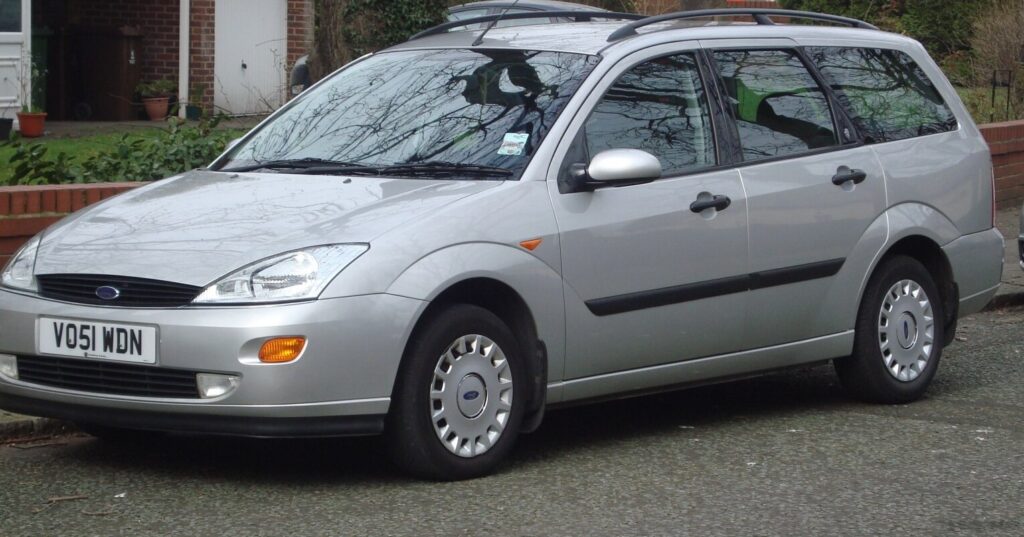
The Ford Focus Turnier I 1.6 16V Automatic, produced between 1999 and 2005, represented a practical and accessible entry point into the first generation Focus range, particularly in European markets. As a station wagon (estate) variant, the Turnier offered increased cargo capacity compared to the hatchback, appealing to families and those requiring versatile load-lugging capabilities. This specific configuration – the 1.6-liter engine paired with a four-speed automatic transmission – was positioned as a mid-range offering, prioritizing comfort and ease of use over outright performance. It sat below the more powerful 1.8 and 2.0-liter options, and the sportier Zetec trims, but above the base 1.4-liter model.
Technical Specifications
| Brand | Ford |
| Model | Focus |
| Generation | Focus Turnier I |
| Type (Engine) | 1.6 16V (100 Hp) Automatic |
| Start of production | 1999 |
| End of production | 2005 |
| Powertrain Architecture | Internal Combustion engine |
| Body type | Station wagon (estate) |
| Seats | 5 |
| Doors | 5 |
| Fuel consumption (urban) | 9.3 l/100 km (25.3 US mpg) |
| Fuel consumption (extra urban) | 5.5 l/100 km (42.8 US mpg) |
| Fuel consumption (combined) | 7 l/100 km (33.6 US mpg) |
| Fuel Type | Petrol (Gasoline) |
| Acceleration 0 – 100 km/h | 11 sec |
| Acceleration 0 – 62 mph | 11 sec |
| Acceleration 0 – 60 mph | 10.5 sec |
| Maximum speed | 185 km/h (114.95 mph) |
| Weight-to-power ratio | 11.8 kg/Hp |
| Weight-to-torque ratio | 8.3 kg/Nm |
| Power | 100 Hp @ 6000 rpm |
| Torque | 143 Nm @ 4000 rpm (105.47 lb.-ft. @ 4000 rpm) |
| Engine layout | Front, Transverse |
| Engine Model/Code | FYDA, FYDC, FYDB, FYDD, FYDH |
| Engine displacement | 1596 cm3 (97.39 cu. in.) |
| Number of cylinders | 4 |
| Engine configuration | Inline |
| Cylinder Bore | 79 mm (3.11 in.) |
| Piston Stroke | 81.4 mm (3.2 in.) |
| Compression ratio | 11:1 |
| Number of valves per cylinder | 4 |
| Fuel injection system | Multi-port manifold injection |
| Engine aspiration | Naturally aspirated engine |
| Valvetrain | DOHC |
| Engine oil capacity | 4.25 l (4.49 US qt | 3.74 UK qt) |
| Coolant capacity | 5 l (5.28 US qt | 4.4 UK qt) |
| Kerb Weight | 1180 kg (2601.45 lbs.) |
| Max. weight | 1635 kg (3604.56 lbs.) |
| Max load | 455 kg (1003.1 lbs.) |
| Trunk (boot) space – minimum | 520 l (18.36 cu. ft.) |
| Trunk (boot) space – maximum | 1580 l (55.8 cu. ft.) |
| Fuel tank capacity | 55 l (14.53 US gal | 12.1 UK gal) |
| Length | 4438 mm (174.72 in.) |
| Width | 1698 mm (66.85 in.) |
| Height | 1447 mm (56.97 in.) |
| Wheelbase | 2615 mm (102.95 in.) |
| Front track | 1484 mm (58.43 in.) |
| Rear track | 1477 mm (58.15 in.) |
| Drivetrain Architecture | Front wheel drive |
| Number of gears | 4 |
| Gearbox type | Automatic transmission |
| Front suspension | Wishbone |
| Rear suspension | Coil spring |
| Front brakes | Ventilated discs |
| Rear brakes | Disc |
| Assisting systems | ABS (Anti-lock braking system) |
| Steering type | Steering rack and pinion |
| Power steering | Hydraulic Steering |
| Tires size | 185/60 R14 |
| Wheel rims size | 14 |
INTRODUCTION
The Ford Focus Turnier I 1.6 16V Automatic, launched in 1999 as part of the first Focus generation (internally designated the 1HX0/A3 platform), was designed to replace the aging Escort range. The Turnier body style, Ford’s term for a station wagon, provided a more practical alternative to the popular hatchback. This variant, powered by the Zetec-E 1.6-liter engine and a four-speed automatic gearbox, aimed to deliver a balance of affordability, fuel efficiency, and convenience for family buyers. It was a key model in establishing the Focus as a strong competitor in the compact family car segment, particularly in Europe where station wagons held significant market share.
Powertrain & Engine Architecture
At the heart of the Focus Turnier 1.6 Automatic lies the Zetec-E engine, specifically the FYDA, FYDC, FYDB, FYDD, or FYDH code depending on the specific market and year of production. This 1.6-liter inline-four engine featured a double overhead camshaft (DOHC) valvetrain with four valves per cylinder, contributing to its relatively efficient breathing. Fuel delivery was handled by a multi-port fuel injection system, providing precise fuel metering for improved combustion. The engine produced 100 horsepower at 6000 rpm and 143 Nm (105.47 lb-ft) of torque at 4000 rpm. The four-speed automatic transmission, while providing smooth shifts, was a somewhat dated design by the late 1990s, lacking the efficiency and responsiveness of more modern automatic gearboxes. It featured a traditional torque converter and hydraulic control system.
Driving Characteristics
The 1.6-liter automatic Focus Turnier offered a comfortable, if not particularly exhilarating, driving experience. Acceleration from 0-60 mph took around 10.5 seconds, and top speed was approximately 115 mph. The automatic transmission, while convenient, resulted in some power loss compared to the manual transmission versions. Gear ratios were optimized for fuel economy and smooth cruising rather than sporty performance. The engine felt somewhat strained when accelerating hard, and overtaking maneuvers required careful planning. Compared to the higher-output 1.8 and 2.0-liter models, the 1.6 Automatic lacked the punch needed for more dynamic driving. However, it provided adequate power for everyday commuting and family transportation.
Equipment & Trim Levels
The 1.6 Automatic Turnier typically came equipped with a reasonable level of standard features. These generally included central locking, power steering, electric front windows, and an adjustable steering column. Interior upholstery was typically cloth, with a relatively simple dashboard layout. Optional extras included air conditioning, alloy wheels, a CD player, and upgraded trim levels with features like rear electric windows and a sunroof. The specific trim level (e.g., LX, Zetec) determined the extent of standard equipment.
Chassis & Braking
The Focus Turnier utilized a front-wheel-drive layout with independent wishbone suspension at the front and a coil spring rear suspension. This setup provided a good balance of ride comfort and handling. The front brakes were ventilated discs, offering good stopping power, while the rear brakes were solid discs. Anti-lock Braking System (ABS) was standard, enhancing safety. The suspension was tuned for comfort, resulting in a slightly softer ride compared to the sportier Zetec models. Stabilizer bars were fitted front and rear to reduce body roll during cornering.
Market Reception & Comparison
The Ford Focus Turnier 1.6 Automatic was generally well-received by critics as a practical and affordable family car. It was praised for its spacious interior, comfortable ride, and reasonable fuel economy (around 33.6 US mpg combined). However, the automatic transmission was often criticized for its lack of responsiveness and dated technology. Compared to the manual transmission versions, the automatic offered slightly worse fuel economy and slower acceleration. The 1.8-liter models provided a noticeable performance upgrade, but at a higher price point. The 1.6 Automatic appealed to buyers who prioritized convenience and ease of driving over outright performance.
Legacy
The Ford Focus Turnier I 1.6 Automatic has proven to be a relatively reliable vehicle, with the Zetec-E engine generally considered durable. However, the automatic transmission can be prone to wear and tear, particularly if not regularly serviced. Today, these cars are readily available on the used car market at affordable prices. They represent a practical and economical option for those seeking a spacious and reliable station wagon. While not a performance icon, the 1.6 Automatic Focus Turnier played a significant role in establishing the Focus as a popular and well-respected family car.