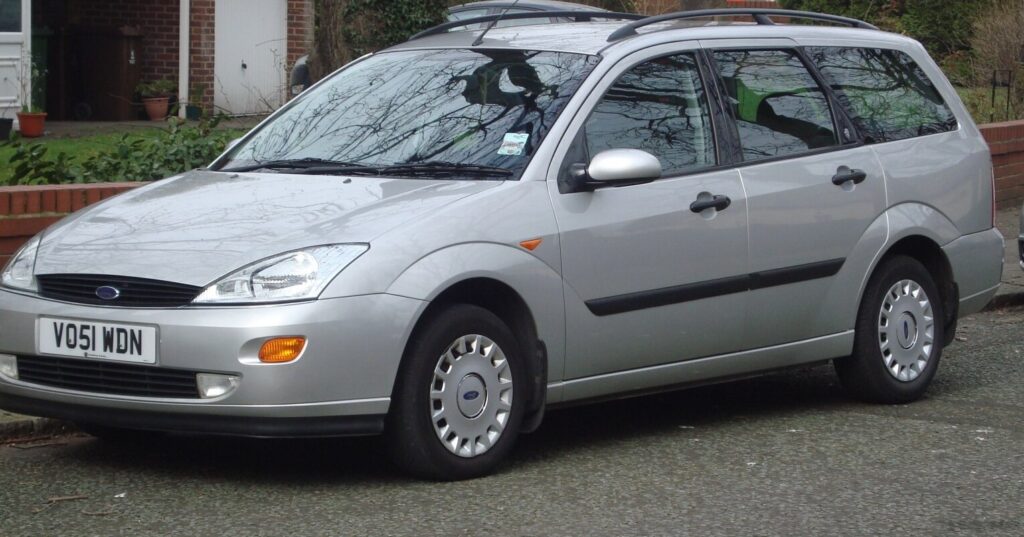
The Ford Focus Turnier I 1.8 DI (75 horsepower) was a diesel-powered station wagon variant produced between 1999 and 2005. Part of the first generation (Mk1) Focus range, known internally as the DH platform, the Turnier – Ford’s European designation for a station wagon or ‘estate’ – offered a practical and economical option for families and those requiring increased cargo capacity. This particular engine and trim level occupied the lower end of the Focus Turnier lineup, prioritizing fuel efficiency and affordability over outright performance. It was positioned below the more powerful petrol variants and the higher-output diesel models.
Technical Specifications
| Brand | Ford |
| Model | Focus |
| Generation | Focus Turnier I |
| Type (Engine) | 1.8 DI (75 Hp) |
| Start of production | 1999 |
| End of production | 2005 |
| Powertrain Architecture | Internal Combustion engine |
| Body type | Station wagon (estate) |
| Seats | 5 |
| Doors | 5 |
| Fuel consumption (urban) | 6.8 l/100 km (34.6 US mpg, 41.5 UK mpg, 14.7 km/l) |
| Fuel consumption (extra urban) | 4.1 l/100 km (57.4 US mpg, 68.9 UK mpg, 24.4 km/l) |
| Fuel consumption (combined) | 5.1 l/100 km (46.1 US mpg, 55.4 UK mpg, 19.6 km/l) |
| Fuel Type | Diesel |
| Acceleration 0 – 100 km/h | 15.1 sec |
| Acceleration 0 – 62 mph | 15.1 sec |
| Acceleration 0 – 60 mph | 14.3 sec |
| Maximum speed | 168 km/h (104.39 mph) |
| Weight-to-power ratio | 16.4 kg/Hp, 61 Hp/tonne |
| Weight-to-torque ratio | 7 kg/Nm, 142.3 Nm/tonne |
| Power | 75 Hp @ 4000 rpm |
| Power per litre | 42.8 Hp/l |
| Torque | 175 Nm @ 1800 rpm (129.07 lb.-ft. @ 1800 rpm) |
| Engine layout | Front, Transverse |
| Engine Model/Code | BHDA, BHDB |
| Engine displacement | 1753 cm3 (106.97 cu. in.) |
| Number of cylinders | 4 |
| Engine configuration | Inline |
| Cylinder Bore | 82.5 mm (3.25 in.) |
| Piston Stroke | 82 mm (3.23 in.) |
| Compression ratio | 19.4:1 |
| Number of valves per cylinder | 2 |
| Fuel injection system | Diesel Commonrail |
| Engine aspiration | Turbocharger |
| Valvetrain | DOHC |
| Engine oil capacity | 5.6 l (5.92 US qt | 4.93 UK qt) |
| Coolant | 6.5 l (6.87 US qt | 5.72 UK qt) |
| Kerb Weight | 1230 kg (2711.69 lbs.) |
| Max. weight | 1755 kg (3869.11 lbs.) |
| Max load | 525 kg (1157.43 lbs.) |
| Trunk (boot) space – minimum | 520 l (18.36 cu. ft.) |
| Trunk (boot) space – maximum | 1580 l (55.8 cu. ft.) |
| Fuel tank capacity | 53 l (14 US gal | 11.66 UK gal) |
| Length | 4438 mm (174.72 in.) |
| Width | 1698 mm (66.85 in.) |
| Height | 1447 mm (56.97 in.) |
| Wheelbase | 2615 mm (102.95 in.) |
| Front track | 1484 mm (58.43 in.) |
| Rear (Back) track | 1477 mm (58.15 in.) |
| Drivetrain Architecture | The Internal combustion engine (ICE) drives the front wheels of the vehicle. |
| Drive wheel | Front wheel drive |
| Number of gears and type of gearbox | 5 gears, manual transmission |
| Front suspension | Wishbone |
| Rear suspension | Coil spring |
| Front brakes | Ventilated discs |
| Rear brakes | Disc |
| Assisting systems | ABS (Anti-lock braking system) |
| Steering type | Steering rack and pinion |
| Power steering | Hydraulic Steering |
| Tires size | 185/60 R14 |
INTRODUCTION
The Ford Focus Turnier I 1.8 DI, produced from 1999 to 2005, represented Ford’s entry into the competitive European small family car segment. The Turnier body style, essentially a station wagon, broadened the Focus’s appeal by offering increased practicality and cargo space compared to the hatchback. This 1.8 DI variant utilized a direct injection diesel engine, a relatively new technology at the time, aimed at providing improved fuel economy and reduced emissions. It was a key model in establishing the Focus as a popular choice for buyers seeking a versatile and affordable vehicle.
Powertrain & Engine Architecture
The heart of the Focus Turnier I 1.8 DI was the BHDA or BHDB engine code, a 1.8-liter inline-four cylinder diesel engine. This engine featured direct fuel injection, a technology that injected fuel directly into the combustion chamber, improving combustion efficiency. The engine employed a turbocharger to boost power output, compensating for the inherent limitations of a relatively small displacement diesel. The fuel injection system was a common rail diesel injection (CRDI) system, allowing for precise control of fuel delivery and contributing to smoother operation and reduced noise. The engine utilized a double overhead camshaft (DOHC) valvetrain with two valves per cylinder. The 1.8 DI was paired with a five-speed manual transmission, optimized for fuel efficiency and providing adequate acceleration for everyday driving.
Driving Characteristics
The 75 horsepower output of the 1.8 DI engine translated to a modest but adequate driving experience. Acceleration was not a strong point, with a 0-60 mph time of around 14.3 seconds. However, the engine delivered a respectable amount of torque – 175 Nm (129 lb-ft) – at relatively low engine speeds (1800 rpm), making it suitable for hauling loads and navigating hilly terrain. The five-speed manual transmission offered a reasonable spread of gear ratios, but drivers often found themselves shifting frequently to maintain momentum. Compared to the higher-output petrol versions of the Focus, the 1.8 DI felt noticeably slower, but it offered significantly better fuel economy. The manual transmission provided a more engaging driving experience than the optional automatic transmission available on other Focus trims.
Equipment & Trim Levels
The 1.8 DI Turnier typically came with a fairly basic level of equipment, reflecting its position as an entry-level model. Standard features generally included power steering, central locking, electric front windows, and an adjustable steering column. Interior upholstery was typically cloth, and the dashboard featured a functional but somewhat utilitarian design. Optional extras included air conditioning, alloy wheels, a CD player, and upgraded interior trim. Safety features such as ABS (Anti-lock Braking System) were standard. The trim level often dictated the availability of these optional extras, with higher trims offering more features as standard.
Chassis & Braking
The Focus Turnier I utilized a front-wheel-drive layout with independent front suspension (wishbone) and a semi-independent rear suspension (coil spring). This suspension setup provided a comfortable ride quality, although it wasn’t particularly sporty. The front brakes were ventilated discs, offering good stopping power, while the rear brakes were solid discs. The steering was a hydraulic power-assisted rack and pinion system, providing precise and responsive steering feel. The 185/60 R14 tires were a common fitment, offering a balance of grip and ride comfort.
Market Reception & Comparison
The Ford Focus Turnier I 1.8 DI was generally well-received by critics as a practical and economical family car. Its fuel efficiency was a major selling point, particularly in Europe where diesel fuel was often cheaper than petrol. However, the engine’s relatively low power output was a common criticism. Compared to the petrol-powered Focus models, the 1.8 DI offered significantly better fuel economy but lacked the same level of performance. Compared to other diesel-powered rivals, such as the Volkswagen Golf TDI, the Focus offered a competitive package in terms of price and practicality.
Legacy
The Ford Focus Turnier I 1.8 DI powertrain has proven to be reasonably reliable over the long term, although, like any diesel engine, it is susceptible to issues related to the fuel injection system and turbocharger. The BHDA and BHDB engines are known for their durability, but regular maintenance is crucial to ensure longevity. Today, these vehicles are relatively affordable on the used car market, making them an attractive option for budget-conscious buyers. However, potential buyers should be aware of the age-related issues that may arise, such as corrosion and wear and tear on suspension components. The 1.8 DI variant remains a testament to Ford’s commitment to providing practical and economical vehicles for the masses.