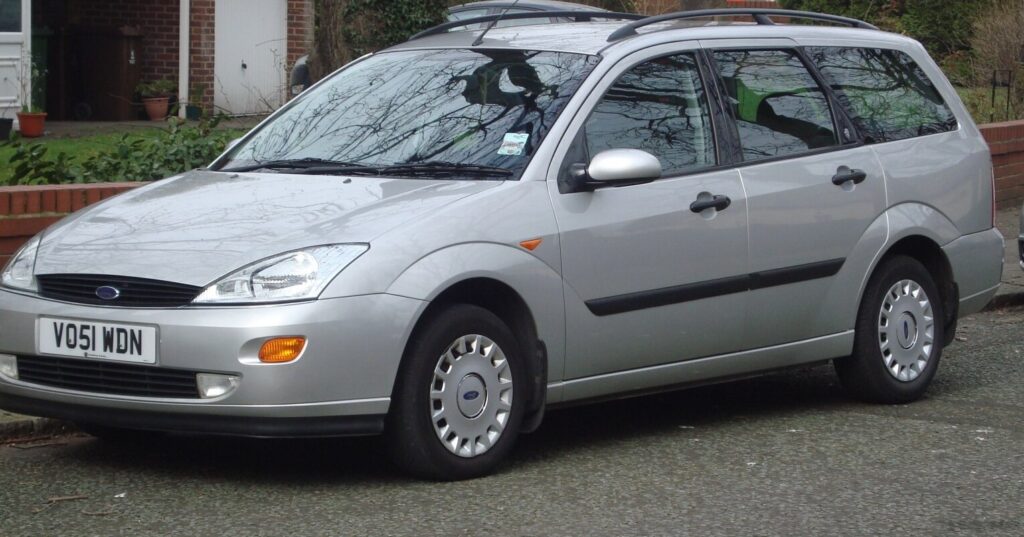
The Ford Focus Turnier I 1.8 TDCi, produced between 2001 and 2005, represents a significant offering in the first generation Focus lineup, specifically the Turnier (estate/wagon) body style. Positioned as a practical and fuel-efficient option, this variant aimed to cater to buyers needing the versatility of a wagon without sacrificing reasonable performance. It was a key component of Ford’s strategy to offer a comprehensive range of Focus models to appeal to a broad European audience, where the Turnier body style was particularly popular. This model utilized the Ford’s C-segment platform, known internally as the 1HX0, and was designed to compete with established rivals like the Volkswagen Golf Estate and Opel/Vauxhall Astra Estate.
Technical Specifications
| Brand | Ford |
| Model | Focus |
| Generation | Focus Turnier I |
| Type (Engine) | 1.8 TDCi (115 Hp) |
| Start of production | 2001 |
| End of production | 2005 |
| Powertrain Architecture | Internal Combustion engine |
| Body type | Station wagon (estate) |
| Seats | 5 |
| Doors | 5 |
| Fuel consumption (urban) | 7.2 l/100 km (32.7 US mpg) |
| Fuel consumption (extra urban) | 4.4 l/100 km (53.5 US mpg) |
| Fuel consumption (combined) | 5.4 l/100 km (43.6 US mpg) |
| Fuel Type | Diesel |
| Acceleration 0 – 100 km/h | 10.8 sec |
| Acceleration 0 – 62 mph | 10.8 sec |
| Acceleration 0 – 60 mph | 10.3 sec |
| Maximum speed | 196 km/h (121.79 mph) |
| Weight-to-power ratio | 11.5 kg/Hp |
| Weight-to-torque ratio | 5.3 kg/Nm |
| Power | 115 Hp @ 3800 rpm |
| Torque | 250 Nm @ 2000 rpm (184.39 lb.-ft. @ 2000 rpm) |
| Engine layout | Front, Transverse |
| Engine Model/Code | F9DA |
| Engine displacement | 1753 cm3 (106.97 cu. in.) |
| Number of cylinders | 4 |
| Engine configuration | Inline |
| Cylinder Bore | 82.5 mm (3.25 in.) |
| Piston Stroke | 82 mm (3.23 in.) |
| Compression ratio | 18.5:1 |
| Number of valves per cylinder | 2 |
| Fuel injection system | Diesel Commonrail |
| Engine aspiration | Turbocharger, Intercooler |
| Valvetrain | OHC |
| Engine oil capacity | 5.6 l (5.92 US qt | 4.93 UK qt) |
| Coolant capacity | 6.5 l (6.87 US qt | 5.72 UK qt) |
| Kerb Weight | 1327 kg (2925.53 lbs.) |
| Max. weight | 1760 kg (3880.14 lbs.) |
| Max load | 433 kg (954.6 lbs.) |
| Trunk (boot) space – minimum | 520 l (18.36 cu. ft.) |
| Trunk (boot) space – maximum | 1580 l (55.8 cu. ft.) |
| Fuel tank capacity | 53 l (14 US gal | 11.66 UK gal) |
| Length | 4465 mm (175.79 in.) |
| Width | 1702 mm (67.01 in.) |
| Height | 1532 mm (60.31 in.) |
| Wheelbase | 2615 mm (102.95 in.) |
| Front track | 1484 mm (58.43 in.) |
| Rear track | 1477 mm (58.15 in.) |
| Drivetrain Architecture | Front wheel drive |
| Number of gears | 5 |
| Gearbox type | Manual transmission |
| Front suspension | Wishbone |
| Rear suspension | Coil spring |
| Front brakes | Ventilated discs |
| Rear brakes | Disc |
| Assisting systems | ABS (Anti-lock braking system) |
| Steering type | Steering rack and pinion |
| Power steering | Hydraulic |
| Tires size | 195/60 R15 |
Powertrain & Engine Architecture
The heart of the Focus Turnier I 1.8 TDCi is the F9DA engine, a 1.8-liter inline-four cylinder diesel. This engine belongs to Ford’s Duratorque family, known for its robust construction and relatively simple design. It utilizes a common rail direct injection system, delivering fuel at extremely high pressures for improved combustion efficiency and reduced emissions. The engine is turbocharged and intercooled, boosting power output and torque. The intercooler helps to cool the compressed air from the turbocharger, increasing its density and further enhancing performance. The engine features an overhead camshaft (OHC) valvetrain with two valves per cylinder. The five-speed manual transmission was the standard offering for this variant, providing a balance between fuel economy and drivability. The transmission’s gear ratios were tuned to maximize the engine’s torque output, providing adequate acceleration for everyday driving.
Driving Characteristics
The 1.8 TDCi engine in the Focus Turnier delivered a respectable, if not exhilarating, driving experience. With 115 horsepower and 250 Nm (184 lb-ft) of torque, it offered sufficient power for comfortable cruising and overtaking on highways. However, it wasn’t a particularly quick car; acceleration from 0-60 mph took around 10.3 seconds. The strength of this engine lay in its mid-range torque, making it easy to pull away from low speeds and maintain momentum. Compared to the higher-output petrol versions of the Focus, the 1.8 TDCi prioritized fuel economy over outright performance. The manual transmission allowed for precise control, but the gear ratios were somewhat widely spaced, requiring frequent shifting in certain situations. The Turnier’s wagon body style added weight compared to the hatchback, slightly impacting acceleration and handling, but the well-tuned suspension helped to mitigate this effect.
Equipment & Trim Levels
The 1.8 TDCi Turnier typically came with a reasonable level of standard equipment. This included power steering, central locking, electric front windows, and an adjustable steering column. Interior upholstery was typically cloth, with a functional and durable design. Optional extras included air conditioning, alloy wheels, a CD player, and rear electric windows. Trim levels varied slightly depending on the market, but generally, the 1.8 TDCi sat in the mid-range of the Focus lineup, offering a good balance of features and affordability. It was positioned above the base models with smaller engines and fewer amenities, but below the more luxurious trims with larger engines and premium features.
Chassis & Braking
The Focus Turnier I utilized a MacPherson strut front suspension and a multi-link rear suspension, providing a comfortable ride and good handling characteristics. The front brakes were ventilated discs, offering strong stopping power, while the rear brakes were solid discs. Anti-lock Braking System (ABS) was standard, enhancing safety and control during emergency braking. The suspension was tuned to provide a balance between comfort and handling, making it suitable for both city driving and longer journeys. Stabilizer bars were fitted to both the front and rear axles to reduce body roll during cornering.
Market Reception & Comparison
The Ford Focus Turnier I 1.8 TDCi was generally well-received by automotive critics. It was praised for its fuel efficiency, practicality, and comfortable ride. However, some reviewers noted that the engine could be somewhat noisy and lacked the refinement of some of its rivals. Compared to the petrol versions of the Focus, the 1.8 TDCi offered significantly better fuel economy, making it a popular choice for drivers covering long distances. Against competitors like the Volkswagen Golf Estate and Opel/Vauxhall Astra Estate, the Focus Turnier offered a competitive package in terms of price, features, and fuel efficiency. Reliability was generally good, although some owners reported issues with the fuel injection system and turbocharger over the long term.
Legacy
The Ford Focus Turnier I 1.8 TDCi remains a relatively common sight on European roads today. The Duratorque engine, while not without its quirks, proved to be reasonably durable and capable of high mileage with proper maintenance. In the used car market, these models are often sought after for their affordability, practicality, and fuel efficiency. However, potential buyers should be aware of the potential for issues with the fuel injection system and turbocharger, and a thorough inspection is recommended before purchase. The 1.8 TDCi variant played a significant role in establishing the Focus as a popular and versatile family car, paving the way for future generations of the model.