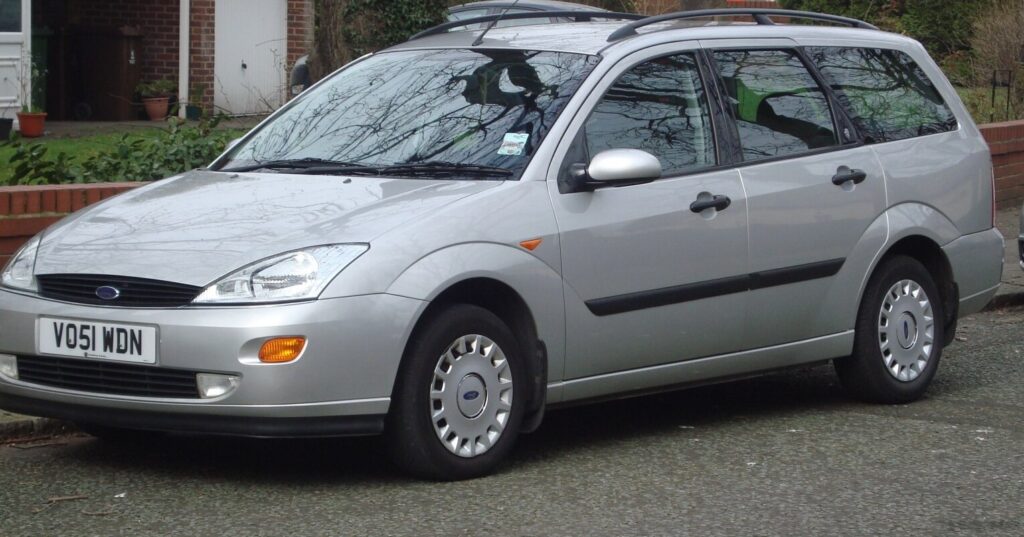
The Ford Focus Turnier I 1.8 Turbo DI (90 hp) was a diesel-powered station wagon variant produced between 1999 and 2005. Positioned as an economy-focused option within the first generation (Mk1) Focus range, it offered practicality and fuel efficiency for European buyers. This model, built on the Ford C-MAX/Focus (Mk1) platform, aimed to provide a cost-effective alternative to petrol-powered versions and higher-specification diesel trims. The “Turnier” designation signified the estate body style, popular in Europe for its increased cargo capacity.
Technical Specifications
| Brand | Ford |
| Model | Focus |
| Generation | Focus Turnier I |
| Type (Engine) | 1.8 Turbo DI (90 Hp) |
| Start of production | 1999 |
| End of production | 2005 |
| Powertrain Architecture | Internal Combustion engine |
| Body type | Station wagon (estate) |
| Seats | 5 |
| Doors | 5 |
| Fuel consumption (urban) | 6.7 l/100 km (35.1 US mpg, 42.2 UK mpg, 14.9 km/l) |
| Fuel consumption (extra urban) | 4.5 l/100 km (52.3 US mpg, 62.8 UK mpg, 22.2 km/l) |
| Fuel consumption (combined) | 5.4 l/100 km (43.6 US mpg, 52.3 UK mpg, 18.5 km/l) |
| Fuel Type | Diesel |
| Acceleration 0 – 100 km/h | 12.4 sec |
| Acceleration 0 – 62 mph | 12.4 sec |
| Acceleration 0 – 60 mph | 11.8 sec |
| Maximum speed | 190 km/h (118.06 mph) |
| Emission standard | Euro 3 |
| Weight-to-power ratio | 13.7 kg/Hp, 73.1 Hp/tonne |
| Weight-to-torque ratio | 6.2 kg/Nm, 162.3 Nm/tonne |
| Power | 90 Hp @ 4000 rpm |
| Power per litre | 51.3 Hp/l |
| Torque | 200 Nm @ 2000 rpm (147.51 lb.-ft. @ 2000 rpm) |
| Engine layout | Front, Transverse |
| Engine Model/Code | C9DC, C9DA, C9DB |
| Engine displacement | 1753 cm3 (106.97 cu. in.) |
| Number of cylinders | 4 |
| Engine configuration | Inline |
| Cylinder Bore | 82.5 mm (3.25 in.) |
| Piston Stroke | 82 mm (3.23 in.) |
| Compression ratio | 19.4:1 |
| Number of valves per cylinder | 2 |
| Fuel injection system | Direct injection |
| Engine aspiration | Turbocharger, Intercooler |
| Valvetrain | OHC |
| Engine oil capacity | 5.6 l (5.92 US qt | 4.93 UK qt) |
| Coolant capacity | 6.5 l (6.87 US qt | 5.72 UK qt) |
| Kerb Weight | 1232 kg (2716.1 lbs.) |
| Max. weight | 1755 kg (3869.11 lbs.) |
| Max load | 523 kg (1153.02 lbs.) |
| Trunk (boot) space – minimum | 520 l (18.36 cu. ft.) |
| Trunk (boot) space – maximum | 1580 l (55.8 cu. ft.) |
| Fuel tank capacity | 53 l (14 US gal | 11.66 UK gal) |
| Length | 4438 mm (174.72 in.) |
| Width | 1698 mm (66.85 in.) |
| Height | 1447 mm (56.97 in.) |
| Wheelbase | 2615 mm (102.95 in.) |
| Front track | 1484 mm (58.43 in.) |
| Rear track | 1477 mm (58.15 in.) |
| Drivetrain Architecture | Front wheel drive |
| Number of gears | 5 |
| Gearbox type | Manual transmission |
| Front suspension | Wishbone |
| Rear suspension | Coil spring |
| Front brakes | Ventilated discs |
| Rear brakes | Drum |
| Assisting systems | ABS (Anti-lock braking system) |
| Steering type | Steering rack and pinion |
| Power steering | Hydraulic |
| Tires size | 185/60 R15 |
| Wheel rims size | 15 |
Powertrain & Engine Architecture
The 1.8 Turbo DI engine, identified by engine codes C9DC, C9DA, and C9DB, was a four-cylinder, inline diesel engine featuring direct injection and a turbocharger with intercooler. This configuration was designed to balance fuel efficiency with reasonable performance. The direct injection system, a relatively advanced technology for its time, allowed for precise fuel delivery and improved combustion efficiency. The engine utilized an overhead camshaft (OHC) valvetrain with two valves per cylinder. The turbocharger boosted power output, compensating for the inherent limitations of a naturally aspirated diesel engine of this displacement. The 5-speed manual transmission was the standard offering, chosen for its efficiency and lower cost compared to an automatic option.
Driving Characteristics
The 90 hp output and 200 Nm (147.51 lb-ft) of torque delivered by the 1.8 Turbo DI engine in the Focus Turnier I resulted in a driving experience geared towards practicality rather than outright performance. Acceleration from 0-100 km/h (0-62 mph) took approximately 12.4 seconds, and top speed was around 190 km/h (118 mph). Compared to higher-output versions of the Focus, such as those equipped with the 2.0-liter petrol engine, the 1.8 Turbo DI felt noticeably slower, particularly during overtaking maneuvers. However, the engine provided adequate torque for everyday driving, making it suitable for commuting and carrying loads. The manual transmission offered precise gear changes, and the relatively long gearing contributed to fuel efficiency on the open road.
Equipment & Trim Levels
The 1.8 Turbo DI Turnier typically represented an entry-level or mid-range trim within the Focus lineup. Standard equipment generally included power steering, ABS brakes, front airbags, and basic audio system. Interior upholstery was typically cloth, and the dashboard featured a functional, if somewhat basic, design. Optional extras could include air conditioning, alloy wheels, electric windows, and a more advanced audio system. The Turnier estate body style itself added practicality with its larger boot space compared to the hatchback version.
Chassis & Braking
The Focus Turnier I utilized a MacPherson strut front suspension and a coil spring rear suspension. The front brakes were ventilated discs, providing good stopping power, while the rear brakes were drums, a cost-saving measure common in this segment. The chassis was tuned for a balance of comfort and handling, offering a reasonably compliant ride without sacrificing too much stability. Stabilizer bars were fitted to both the front and rear axles to reduce body roll during cornering. The weight distribution was fairly balanced, contributing to predictable handling characteristics.
Market Reception & Comparison
The Ford Focus Turnier I 1.8 Turbo DI was generally well-received as a practical and fuel-efficient estate car. Critics praised its spacious interior, good handling, and competitive fuel economy. However, some reviewers noted the engine’s lack of outright power compared to petrol alternatives. Compared to other diesel-powered estate cars in its class, such as the Vauxhall/Opel Astra Estate and Volkswagen Golf Estate, the Focus offered a compelling combination of value and practicality. The 1.8 Turbo DI was often seen as a more sensible choice than the higher-specification petrol models, particularly for drivers who prioritized fuel efficiency and low running costs.
Legacy
The 1.8 Turbo DI engine, while not known for being particularly high-performance, proved to be relatively reliable. Common issues included turbocharger wear and potential problems with the fuel injection system, but these were generally manageable with regular maintenance. Today, the Focus Turnier I 1.8 Turbo DI can be found as an affordable used car, appealing to buyers seeking a practical and economical estate. Its simple mechanical design and readily available parts make it relatively easy to maintain, and its fuel efficiency remains a significant advantage. While not a collector’s item, it represents a solid and dependable option for those needing a workhorse vehicle.