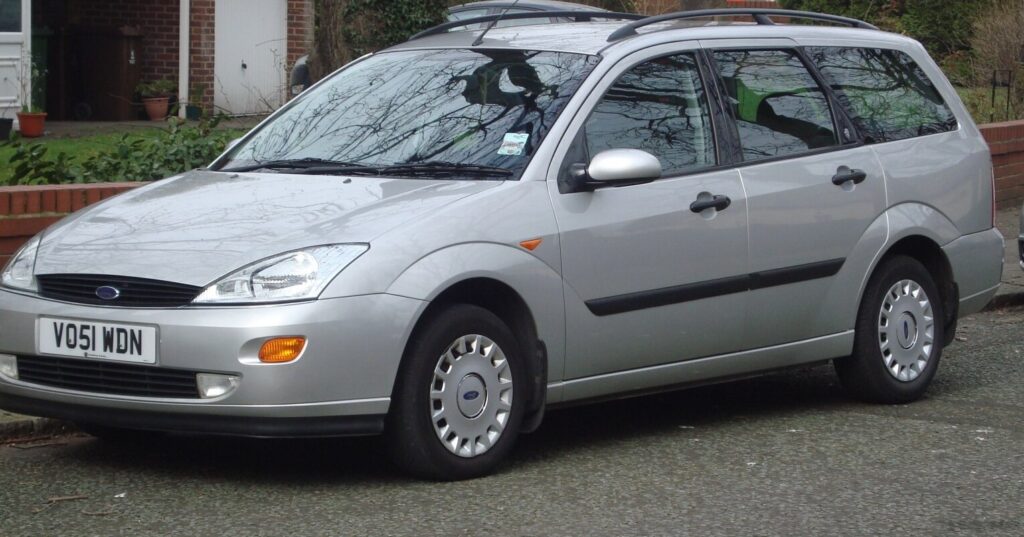
The Ford Focus Turnier I 2.0 16V, produced between 1999 and 2005, represents a significant offering in the first generation of the globally successful Focus range. As the station wagon (estate) variant, the Turnier aimed to provide practicality and versatility to Ford’s compact family car lineup. This particular 2.0-liter, 16-valve engine configuration, producing 131 horsepower, occupied a mid-range position within the Focus Turnier I portfolio, offering a balance between performance and fuel economy. It served as a step up from the base 1.4 and 1.6-liter engines, while remaining more accessible than the high-performance ST models that would arrive later.
Technical Specifications
| Brand | Ford |
| Model | Focus |
| Generation | Focus Turnier I |
| Type (Engine) | 2.0 16V (131 Hp) |
| Start of production | 1999 |
| End of production | 2005 |
| Powertrain Architecture | Internal Combustion engine |
| Body type | Station wagon (estate) |
| Seats | 5 |
| Doors | 5 |
| Fuel consumption (urban) | 11.8 l/100 km (19.9 US mpg) |
| Fuel consumption (extra urban) | 7.2 l/100 km (32.7 US mpg) |
| Fuel Type | Petrol (Gasoline) |
| Acceleration 0 – 100 km/h | 9.6 sec |
| Acceleration 0 – 62 mph | 9.6 sec |
| Acceleration 0 – 60 mph | 9.1 sec |
| Maximum speed | 201 km/h (124.9 mph) |
| Weight-to-power ratio | 9.1 kg/Hp |
| Weight-to-torque ratio | 6.9 kg/Nm |
| Power | 131 Hp @ 5500 rpm |
| Power per litre | 65.9 Hp/l |
| Torque | 173 Nm @ 4250 rpm (127.6 lb.-ft. @ 4250 rpm) |
| Engine layout | Front, Transverse |
| Engine Model/Code | EDDC, EDDB, EDDD, EDDF |
| Engine displacement | 1988 cm3 (121.32 cu. in.) |
| Number of cylinders | 4 |
| Engine configuration | Inline |
| Cylinder Bore | 84.8 mm (3.34 in.) |
| Piston Stroke | 88 mm (3.46 in.) |
| Compression ratio | 10:1 |
| Number of valves per cylinder | 4 |
| Fuel injection system | Multi-port manifold injection |
| Engine aspiration | Naturally aspirated engine |
| Valvetrain | DOHC |
| Engine oil capacity | 4.25 l (4.49 US qt | 3.74 UK qt) |
| Coolant | 5.75 l (6.08 US qt | 5.06 UK qt) |
| Kerb Weight | 1195 kg (2634.52 lbs.) |
| Max. weight | 1640 kg (3615.58 lbs.) |
| Max load | 445 kg (981.06 lbs.) |
| Trunk (boot) space – minimum | 520 l (18.36 cu. ft.) |
| Trunk (boot) space – maximum | 1580 l (55.8 cu. ft.) |
| Fuel tank capacity | 52 l (13.74 US gal | 11.44 UK gal) |
| Length | 4438 mm (174.72 in.) |
| Width | 1698 mm (66.85 in.) |
| Height | 1447 mm (56.97 in.) |
| Wheelbase | 2615 mm (102.95 in.) |
| Front track | 1484 mm (58.43 in.) |
| Rear (Back) track | 1477 mm (58.15 in.) |
| Drivetrain Architecture | Front wheel drive |
| Number of gears | 5 gears, manual transmission |
| Front suspension | Wishbone |
| Rear suspension | Coil spring |
| Front brakes | Ventilated discs |
| Rear brakes | Disc |
| Assisting systems | ABS (Anti-lock braking system) |
| Steering type | Steering rack and pinion |
| Power steering | Hydraulic Steering |
| Tires size | 185/65 R14 |
INTRODUCTION
The Ford Focus Turnier I 2.0 16V, launched in 1999, was a key component of Ford’s strategy to offer a modern and versatile compact family car. Built on the 1HX0/A3 platform, the Turnier body style – Ford’s term for a station wagon – expanded the Focus range’s appeal to buyers needing increased cargo capacity. This 2.0-liter variant aimed to bridge the gap between the more economical engines and the performance-oriented models, providing a practical and reasonably spirited driving experience. It was marketed towards families and individuals who required a flexible vehicle for both daily commuting and weekend activities.
Powertrain & Engine Architecture
At the heart of the Focus Turnier I 2.0 16V lies the Ford Zetec-E engine, specifically the EDDC, EDDB, EDDD, or EDDF code depending on the specific market and year of production. This 1.988-liter inline-four cylinder engine features a double overhead camshaft (DOHC) valvetrain with four valves per cylinder, contributing to its relatively high power output for its displacement. Fuel delivery is managed by a multi-port fuel injection system, ensuring efficient combustion and smooth power delivery. The engine’s 10:1 compression ratio strikes a balance between performance and fuel efficiency. The 131 horsepower and 173 Nm (127.6 lb-ft) of torque are respectable figures for a naturally aspirated engine of this size. The engine is transversely mounted, driving the front wheels. The standard transmission for this variant was a five-speed manual gearbox, although a four-speed automatic transmission was also available, albeit less common.
Driving Characteristics
The 2.0-liter engine in the Focus Turnier I provided a noticeable step up in performance compared to the smaller displacement engines. Acceleration to 60 mph took approximately 9.1 seconds, and the car could reach a top speed of 124.9 mph. While not a sports car, the 2.0-liter engine offered sufficient power for comfortable highway cruising and overtaking maneuvers. The five-speed manual transmission allowed drivers to effectively utilize the engine’s powerband, while the optional automatic transmission provided convenience, albeit at the expense of some responsiveness. The gear ratios were tuned for a balance of acceleration and fuel economy. Compared to the higher-output versions, the 2.0-liter felt less eager to rev, but offered a more relaxed and refined driving experience. The automatic transmission, while convenient, could feel somewhat sluggish, particularly during quick acceleration.
Equipment & Trim Levels
The Focus Turnier I 2.0 16V typically came equipped with a reasonable level of standard features. These included power steering, central locking, electric front windows, and an adjustable steering column. Interior upholstery was typically cloth, with a functional and durable design. Higher trim levels offered options such as air conditioning, alloy wheels, a CD player, and upgraded interior trim. The dashboard layout was straightforward and user-friendly, with clearly labeled controls. Safety features included ABS (Anti-lock Braking System) and driver and passenger airbags. The Turnier’s key selling point was its practicality, with a generous 520 liters of boot space (18.36 cu. ft.) that could be expanded to 1580 liters (55.8 cu. ft.) with the rear seats folded down.
Chassis & Braking
The Focus Turnier I utilized a MacPherson strut front suspension and a coil spring rear suspension. This setup provided a good balance of ride comfort and handling. The front brakes were ventilated discs, offering good stopping power, while the rear brakes were typically solid discs. The hydraulic power steering provided a light and responsive feel. The chassis was relatively lightweight, contributing to the car’s agility. Stabilizer bars were fitted to both the front and rear axles to reduce body roll during cornering. The 185/65 R14 tires provided adequate grip for most driving conditions.
Market Reception & Comparison
The Ford Focus Turnier I 2.0 16V was generally well-received by automotive critics. It was praised for its practicality, comfortable ride, and decent performance. However, some critics noted that the interior plastics felt somewhat low-rent and that the automatic transmission could be slow to respond. Compared to the 1.4 and 1.6-liter versions, the 2.0-liter offered a significant improvement in performance, making it a more enjoyable car to drive, especially on longer journeys. Fuel economy was comparable to other cars in its class, averaging around 23.9 mpg in the UK or 19.9 mpg in the US for urban driving and 39.2 mpg or 32.7 mpg for extra-urban driving. The 2.0-liter variant represented a sweet spot in the Focus Turnier I range, offering a good balance of performance, practicality, and affordability.
Legacy
The Ford Focus Turnier I 2.0 16V has proven to be a relatively reliable car, with many examples still on the road today. The Zetec-E engine is known for its durability, although regular maintenance is essential to prevent issues such as oil leaks and timing belt failure. The car’s simple mechanical design makes it relatively easy and affordable to repair. In the used car market, the 2.0-liter variant is often sought after by buyers looking for a practical and reliable family car with a bit more performance than the base models. While not a collector’s item, it remains a popular choice for those seeking a well-rounded and affordable station wagon.