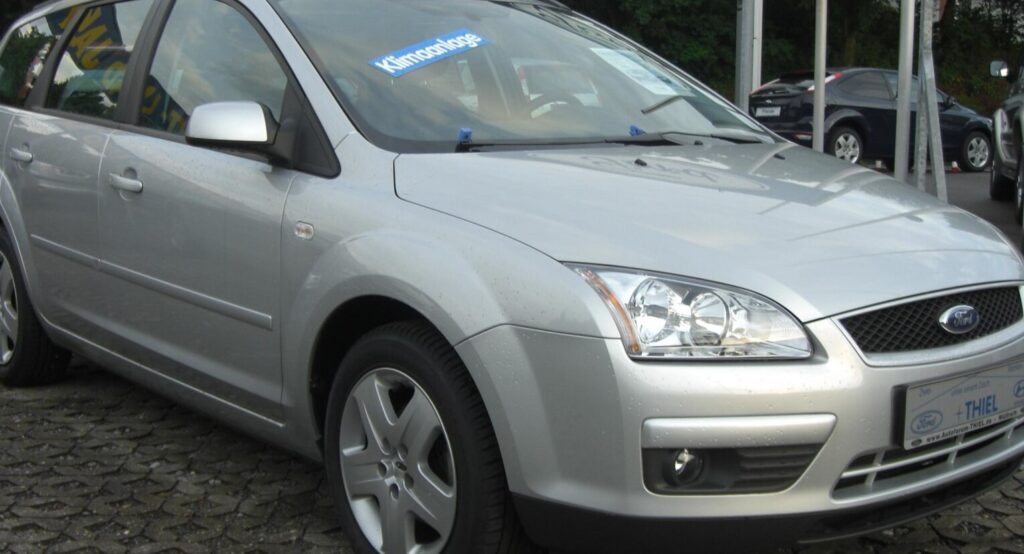
The Ford Focus Turnier II 1.6 TDCi 90 hp, produced between 2005 and 2010, represented an entry-level diesel option within the second generation Focus Turnier (estate) lineup. Positioned as a fuel-efficient and practical choice, it catered to buyers prioritizing economy over outright performance. This variant was a key component of Ford’s strategy to offer a broad range of Focus models to suit diverse European market demands, particularly for families and those requiring a versatile vehicle. It sat below the more powerful TDCi variants and the petrol-powered options in terms of price and performance.
Technical Specifications
| Brand | Ford |
| Model | Focus |
| Generation | Focus Turnier II |
| Type (Engine) | 1.6 TDCi (90 Hp) |
| Start of production | 2005 |
| End of production | 2010 |
| Powertrain Architecture | Internal Combustion engine |
| Body type | Station wagon (estate) |
| Seats | 5 |
| Doors | 5 |
| Fuel consumption (urban) | 5.9 l/100 km (39.9 US mpg, 47.9 UK mpg, 16.9 km/l) |
| Fuel consumption (extra urban) | 4 l/100 km (58.8 US mpg, 70.6 UK mpg, 25 km/l) |
| Fuel Type | Diesel |
| Acceleration 0 – 100 km/h | 12.9 sec |
| Acceleration 0 – 62 mph | 12.9 sec |
| Acceleration 0 – 60 mph | 12.3 sec |
| Maximum speed | 177 km/h (109.98 mph) |
| Weight-to-power ratio | 14.7 kg/Hp, 68.2 Hp/tonne |
| Weight-to-torque ratio | 6.5 kg/Nm, 154.5 Nm/tonne |
| Power | 90 Hp @ 4000 rpm |
| Power per litre | 57.7 Hp/l |
| Torque | 204 Nm @ 1750 rpm (150.46 lb.-ft. @ 1750 rpm) |
| Engine layout | Front, Transverse |
| Engine Model/Code | HHDA, HHDB, GPDA, GPDC |
| Engine displacement | 1560 cm3 (95.2 cu. in.) |
| Number of cylinders | 4 |
| Engine configuration | Inline |
| Cylinder Bore | 75 mm (2.95 in.) |
| Piston Stroke | 88.3 mm (3.48 in.) |
| Compression ratio | 18.3:1 |
| Number of valves per cylinder | 4 |
| Fuel injection system | Diesel Commonrail |
| Engine aspiration | Turbocharger, Intercooler |
| Engine oil capacity | 3.8 l (4.02 US qt | 3.34 UK qt) |
| Coolant | 7.3 l (7.71 US qt | 6.42 UK qt) |
| Kerb Weight | 1320 kg (2910.1 lbs.) |
| Max. weight | 1880 kg (4144.69 lbs.) |
| Max load | 560 kg (1234.59 lbs.) |
| Trunk (boot) space – minimum | 482 l (17.02 cu. ft.) |
| Trunk (boot) space – maximum | 1525 l (53.85 cu. ft.) |
| Fuel tank capacity | 55 l (14.53 US gal | 12.1 UK gal) |
| Length | 4472 mm (176.06 in.) |
| Width | 1840 mm (72.44 in.) |
| Height | 1501 mm (59.09 in.) |
| Wheelbase | 2640 mm (103.94 in.) |
| Front track | 1535 mm (60.43 in.) |
| Rear (Back) track | 1531 mm (60.28 in.) |
| Drivetrain Architecture | The Internal combustion engine (ICE) drives the front wheels of the vehicle. |
| Drive wheel | Front wheel drive |
| Number of gears and type of gearbox | 5 gears, manual transmission |
| Front suspension | Spring Strut |
| Rear suspension | Transverse stabilizer |
| Front brakes | Disc |
| Rear brakes | Disc |
| Assisting systems | ABS (Anti-lock braking system) |
| Steering type | Steering rack and pinion |
| Tires size | 195/65 R15 |
| Wheel rims size | 6JX15 |
INTRODUCTION
The Ford Focus Turnier II 1.6 TDCi 90 hp, launched in 2005 as part of the Mk2 Focus range, was a crucial model for Ford in the European market. The Turnier, Ford’s designation for the estate/wagon body style, offered increased practicality compared to the hatchback. This particular variant, powered by the 1.6-liter TDCi engine, aimed to provide a balance between fuel efficiency, reasonable performance, and affordability. It was built on the C170 platform, also known as the 1HX0 for the Focus range, and represented a significant step forward in terms of interior space and refinement compared to its predecessor.
Powertrain & Engine Architecture
The heart of this Focus variant is the 1.6-liter TDCi diesel engine, identified by engine codes such as HHDA, HHDB, GPDA, and GPDC. This engine is a four-cylinder, inline configuration, utilizing a common rail direct injection system. The common rail system, operating at very high pressures, allows for precise fuel delivery and optimized combustion. A turbocharger with an intercooler is employed to boost power output and improve torque. The engine features four valves per cylinder, contributing to its efficiency and responsiveness. The 90 hp output is achieved at 4000 rpm, while peak torque of 204 Nm (150.46 lb-ft) is delivered at a relatively low 1750 rpm. This torque curve provides good drivability in everyday situations. The engine is transversely mounted in the front of the vehicle. The 5-speed manual transmission was the standard offering for this trim, designed to efficiently transfer power to the front wheels.
Driving Characteristics
The 1.6 TDCi 90 hp Focus Turnier offered a comfortable, if not particularly exhilarating, driving experience. Acceleration from 0-60 mph took around 12.3 seconds, and top speed was approximately 109.98 mph. Compared to the higher-output TDCi variants (like the 115 hp version) or the petrol engines, this model felt noticeably slower, especially when fully loaded. However, the strong low-end torque made it well-suited for everyday driving and overtaking maneuvers on the highway. The gear ratios were optimized for fuel economy, meaning the engine often operated at lower revolutions. While the manual transmission was precise, it didn’t offer the sporty feel of some competitors. The focus was clearly on practicality and efficiency rather than dynamic performance.
Equipment & Trim Levels
The 1.6 TDCi 90 hp typically represented an entry-level trim within the Turnier range. Standard equipment generally included power steering, central locking, electric front windows, and an adjustable steering column. Air conditioning was often an optional extra. Interior upholstery was typically cloth, and the dashboard featured a functional, if somewhat basic, design. Higher trim levels offered upgrades such as alloy wheels, upgraded audio systems, and additional safety features. The Turnier’s estate body style provided a generous 482 liters of boot space (minimum), expanding to 1525 liters with the rear seats folded down, making it a practical choice for families and those needing to transport larger items.
Chassis & Braking
The Focus Turnier II utilized a MacPherson strut front suspension and a multi-link rear suspension, providing a good balance between ride comfort and handling. The suspension was tuned for everyday use, prioritizing comfort over sporty handling. Front and rear disc brakes provided adequate stopping power, assisted by an Anti-lock Braking System (ABS). The weight distribution was reasonably balanced, contributing to predictable handling characteristics. Stabilizer bars were fitted to both the front and rear axles to reduce body roll during cornering.
Market Reception & Comparison
The 1.6 TDCi 90 hp Focus Turnier was generally well-received by critics as a sensible and economical choice. It was praised for its fuel efficiency and practicality, but criticized for its lack of outright performance. Compared to the more powerful TDCi variants, it offered lower running costs but sacrificed acceleration and overall driving enjoyment. Against competitors like the Volkswagen Golf Estate and Opel/Vauxhall Astra Estate, the Focus offered a competitive package in terms of price, space, and fuel economy. Its reliability was generally considered good, although some owners reported issues with the diesel particulate filter (DPF) system, a common concern with modern diesel engines.
Legacy
The 1.6 TDCi 90 hp Focus Turnier II remains a relatively common sight on used car markets today. Its reputation for fuel efficiency and practicality continues to make it an attractive option for budget-conscious buyers. While the engine is generally reliable, potential buyers should be aware of the possibility of DPF issues and ensure regular maintenance has been carried out. The Turnier’s spacious interior and versatile cargo area ensure it remains a practical choice for families and those needing a versatile vehicle. The 1.6 TDCi engine, while not the most powerful, proved to be a durable and economical powerplant in the Focus lineup, contributing to the model’s overall success.