
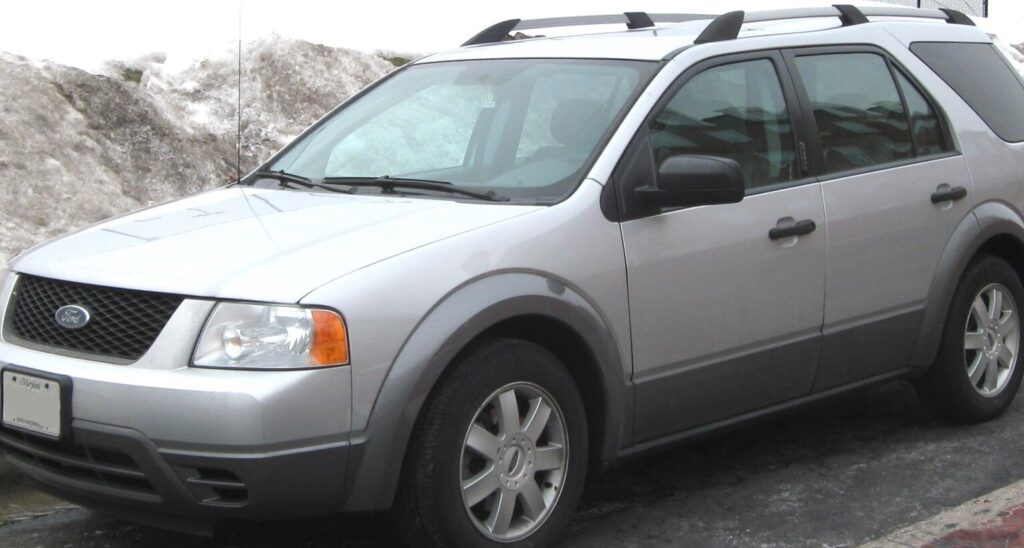
The Ford Freestyle 3.0 i V6 24V AWD, produced from 2005 to 2007, represented Ford’s entry into the burgeoning crossover SUV market. Built on the D3 platform, shared with the Ford Five Hundred and Mercury Montego, the Freestyle aimed to offer car-like handling with the versatility of an SUV, specifically targeting families needing three-row seating and all-weather capability. This variant, equipped with the 3.0-liter Duratec V6 engine and an automatic transmission, occupied a mid-range position within the Freestyle lineup, offering a balance between performance and fuel economy compared to the base 3.0L front-wheel drive model.
Technical Specifications
| Brand | Ford |
| Model | Freestyle |
| Generation | Freestyle |
| Type (Engine) | 3.0 i V6 24V (203 Hp) AWD |
| Start of production | 2005 |
| End of production | 2007 |
| Powertrain Architecture | Internal Combustion engine |
| Body type | Crossover |
| Seats | 7 |
| Doors | 5 |
| Fuel Type | Petrol (Gasoline) |
| Maximum speed | 180 km/h (111.85 mph) |
| Weight-to-power ratio | 9.2 kg/Hp, 108.8 Hp/tonne |
| Weight-to-torque ratio | 6.9 kg/Nm, 145.3 Nm/tonne |
| Power | 203 Hp @ 5650 rpm |
| Power per litre | 68.4 Hp/l |
| Torque | 271 Nm @ 4500 rpm (199.88 lb.-ft. @ 4500 rpm) |
| Engine layout | Front, Transverse |
| Engine displacement | 2967 cm3 (181.06 cu. in.) |
| Number of cylinders | 6 |
| Engine configuration | V-engine |
| Cylinder Bore | 89 mm (3.5 in.) |
| Piston Stroke | 79.5 mm (3.13 in.) |
| Compression ratio | 10:1 |
| Number of valves per cylinder | 4 |
| Fuel injection system | Multi-port manifold injection |
| Engine aspiration | Naturally aspirated engine |
| Valvetrain | DOHC |
| Engine oil capacity | 5.7 l (6.02 US qt | 5.02 UK qt) |
| Coolant | 11 l (11.62 US qt | 9.68 UK qt) |
| Kerb Weight | 1865 kg (4111.62 lbs.) |
| Trunk (boot) space – minimum | 1340 l (47.32 cu. ft.) |
| Trunk (boot) space – maximum | 4365 l (154.15 cu. ft.) |
| Fuel tank capacity | 72 l (19.02 US gal | 15.84 UK gal) |
| Length | 5075 mm (199.8 in.) |
| Width | 1855 mm (73.03 in.) |
| Height | 1650 mm (64.96 in.) |
| Wheelbase | 2870 mm (112.99 in.) |
| Front track | 1640 mm (64.57 in.) |
| Rear (Back) track | 1650 mm (64.96 in.) |
| Drivetrain Architecture | All wheel drive (4×4). ICE drives front wheels, rear wheels engaged via clutch. |
| Front suspension | Spring Strut |
| Rear suspension | Transverse stabilizer |
| Front brakes | Ventilated discs |
| Rear brakes | Disc |
| Assisting systems | ABS (Anti-lock braking system) |
| Steering type | Steering rack and pinion |
| Tires size | 215/60 R17 |
| Wheel rims size | 8J x 17 |
Powertrain & Engine Architecture
The heart of the Freestyle 3.0 AWD was the 3.0-liter Duratec V6 engine. This engine, designated as the 302, was a 60-degree V6 featuring a cast iron block and aluminum cylinder heads. It utilized a dual overhead camshaft (DOHC) valvetrain with four valves per cylinder, contributing to its respectable power output. Fuel delivery was managed by a multi-port fuel injection system. The engine produced 203 horsepower at 5650 rpm and 271 Nm (199.88 lb-ft) of torque at 4500 rpm. The engine was transversely mounted in the front of the vehicle. The automatic transmission paired with this engine was a 5-speed automatic, offering smooth shifts but not the most aggressive response. This transmission was chosen for its ease of use and suitability for family-oriented drivers.
Driving Characteristics
The 3.0L V6 and 5-speed automatic combination in the Freestyle AWD provided adequate, but not exhilarating, performance. Acceleration from 0 to 60 mph was estimated around 8.5-9.5 seconds. The automatic transmission’s gear ratios were tuned for comfort and fuel efficiency rather than outright speed. Compared to the front-wheel-drive Freestyle, the AWD version experienced a slight performance penalty due to the added weight and drivetrain losses. However, the all-wheel-drive system provided enhanced traction in inclement weather, making it a more confident vehicle in slippery conditions. The ride quality was generally comfortable, prioritizing a smooth experience over sporty handling.
Equipment & Trim Levels
The Freestyle 3.0 AWD typically came standard with features like air conditioning, power windows and locks, a CD player, and cloth upholstery. Higher trim levels, such as the Limited, added features like leather upholstery, heated front seats, a premium sound system, and alloy wheels. Optional extras included a DVD entertainment system, power liftgate, and a navigation system. Safety features included ABS brakes, front airbags, and side curtain airbags.
Chassis & Braking
The Freestyle’s chassis featured an independent front suspension with MacPherson struts and a multi-link independent rear suspension. This setup aimed to provide a comfortable ride and predictable handling. The AWD system utilized a viscous coupling to transfer torque to the rear wheels when needed. Braking duties were handled by ventilated discs at the front and solid discs at the rear. ABS was standard, providing enhanced braking control. The suspension was tuned for comfort, with a focus on absorbing bumps and providing a stable ride.
Market Reception & Comparison
The Ford Freestyle was generally well-received by critics as a practical and versatile crossover. However, the 3.0L V6 automatic combination was sometimes criticized for its lack of outright power and relatively slow acceleration. Compared to other crossovers of the time, such as the Toyota Highlander and Honda Pilot, the Freestyle offered a more affordable price point but lacked the refinement and performance of its Japanese competitors. Fuel economy was average for the class, with EPA estimates around 16 mpg city and 22 mpg highway. Reliability was generally considered acceptable, but some owners reported issues with the automatic transmission and the AWD system.
Legacy
The Ford Freestyle, while not a runaway sales success, played a role in establishing Ford’s presence in the growing crossover SUV market. The 3.0L Duratec V6 and 5-speed automatic powertrain proved to be reasonably durable, and many examples are still on the road today. However, due to its age, maintenance costs can be higher, and finding replacement parts may become increasingly challenging. In the used car market, the Freestyle 3.0 AWD represents an affordable option for families needing a spacious and capable vehicle, but potential buyers should be aware of the potential for age-related issues and the importance of a thorough pre-purchase inspection.
