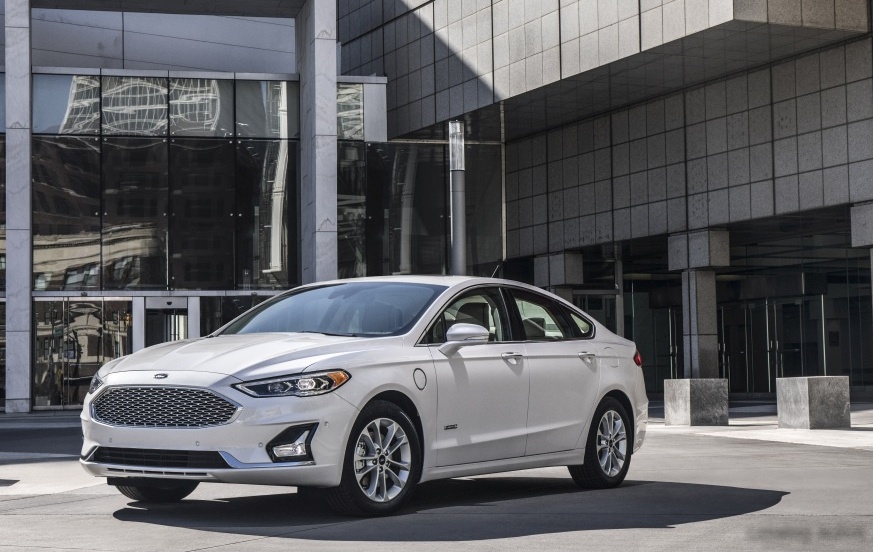
The Ford Fusion II, specifically the 1.5 EcoBoost (181 hp) SelectShift Start-Stop variant introduced with the 2018 facelift, represented a key offering in Ford’s mid-size sedan lineup for the North American market. Produced from 2018 onwards, this version aimed to balance fuel efficiency with respectable performance, slotting into the mid-range of the Fusion’s trim levels. It was positioned as an upgrade over the base 2.5L naturally aspirated engine, while remaining more accessible than the more powerful 2.0L EcoBoost and the Fusion Hybrid models. The Fusion II, built on the CD270 platform, was Ford’s attempt to create a globally appealing sedan, and the 1.5 EcoBoost played a significant role in attracting buyers seeking a modern, efficient, and well-equipped vehicle.
Technical Specifications
| Brand | Ford |
| Model | Fusion |
| Generation | Fusion II (facelift 2018) |
| Type (Engine) | 1.5 EcoBoost (181 Hp) SelectShift Start-Stop |
| Start of production | 2018 |
| Powertrain Architecture | Internal Combustion engine |
| Body type | Sedan |
| Seats | 5 |
| Doors | 4 |
| Fuel consumption (urban) | 10.2 l/100 km (23.1 US mpg) |
| Fuel consumption (extra urban) | 6.9 l/100 km (34.1 US mpg) |
| Fuel consumption (combined) | 8.7 l/100 km (27 US mpg) |
| Fuel Type | Petrol (Gasoline) |
| Weight-to-power ratio | 8.7 kg/Hp |
| Weight-to-torque ratio | 6.3 kg/Nm |
| Power | 181 Hp @ 6000 rpm |
| Power per litre | 120.7 Hp/l |
| Torque | 251 Nm @ 4320 rpm (185.13 lb.-ft. @ 4320 rpm) |
| Engine layout | Front, Transverse |
| Engine displacement | 1499 cm3 (91.47 cu. in.) |
| Number of cylinders | 4 |
| Engine configuration | Inline |
| Cylinder Bore | 79 mm (3.11 in.) |
| Piston Stroke | 76.45 mm (3.01 in.) |
| Compression ratio | 10:1 |
| Number of valves per cylinder | 4 |
| Fuel injection system | Direct injection |
| Engine aspiration | Turbocharger, Intercooler |
| Valvetrain | DOHC, Ti-VCT |
| Engine oil capacity | 4.05 l (4.28 US qt | 3.56 UK qt) |
| Coolant capacity | 10.3 l (10.88 US qt | 9.06 UK qt) |
| Kerb Weight | 1575 kg (3472.28 lbs.) |
| Trunk (boot) space | 453 l (16 cu. ft.) |
| Fuel tank capacity | 62 l (16.38 US gal | 13.64 UK gal) |
| Length | 4872 mm (191.81 in.) |
| Width | 1852 mm (72.91 in.) |
| Width with mirrors folded | 1910 mm (75.2 in.) |
| Width including mirrors | 2121 mm (83.5 in.) |
| Height | 1478 mm (58.19 in.) |
| Wheelbase | 2850 mm (112.2 in.) |
| Front track | 1593 mm (62.72 in.) |
| Rear track | 1585 mm (62.4 in.) |
| Drivetrain | Front wheel drive |
| Number of gears | 6 |
| Gearbox type | Automatic transmission SelectShift |
| Front suspension | Independent, McPherson with coil spring and anti-roll bar |
| Rear suspension | Independent multi-link suspension |
| Front brakes | Ventilated discs |
| Rear brakes | Disc |
| Tire size | 235/50 R17 |
| Wheel rims size | 17 |
Powertrain & Engine Architecture
The heart of this Fusion variant is the 1.5-liter EcoBoost inline-four cylinder engine, part of Ford’s EcoBoost family of turbocharged direct-injection engines. This engine, designated with various internal codes depending on the specific calibration, utilizes a single-scroll turbocharger and intercooler to boost power and efficiency. Direct fuel injection, combined with Ford’s Ti-VCT (Twin Independent Variable Camshaft Timing), optimizes combustion and allows for a relatively high compression ratio of 10:1. The engine produces 181 horsepower at 6000 rpm and 185 lb-ft of torque at 4320 rpm. The SelectShift six-speed automatic transmission, a crucial component of this package, is designed for smooth and responsive shifting. It features a manual shift mode allowing drivers some control over gear selection. The Start-Stop system, standard on this trim, automatically shuts off the engine when the vehicle is stationary to conserve fuel.
Driving Characteristics
The 1.5 EcoBoost automatic Fusion delivers a comfortable and generally refined driving experience. While not as overtly sporty as the 2.0L EcoBoost, it provides adequate acceleration for everyday driving situations. The turbocharger does introduce a slight amount of turbo lag, but the SelectShift transmission is generally quick to downshift and provide boost when needed. The automatic transmission’s gear ratios are tuned for fuel economy, meaning it prioritizes higher gears at cruising speeds. Compared to the manual transmission versions of the 1.5 EcoBoost, the automatic offers less driver engagement but greater convenience. The automatic also tends to feel slightly less responsive during quick acceleration maneuvers. The weight of the vehicle (approximately 3472 lbs) is noticeable, but the engine’s torque output helps to mitigate this.
Equipment & Trim Levels
The 1.5 EcoBoost SelectShift Start-Stop typically came standard with a respectable array of features. Interior appointments generally included cloth upholstery, though leather options were available. Standard equipment often included Ford’s SYNC infotainment system with a touchscreen display, Bluetooth connectivity, and a rearview camera. Higher trim levels, such as the SEL and Titanium, added features like heated seats, a premium sound system, and advanced driver-assistance systems (ADAS) such as blind-spot monitoring and lane-keeping assist. Optional extras for the 1.5 EcoBoost included a sunroof, navigation system, and upgraded wheels.
Chassis & Braking
The Fusion II utilizes an independent front suspension with McPherson struts and a multi-link independent rear suspension. This setup provides a good balance of ride comfort and handling. The front suspension incorporates a coil spring and anti-roll bar to reduce body roll during cornering. Braking duties are handled by ventilated discs at the front and solid discs at the rear. Anti-lock brakes (ABS) are standard, as is electronic stability control. The steering system is an electric power-assisted rack and pinion setup, providing light and precise steering feel.
Market Reception & Comparison
The 1.5 EcoBoost automatic Fusion was generally well-received by automotive critics as a sensible and practical choice in the mid-size sedan segment. It was praised for its fuel efficiency, comfortable ride, and well-equipped interior. However, some reviewers noted that the engine could feel strained when pushed hard, and the automatic transmission wasn’t as engaging as some competitors. Compared to the 2.5L base engine, the 1.5 EcoBoost offered a significant performance upgrade with only a modest decrease in fuel economy. Compared to the 2.0L EcoBoost, it provided a more affordable entry point into the Fusion lineup, albeit with less power. Reliability reports generally indicated that the 1.5 EcoBoost engine and SelectShift transmission were reasonably reliable, though some owners reported minor issues with the Start-Stop system.
Legacy
The Ford Fusion II, including the 1.5 EcoBoost variant, was discontinued in 2020 as Ford shifted its focus towards SUVs and trucks. On the used car market, these models represent a good value proposition for buyers seeking a comfortable, fuel-efficient, and well-equipped mid-size sedan. The 1.5 EcoBoost engine, while not known for being exceptionally durable, has proven to be generally reliable with proper maintenance. The SelectShift transmission has also held up well over time. However, potential buyers should be aware of the potential for issues with the Start-Stop system and ensure that all scheduled maintenance has been performed. The Fusion II, and particularly the 1.5 EcoBoost, remains a popular choice for those seeking a practical and affordable used car.