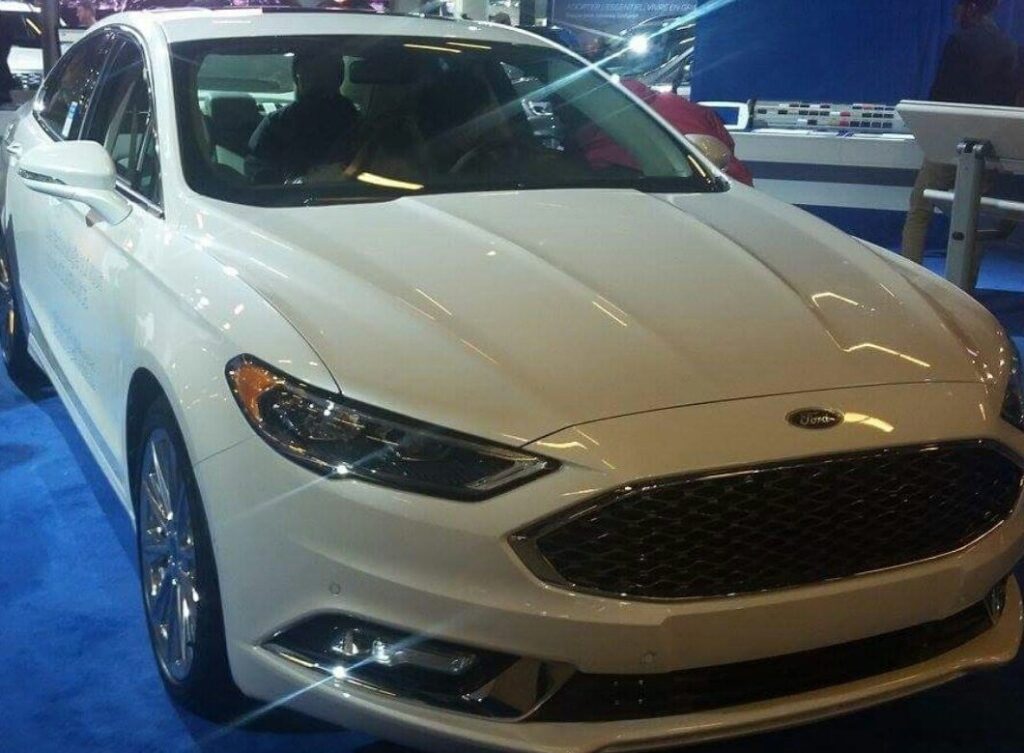
The Ford Fusion II, specifically the 2.0-liter (188 hp) Atkinson cycle hybrid variant with an eCVT transmission, represented a significant step in Ford’s commitment to fuel efficiency and hybrid technology within the mid-size sedan segment. Produced from 2016 to 2018 as part of the facelifted second generation (introduced in 2013), this model aimed to provide a compelling alternative to traditional gasoline-powered vehicles, appealing to environmentally conscious consumers without sacrificing mainstream practicality. It occupied a mid-to-upper trim level within the Fusion lineup, offering a more sophisticated and fuel-efficient option compared to the base 2.5-liter engine, but positioned below the more luxurious and performance-oriented trims.
Technical Specifications
| Brand | Ford |
| Model | Fusion |
| Generation | Fusion II (facelift 2016) |
| Type (Engine) | 2.0 (188 Hp) Atkinson Hybrid eCVT |
| Start of production | 2016 |
| End of production | 2018 |
| Powertrain Architecture | FHEV (Full Hybrid Electric Vehicle) |
| Body type | Sedan |
| Seats | 5 |
| Doors | 4 |
| Fuel consumption (urban) | 5.4 l/100 km (43.6 US mpg, 52.3 UK mpg, 18.5 km/l) |
| Fuel consumption (extra urban) | 5.7 l/100 km (41.3 US mpg, 49.6 UK mpg, 17.5 km/l) |
| Fuel consumption (combined) | 5.6 l/100 km (42 US mpg, 50.4 UK mpg, 17.9 km/l) |
| Fuel Type | Petrol (Gasoline) |
| Weight-to-power ratio | 8.9 kg/Hp, 113 Hp/tonne |
| Weight-to-torque ratio | 9.5 kg/Nm, 105.2 Nm/tonne |
| Gross battery capacity | 1.4 kWh |
| Battery technology | Lithium-ion (Li-Ion) |
| Max speed (electric) | 137 km/h (85.13 mph) |
| Electric motor power | 120 Hp |
| Electric motor type | Synchronous |
| System power | 188 Hp |
| Power | 141 Hp @ 6000 rpm |
| Power per litre | 70.5 Hp/l |
| Torque | 175 Nm @ 4000 rpm (129.07 lb.-ft. @ 4000 rpm) |
| Engine layout | Front, Transverse |
| Engine displacement | 1999 cm3 (121.99 cu. in.) |
| Number of cylinders | 4 |
| Engine configuration | Inline |
| Cylinder Bore | 87.5 mm (3.44 in.) |
| Piston Stroke | 83.1 mm (3.27 in.) |
| Compression ratio | 12.3:1 |
| Number of valves per cylinder | 4 |
| Fuel injection system | Multi-port manifold injection |
| Engine aspiration | Naturally aspirated engine |
| Valvetrain | iVCT, DOHC, Atkinson cycle |
| Engine oil capacity | 4.3 l (4.54 US qt | 3.78 UK qt) |
| Coolant | 8.5 l (8.98 US qt | 7.48 UK qt) |
| Kerb Weight | 1664 kg (3668.49 lbs.) |
| Trunk (boot) space – minimum | 340 l (12.01 cu. ft.) |
| Fuel tank capacity | 53 l (14 US gal | 11.66 UK gal) |
| Length | 4872 mm (191.81 in.) |
| Width | 1852 mm (72.91 in.) |
| Width including mirrors | 2121 mm (83.5 in.) |
| Height | 1473 mm (57.99 in.) |
| Wheelbase | 2850 mm (112.2 in.) |
| Front track | 1582 mm (62.28 in.) |
| Rear (Back) track | 1575 mm (62.01 in.) |
| Minimum turning circle (turning diameter) | 11.5 m (37.73 ft.) |
| Drivetrain Architecture | The Internal combustion engine (ICE) and electric motor drive the front wheels of the car with the ability to work in full electric or mixed mode. |
| Drive wheel | Front wheel drive |
| Number of gears and type of gearbox | automatic transmission eCVT |
| Front suspension | Independent, type McPherson with coil spring and anti-roll bar |
| Rear suspension | Independent multi-link suspension |
| Front brakes | Ventilated discs |
| Rear brakes | Disc |
| Assisting systems | ABS (Anti-lock braking system) |
| Steering type | Steering rack and pinion |
| Tires size | 225/50 R17 |
| Wheel rims size | 17 |
INTRODUCTION
The 2016-2018 Ford Fusion Hybrid 2.0L represented a significant evolution of Ford’s hybrid technology. Built on the second-generation Fusion platform (introduced in 2013 and facelifted in 2016), this variant combined a 2.0-liter Atkinson cycle four-cylinder engine with an electric motor and a lithium-ion battery pack. The result was a full hybrid (FHEV) system capable of operating in electric-only mode at lower speeds, providing substantial fuel economy improvements over traditional gasoline engines. This model was primarily targeted at the North American market, where fuel efficiency and environmental concerns were increasingly influencing consumer purchasing decisions. The facelift brought updated styling and enhanced technology features, further solidifying the Fusion’s position as a competitive offering in the mid-size sedan class.
Powertrain & Engine Architecture
At the heart of the Fusion Hybrid 2.0L lies the 2.0-liter inline-four cylinder engine, designated with various internal codes depending on the specific production run. This engine utilizes a sophisticated Atkinson cycle design, which prioritizes efficiency over outright power by delaying the closing of the intake valves. This allows for a more complete expansion of the combustion gases, extracting more energy from the fuel. The engine features multi-port fuel injection and a double overhead camshaft (DOHC) valvetrain with Ford’s intelligent Variable Camshaft Timing (iVCT) system. This system optimizes valve timing based on engine speed and load, further enhancing efficiency and responsiveness. The electric motor, a synchronous type, delivers 120 horsepower and works in conjunction with the gasoline engine to provide a combined system output of 188 horsepower. The power is seamlessly managed by an electronically controlled continuously variable transmission (eCVT), which eliminates traditional gear changes for smooth and efficient power delivery. The 1.4 kWh lithium-ion battery pack is strategically positioned to minimize impact on interior space and provides sufficient energy for electric-only driving under certain conditions.
Driving Characteristics
The driving experience in the Fusion Hybrid 2.0L is characterized by smoothness and quiet operation. The eCVT provides seamless acceleration, although it lacks the immediate responsiveness of a traditional automatic transmission. The electric motor provides instant torque, contributing to brisk acceleration from a standstill and assisting the gasoline engine during passing maneuvers. While not a performance-oriented vehicle, the 188 horsepower system output provides adequate power for everyday driving situations. Compared to the base 2.5-liter Fusion, the hybrid offers noticeably improved fuel economy, particularly in city driving. The hybrid system automatically manages the transition between gasoline and electric power, optimizing efficiency based on driving conditions. The steering is light and precise, and the suspension provides a comfortable ride, absorbing bumps and imperfections in the road surface effectively. Compared to higher-output Fusion models, such as those equipped with the 2.5L turbo, the hybrid prioritizes efficiency over outright performance.
Equipment & Trim Levels
The Fusion Hybrid 2.0L was typically offered in well-equipped trim levels, often including features such as Ford’s SYNC infotainment system with a touchscreen display, Bluetooth connectivity, and a rearview camera. Standard features also included automatic climate control, power windows and locks, and keyless entry. Higher trim levels added features such as leather upholstery, heated front seats, a premium sound system, and advanced safety technologies like blind-spot monitoring and lane-keeping assist. Optional extras included a sunroof, navigation system, and adaptive cruise control. Interior upholstery typically consisted of cloth or leather, with a focus on comfort and durability. The dashboard layout was clean and modern, with intuitive controls and a user-friendly interface.
Chassis & Braking
The Fusion Hybrid 2.0L utilizes an independent front suspension with McPherson struts and a multi-link independent rear suspension. This setup provides a comfortable ride and good handling characteristics. The front suspension incorporates a coil spring and anti-roll bar to reduce body roll during cornering. The braking system consists of ventilated discs at the front and solid discs at the rear, providing adequate stopping power. An Anti-lock Braking System (ABS) is standard, enhancing safety and control during emergency braking situations. The steering system employs a rack-and-pinion design, offering precise and responsive steering feel. The vehicle is equipped with 17-inch alloy wheels and 225/50 R17 tires, providing a balance of comfort and grip.
Market Reception & Comparison
The Ford Fusion Hybrid 2.0L was generally well-received by automotive critics, who praised its fuel efficiency, comfortable ride, and well-equipped interior. However, some reviewers noted that the eCVT transmission could feel somewhat sluggish compared to traditional automatic transmissions. Compared to other hybrid sedans in its class, such as the Toyota Camry Hybrid and Honda Accord Hybrid, the Fusion Hybrid offered a competitive combination of fuel economy, features, and price. The Fusion Hybrid typically achieved slightly lower fuel economy ratings than its Toyota and Honda rivals, but it offered a more stylish design and a more engaging driving experience. Reliability ratings were generally good, although some owners reported minor issues with the hybrid system components.
Legacy
The Ford Fusion Hybrid 2.0L represents a significant milestone in Ford’s development of hybrid technology. While the Fusion itself was discontinued in 2020, the lessons learned from the development of this hybrid powertrain have informed Ford’s subsequent hybrid and electric vehicle offerings. The 2.0L Atkinson cycle engine and eCVT transmission proved to be a reliable and efficient combination, and the Fusion Hybrid remains a popular choice among used car buyers seeking a fuel-efficient and well-equipped mid-size sedan. The vehicle’s legacy lies in its contribution to the growing adoption of hybrid technology and its demonstration of Ford’s commitment to sustainable transportation.