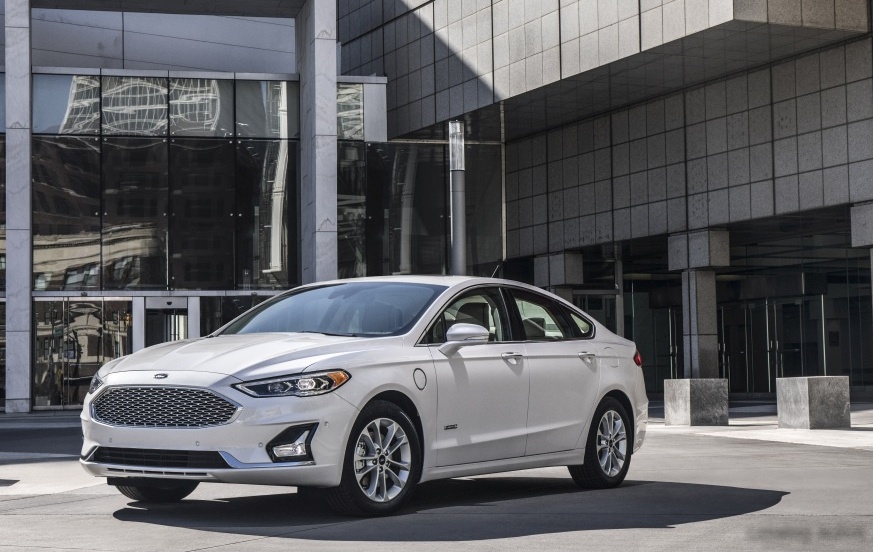
The Ford Fusion II, specifically the 2.0 EcoBoost (240 Hp) SelectShift variant introduced with the 2018 facelift, represents a significant iteration of Ford’s mid-size sedan. Production began in 2018 and continued until the Fusion’s discontinuation in North America. This model occupied a premium position within the Fusion lineup, offering a blend of performance and technology aimed at buyers seeking a more engaging driving experience than the base engine options provided. It was built on the CD2 platform, shared with the Mazda 6 and earlier Ford Mondeos, and designed to compete with established players like the Toyota Camry, Honda Accord, and Hyundai Sonata in the highly competitive American family sedan market.
Technical Specifications
| Brand | Ford |
| Model | Fusion |
| Generation | Fusion II (facelift 2018) |
| Type (Engine) | 2.0 EcoBoost (240 Hp) SelectShift |
| Start of production | 2018 |
| Powertrain Architecture | Internal Combustion engine |
| Body type | Sedan |
| Seats | 5 |
| Doors | 4 |
| Fuel consumption (economy) – urban | 11.2 l/100 km (21 US mpg, 25.2 UK mpg, 8.9 km/l) |
| Fuel consumption (economy) – extra urban | 7.5 l/100 km (31.4 US mpg, 37.7 UK mpg, 13.3 km/l) |
| Fuel consumption (economy) – combined | 9.4 l/100 km (25 US mpg, 30.1 UK mpg, 10.6 km/l) |
| Fuel Type | Petrol (Gasoline) |
| Power | 240 Hp @ 5500 rpm |
| Power per litre | 120.1 Hp/l |
| Torque | 373 Nm @ 3000 rpm (275.11 lb.-ft. @ 3000 rpm) |
| Engine layout | Front, Transverse |
| Engine displacement | 1999 cm3 (121.99 cu. in.) |
| Number of cylinders | 4 |
| Engine configuration | Inline |
| Cylinder Bore | 87.5 mm (3.44 in.) |
| Piston Stroke | 83.1 mm (3.27 in.) |
| Compression ratio | 9.3:1 |
| Number of valves per cylinder | 4 |
| Fuel injection system | Direct injection |
| Engine aspiration | Turbocharger, Intercooler |
| Valvetrain | DOHC, Ti-VCT |
| Engine oil capacity | 5.4 l (5.71 US qt | 4.75 UK qt) |
| Coolant | 8 l (8.45 US qt | 7.04 UK qt) |
| Trunk (boot) space – minimum | 453 l (16 cu. ft.) |
| Fuel tank capacity | 62 l (16.38 US gal | 13.64 UK gal) |
| Length | 4872 mm (191.81 in.) |
| Width | 1852 mm (72.91 in.) |
| Width with mirrors folded | 1910 mm (75.2 in.) |
| Width including mirrors | 2121 mm (83.5 in.) |
| Height | 1478 mm (58.19 in.) |
| Wheelbase | 2850 mm (112.2 in.) |
| Front track | 1593 mm (62.72 in.) |
| Rear (Back) track | 1585 mm (62.4 in.) |
| Drivetrain Architecture | Front wheel drive |
| Number of gears and type of gearbox | 6 gears, automatic transmission SelectShift |
| Front suspension | Independent, type McPherson with coil spring and anti-roll bar |
| Rear suspension | Independent multi-link suspension |
| Front brakes | Ventilated discs |
| Rear brakes | Disc |
| Tires size | 235/40 R19 |
| Wheel rims size | 19 |
Powertrain & Engine Architecture
At the heart of the 2018 Fusion 2.0 EcoBoost lies the Ford EcoBoost 2.0-liter inline-four cylinder engine. This engine, part of Ford’s EcoBoost family, utilizes direct fuel injection and a single twin-scroll turbocharger with an integrated intercooler. The engine code is generally identified as GTDI. The Ti-VCT (Twin Independent Variable Camshaft Timing) system optimizes valve timing for improved performance and fuel efficiency across the rev range. The 2.0L engine produces 240 horsepower at 5500 rpm and 275 lb-ft of torque at 3000 rpm. This power is delivered through a six-speed “SelectShift” automatic transmission, which includes paddle shifters for manual gear selection. The SelectShift transmission is designed to provide smooth and responsive shifts, adapting to driving conditions and driver input.
Driving Characteristics
The 2.0 EcoBoost SelectShift Fusion offered a noticeably more spirited driving experience compared to the base 2.5-liter naturally aspirated engine. The turbocharger provides a substantial boost in mid-range torque, making for effortless acceleration in everyday driving situations and confident passing maneuvers. While not a sports sedan, the 240 hp output and well-tuned automatic transmission allowed for 0-60 mph times in the low-to-mid 6-second range. The six-speed automatic transmission is well-geared, keeping the engine in its optimal power band. Compared to the manual transmission options available on other Fusion trims, the automatic prioritized comfort and ease of use over outright performance, but the paddle shifters offered some degree of driver control.
Equipment & Trim Levels
The 2.0 EcoBoost trim typically included features such as leather upholstery, heated front seats, a premium audio system (often Sony branded), and Ford’s SYNC 3 infotainment system with an 8-inch touchscreen. Standard safety features included blind-spot monitoring, rear cross-traffic alert, and lane-keeping assist. Optional extras included a sunroof, navigation system, and adaptive cruise control. The 2.0 EcoBoost was often bundled with appearance packages that included unique alloy wheel designs and exterior trim accents.
Chassis & Braking
The Fusion’s chassis featured an independent McPherson strut front suspension and an independent multi-link rear suspension. This setup provided a comfortable ride while maintaining reasonably good handling characteristics. The 2.0 EcoBoost models typically came equipped with larger diameter wheels and tires (often 19-inch) compared to lower trims, contributing to improved grip and stability. Braking duties were handled by ventilated discs at the front and solid discs at the rear. Anti-lock brakes (ABS) and electronic stability control (ESC) were standard equipment.
Market Reception & Comparison
Critics generally praised the 2.0 EcoBoost Fusion for its strong performance and refined driving experience. The engine was considered a significant upgrade over the base engine, providing ample power for most drivers. Fuel economy was respectable, averaging around 25 mpg combined, although it was slightly lower than the base engine due to the increased power output. Compared to rivals like the Honda Accord and Toyota Camry, the Fusion offered a more European-inspired driving feel and a more stylish interior design. However, some reviewers noted that the Fusion’s infotainment system wasn’t as intuitive as those found in some competitors.
Legacy
The 2.0 EcoBoost engine proved to be a relatively reliable powertrain, although some owners have reported issues with the turbocharger and fuel injectors over the long term. Regular maintenance, including oil changes and timely replacement of wear items, is crucial for ensuring the longevity of this engine. On the used car market, the 2018 and later Fusion 2.0 EcoBoost models hold their value reasonably well, appealing to buyers who prioritize performance and features. While Ford discontinued the Fusion in North America, the model remains a popular choice for those seeking a well-rounded and capable mid-size sedan.