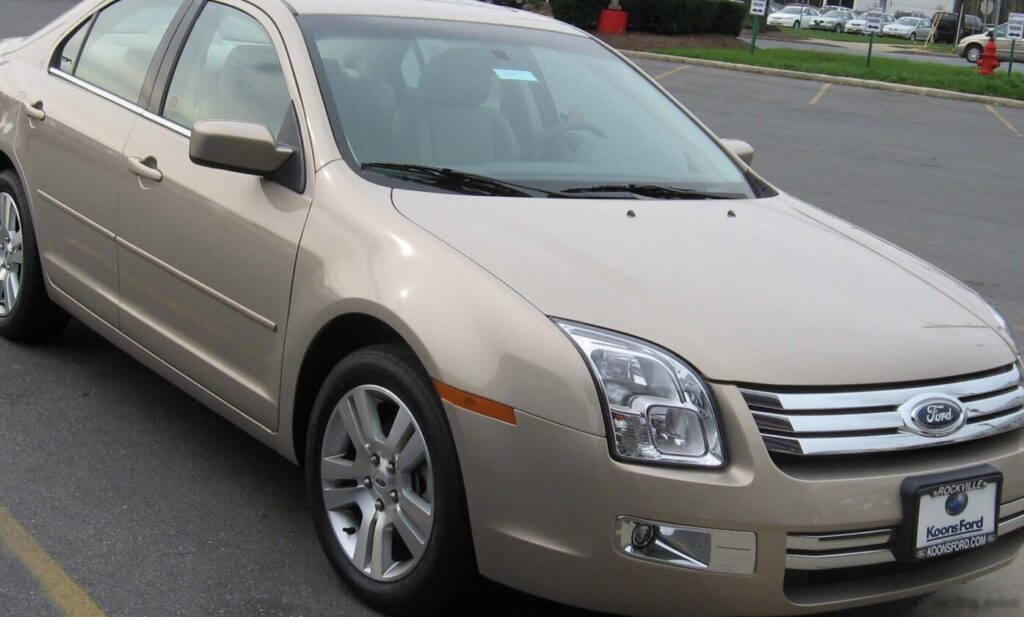
The Ford Fusion 3.0 i V6 24V, producing 212 horsepower, was a mid-range offering in the first generation (2006-2012) of the North American Ford Fusion. Introduced for the 2006 model year and continuing through 2009, this variant aimed to provide a balance between performance and comfort for buyers seeking an upgrade from the base four-cylinder models. It occupied a position above the 2.3L inline-four, but below the more expensive and often better-equipped hybrid variants. The Fusion, designed as a replacement for both the Ford Taurus and Mercury Sable, was Ford’s attempt to create a modern, competitive mid-size sedan, and the 3.0L V6 played a key role in attracting customers desiring more power.
Technical Specifications
| Brand | Ford |
| Model | Fusion |
| Generation | Fusion (USA) |
| Type (Engine) | 3.0 i V6 24V (212 Hp) |
| Start of production | 2005 year |
| End of production | 2009 year |
| Powertrain Architecture | Internal Combustion engine |
| Body type | Sedan |
| Seats | 5 |
| Doors | 4 |
| Fuel Type | Petrol (Gasoline) |
| Maximum speed | 180 km/h (111.85 mph) |
| Weight-to-power ratio | 7.2 kg/Hp, 138.1 Hp/tonne |
| Weight-to-torque ratio | 5.7 kg/Nm, 176.5 Nm/tonne |
| Power | 212 Hp @ 6250 rpm |
| Power per litre | 71.5 Hp/l |
| Torque | 271 Nm @ 4750 rpm (199.88 lb.-ft. @ 4750 rpm) |
| Engine layout | Front, Transverse |
| Engine displacement | 2967 cm3 (181.06 cu. in.) |
| Number of cylinders | 6 |
| Engine configuration | V-engine |
| Cylinder Bore | 89 mm (3.5 in.) |
| Piston Stroke | 79.5 mm (3.13 in.) |
| Compression ratio | 10:1 |
| Number of valves per cylinder | 4 |
| Fuel injection system | Multi-port manifold injection |
| Engine aspiration | Naturally aspirated engine |
| Valvetrain | DOHC |
| Engine oil capacity | 5.7 l (6.02 US qt | 5.02 UK qt) |
| Coolant | 9.2 l (9.72 US qt | 8.09 UK qt) |
| Kerb Weight | 1535 kg (3384.1 lbs) |
| Trunk (boot) space – minimum | 448 l (15.82 cu. ft.) |
| Fuel tank capacity | 68 l (17.96 US gal | 14.96 UK gal) |
| Length | 4831 mm (190.2 in.) |
| Width | 1834 mm (72.2 in.) |
| Height | 1417 mm (55.79 in.) |
| Wheelbase | 2728 mm (107.4 in.) |
| Front track | 1565 mm (61.61 in.) |
| Rear (Back) track | 1557 mm (61.3 in.) |
| Drivetrain Architecture | The Internal combustion engine (ICE) drives the front wheels of the vehicle. |
| Drive wheel | Front wheel drive |
| Number of gears and type of gearbox | 6 gears, automatic transmission |
| Front suspension | Coil spring |
| Rear suspension | Coil spring |
| Front brakes | Disc |
| Rear brakes | Disc |
| Assisting systems | ABS (Anti-lock braking system) |
| Steering type | Steering rack and pinion |
| Tires size | 205/60 R16 |
| Wheel rims size | 16 |
Powertrain & Engine Architecture
The heart of the Fusion 3.0 i is the Duratec 30 V6 engine. This engine, part of Ford’s Duratec family, is a 60-degree V6 featuring a cast iron block and aluminum cylinder heads. It utilizes a dual overhead camshaft (DOHC) valvetrain with four valves per cylinder, contributing to its relatively high output for its displacement. Fuel delivery is managed by a multi-port fuel injection system, providing precise fuel metering for optimal combustion. The engine’s 3.0-liter displacement (2967 cc) is achieved with a bore of 89 mm and a stroke of 79.5 mm. The 10:1 compression ratio strikes a balance between performance and fuel efficiency. Paired with this engine is a six-speed automatic transmission, designed to provide smooth shifts and efficient power delivery. This transmission was a significant upgrade from the four-speed automatics found in earlier Ford models.
Driving Characteristics
The 3.0L V6-equipped Fusion offered a noticeable improvement in acceleration and overall responsiveness compared to the base 2.3L four-cylinder. While not a sports car, the 212 horsepower and 199.88 lb-ft of torque provided ample power for highway merging, passing maneuvers, and everyday driving. The six-speed automatic transmission helped to keep the engine in its optimal power band, although some reviewers noted that it could occasionally feel hesitant during downshifts. The automatic transmission’s gear ratios were tuned for a balance of fuel economy and performance, prioritizing smooth cruising over aggressive acceleration. Compared to the manual transmission options available on other Fusion trims, the automatic version offered greater convenience but slightly diminished fuel economy and a less engaging driving experience.
Equipment & Trim Levels
The Fusion 3.0 i V6 typically came standard with features such as air conditioning, power windows and locks, a CD player with an auxiliary input, and keyless entry. Higher trim levels, such as the SEL and Limited, added features like leather upholstery, a sunroof, upgraded audio systems, and automatic climate control. Optional extras included a navigation system, heated seats, and a premium sound system. Interior upholstery generally consisted of cloth on the base models, with leather becoming standard on the higher trims. The dashboard layout was functional and straightforward, prioritizing ease of use over flashy design.
Chassis & Braking
The Fusion’s chassis featured an independent front suspension with coil springs and a multi-link rear suspension, also utilizing coil springs. This suspension setup provided a comfortable ride quality while maintaining reasonable handling characteristics. The 3.0L V6 models typically came equipped with disc brakes on all four wheels, offering adequate stopping power for the vehicle’s weight and performance. An Anti-lock Braking System (ABS) was standard, enhancing safety during emergency braking situations. The Fusion’s steering utilized a rack-and-pinion system, providing precise and responsive steering feel.
Market Reception & Comparison
The Fusion 3.0 i V6 was generally well-received by automotive critics as a competent and comfortable mid-size sedan. Reviewers praised its smooth engine, comfortable ride, and spacious interior. However, some criticized its somewhat bland styling and lack of a truly sporty driving experience. Compared to competitors like the Honda Accord and Toyota Camry, the Fusion offered a more Americanized driving experience, prioritizing comfort over outright handling precision. Fuel economy was respectable for a V6-powered sedan, but not class-leading. Reliability was generally good, although some owners reported minor issues with the automatic transmission and electrical components.
Legacy
The Ford Fusion 3.0 i V6, while not a groundbreaking vehicle, played an important role in establishing the Fusion as a viable competitor in the mid-size sedan segment. The Duratec 30 V6 engine proved to be a reliable and durable powerplant, and many examples are still on the road today. In the used car market, these Fusions are often sought after by buyers looking for a comfortable, affordable, and relatively powerful sedan. While maintenance costs may be slightly higher than those of the four-cylinder models, the added performance and refinement of the V6 engine make it a worthwhile option for many buyers. The Fusion’s success paved the way for future generations of the model, solidifying its position as a popular choice among American car buyers.