
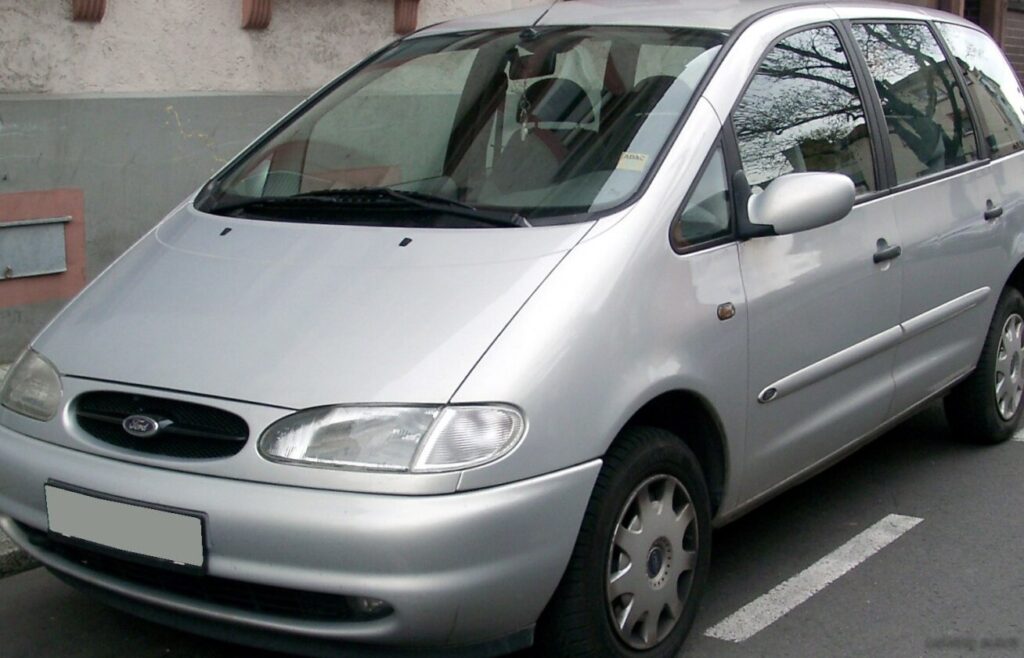
The Ford Galaxy I 1.9 TDI, produced between 1997 and 2000, represents a significant entry into the people-carrier market for Ford. Developed in collaboration with Volkswagen, the Galaxy shared its platform (the Mk1 VW Sharan and SEAT Alhambra) and many components, offering Ford a competitive vehicle in the burgeoning multi-purpose vehicle (MPV) segment, particularly popular in Europe. This variant, equipped with the 1.9-liter turbocharged diesel engine producing 110 horsepower, was positioned as a practical and economical choice for families needing space and versatility. It aimed to balance fuel efficiency with adequate performance for long journeys and everyday use.
Technical Specifications
| Brand | Ford |
| Model | Galaxy |
| Generation | Galaxy I |
| Type (Engine) | 1.9 TDI (110 Hp) |
| Start of production | 1997 |
| End of production | 2000 |
| Powertrain Architecture | Internal Combustion engine |
| Body type | Minivan |
| Seats | 7 |
| Doors | 5 |
| Fuel consumption (urban) | 7.8 l/100 km (30.2 US mpg, 36.2 UK mpg, 12.8 km/l) |
| Fuel consumption (extra urban) | 5.4 l/100 km (43.6 US mpg, 52.3 UK mpg, 18.5 km/l) |
| Fuel consumption (combined) | 6.7 l/100 km (35.1 US mpg, 42.2 UK mpg, 14.9 km/l) |
| Fuel Type | Diesel |
| Acceleration 0 – 100 km/h | 14.7 sec |
| Acceleration 0 – 62 mph | 14.7 sec |
| Acceleration 0 – 60 mph | 14 sec |
| Maximum speed | 172 km/h (106.88 mph) |
| Weight-to-power ratio | 14.9 kg/Hp, 67.1 Hp/tonne |
| Weight-to-torque ratio | 7 kg/Nm, 143.3 Nm/tonne |
| Power | 110 Hp @ 4150 rpm |
| Power per litre | 58 Hp/l |
| Torque | 235 Nm @ 1900 rpm (173.33 lb.-ft. @ 1900 rpm) |
| Engine layout | Front, Transverse |
| Engine Model/Code | AFN, AVG |
| Engine displacement | 1896 cm3 (115.7 cu. in.) |
| Number of cylinders | 4 |
| Engine configuration | Inline |
| Cylinder Bore | 79.5 mm (3.13 in.) |
| Piston Stroke | 95.5 mm (3.76 in.) |
| Compression ratio | 19.5:1 |
| Number of valves per cylinder | 2 |
| Fuel injection system | Direct injection |
| Engine aspiration | Turbocharger, Intercooler |
| Valvetrain | SOHC |
| Engine oil capacity | 4.3 l (4.54 US qt | 3.78 UK qt) |
| Kerb Weight | 1640 kg (3615.58 lbs.) |
| Max. weight | 2400 kg (5291.09 lbs.) |
| Max load | 760 kg (1675.51 lbs.) |
| Trunk (boot) space – minimum | 266 l (9.39 cu. ft.) |
| Trunk (boot) space – maximum | 2610 l (92.17 cu. ft.) |
| Fuel tank capacity | 75 l (19.81 US gal | 16.5 UK gal) |
| Length | 4641 mm (182.72 in.) |
| Width | 1810 mm (71.26 in.) |
| Height | 1730 mm (68.11 in.) |
| Wheelbase | 2835 mm (111.61 in.) |
| Front track | 1530 mm (60.24 in.) |
| Rear (Back) track | 1524 mm (60 in.) |
| Drivetrain Architecture | The Internal combustion engine (ICE) drives the front wheels of the vehicle. |
| Drive wheel | Front wheel drive |
| Number of gears and type of gearbox | 5 gears, manual transmission |
| Front suspension | Wishbone |
| Rear suspension | Coil spring |
| Front brakes | Ventilated discs |
| Rear brakes | Disc |
| Assisting systems | ABS (Anti-lock braking system) |
| Steering type | Steering rack and pinion |
| Power steering | Hydraulic Steering |
| Tires size | 195/65 R15 |
INTRODUCTION
The Ford Galaxy I, launched in 1995, was Ford’s initial foray into the large MPV segment. The 1.9 TDI variant, introduced shortly after the initial launch and produced through 2000, quickly became a popular choice, particularly in European markets where diesel engines were favored for their fuel economy. Built on the shared Volkswagen Group ‘PQ46’ platform (also known as the 1HX0 internally), the Galaxy offered a spacious seven-seat configuration and a versatile interior. The 1.9 TDI engine, sourced from Volkswagen, provided a balance between performance and economy, making it suitable for both family transport and longer journeys. This model competed directly with vehicles like the Renault Espace, Citroën Evasion, and, of course, its platform siblings, the VW Sharan and SEAT Alhambra.
Powertrain & Engine Architecture
The heart of the Galaxy I 1.9 TDI is the Volkswagen Group-sourced 1.9-liter inline-four cylinder diesel engine. Engine codes AFN and AVG were commonly used for this powerplant. This engine is a direct-injection diesel, utilizing a Bosch VE distributor-type fuel injection pump. This system, while robust, is less sophisticated than the common-rail systems that would become prevalent in later years. The engine features a single overhead camshaft (SOHC) operating two valves per cylinder. A turbocharger with an intercooler is employed to boost power and torque, providing improved acceleration and hill-climbing ability. The 1.9 TDI produces 110 horsepower at 4150 rpm and 235 Nm (173 lb-ft) of torque at 1900 rpm. The five-speed manual transmission was the standard offering, providing a reasonable spread of gears for both urban and highway driving. The transmission is a front-wheel-drive configuration, typical for this class of vehicle.
Driving Characteristics
The 1.9 TDI-powered Galaxy I offered a practical, if not particularly sporty, driving experience. Acceleration from 0-60 mph took around 14 seconds, and top speed was approximately 107 mph. The engine’s torque delivery was its strong suit, providing ample pulling power for a fully loaded vehicle. The five-speed manual transmission allowed for reasonably efficient cruising on the highway. Compared to the higher-output 2.8-liter VR6 petrol engine option, the 1.9 TDI lacked outright performance but significantly surpassed it in fuel economy. The gear ratios were tuned for economy and usability rather than outright speed. The relatively long gearing helped to keep engine speeds down at highway speeds, contributing to a quieter and more comfortable ride. Compared to the later common-rail diesel versions, the VE pump system could feel a little agricultural and lacked the refinement of more modern diesel engines.
Equipment & Trim Levels
The Galaxy I 1.9 TDI was typically offered in a relatively well-equipped trim level, focusing on practicality and family needs. Standard features generally included power steering, central locking, electric front windows, and an adjustable steering column. Interior upholstery was typically cloth, with a durable and functional design. Optional extras included air conditioning, alloy wheels, a sunroof, and upgraded audio systems. Higher trim levels, if available, might have added features like rear electric windows and more luxurious interior trim. The dashboard layout was functional and straightforward, prioritizing ease of use over stylistic flair. The spacious interior was a key selling point, with flexible seating arrangements allowing for various configurations to maximize cargo space.
Chassis & Braking
The Galaxy I utilized a front-wheel-drive chassis with independent wishbone suspension at the front and a semi-independent coil spring suspension at the rear. This setup provided a comfortable ride, although it wasn’t particularly sporty. The front brakes were ventilated discs, providing adequate stopping power, while the rear brakes were solid discs. Anti-lock Braking System (ABS) was standard, enhancing safety. The steering was a hydraulic power-assisted rack and pinion system, offering reasonable precision and feel. The standard tire size was 195/65 R15, providing a good balance between comfort and handling. Stabilizer bars were fitted to both the front and rear axles to reduce body roll during cornering.
Market Reception & Comparison
The Ford Galaxy I 1.9 TDI was generally well-received by critics and buyers alike. It was praised for its spacious interior, versatility, and fuel efficiency. The 1.9 TDI engine was considered a good compromise between performance and economy, making it a popular choice for families. However, some critics noted the engine could be noisy and lacked the refinement of some competitors. Compared to the petrol-powered VR6 version, the 1.9 TDI offered significantly better fuel economy, making it a more sensible choice for high-mileage drivers. Reliability was generally good, although the VE injection pump could be prone to wear and tear over time. The Galaxy’s shared platform with the VW Sharan and SEAT Alhambra meant that parts availability was generally good and repair costs were reasonable.
Legacy
The Ford Galaxy I 1.9 TDI remains a relatively common sight on European roads today, testament to its durability and practicality. The 1.9 TDI engine, while now aging, is known for its robustness and relatively simple mechanical design. However, finding well-maintained examples can be challenging, and potential buyers should be aware of the potential for wear and tear on the fuel injection pump and turbocharger. In the used car market, these Galaxies represent an affordable and spacious option for families, but prospective owners should factor in the cost of potential maintenance and repairs. The Galaxy I paved the way for subsequent generations of the model, establishing Ford as a key player in the MPV segment.
