
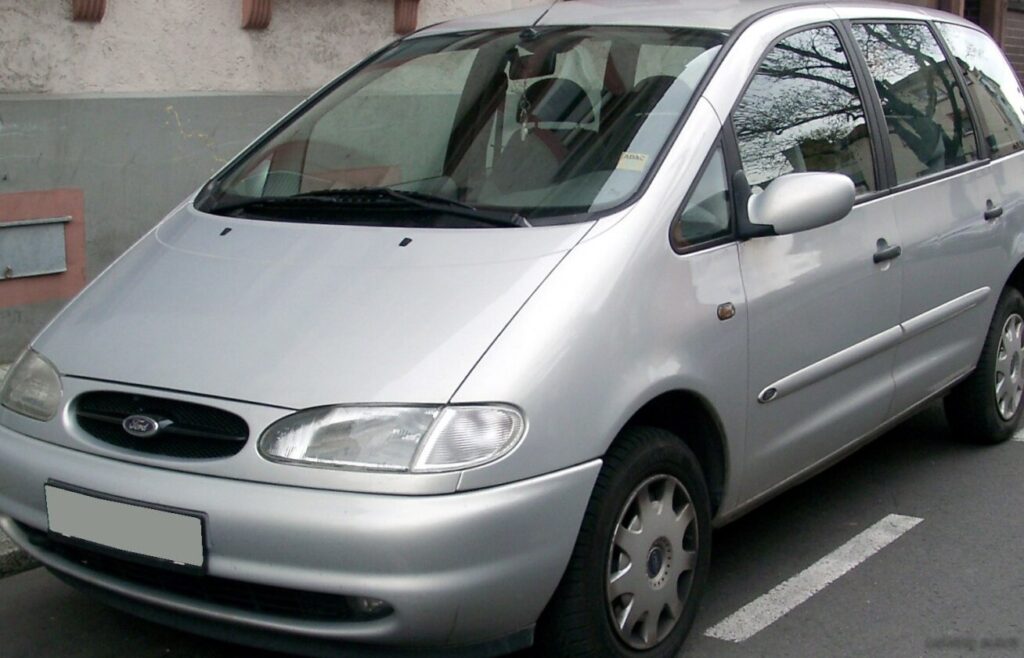
The Ford Galaxy I 1.9 TDI Automatic, produced between 2000 and 2006, represents a significant offering in the first generation of Ford’s people-mover. Positioned as a mid-range trim within the Galaxy I lineup, it aimed to provide a balance between fuel efficiency, practicality, and comfortable transportation for families. The Galaxy, co-developed with Volkswagen (sharing a platform with the VW Sharan and SEAT Alhambra), was Ford’s initial foray into the large MPV segment in Europe, designed to compete with established models like the Renault Espace and Citroën Evasion. This variant, with its 1.9-liter turbocharged diesel engine and automatic transmission, catered to buyers prioritizing ease of driving over outright performance.
Technical Specifications
| Brand | Ford |
| Model | Galaxy |
| Generation | Galaxy I |
| Type (Engine) | 1.9 TDI (116 Hp) Automatic |
| Start of production | 2000 year |
| End of production | 2006 year |
| Powertrain Architecture | Internal Combustion engine |
| Body type | Minivan |
| Seats | 7 |
| Doors | 5 |
| Fuel consumption (economy) – urban | 9.9 l/100 km (23.8 US mpg, 28.5 UK mpg, 10.1 km/l) |
| Fuel consumption (economy) – extra urban | 6.5 l/100 km (36.2 US mpg, 43.5 UK mpg, 15.4 km/l) |
| Fuel consumption (economy) – combined | 7.8 l/100 km (30.2 US mpg, 36.2 UK mpg, 12.8 km/l) |
| Fuel Type | Diesel |
| Acceleration 0 – 100 km/h | 15.1 sec |
| Acceleration 0 – 62 mph | 15.1 sec |
| Acceleration 0 – 60 mph | 14.3 sec |
| Maximum speed | 178 km/h (110.6 mph) |
| Weight-to-power ratio | 14.9 kg/Hp, 67.2 Hp/tonne |
| Weight-to-torque ratio | 6.1 kg/Nm, 165.2 Nm/tonne |
| Power | 116 Hp @ 4000 rpm |
| Power per litre | 61.2 Hp/l |
| Torque | 285 Nm @ 1900 rpm (210.21 lb.-ft. @ 1900 rpm) |
| Engine layout | Front, Transverse |
| Engine Model/Code | AUY |
| Engine displacement | 1896 cm3 (115.7 cu. in.) |
| Number of cylinders | 4 |
| Engine configuration | Inline |
| Cylinder Bore | 79.5 mm (3.13 in.) |
| Piston Stroke | 95.5 mm (3.76 in.) |
| Compression ratio | 18:1 |
| Number of valves per cylinder | 2 |
| Fuel injection system | Pump-nozzle (Unit Injector) |
| Engine aspiration | Turbocharger, Intercooler |
| Valvetrain | SOHC |
| Engine oil capacity | 4.3 l (4.54 US qt | 3.78 UK qt) |
| Kerb Weight | 1725 kg (3802.97 lbs.) |
| Max. weight | 2420 kg (5335.19 lbs.) |
| Max load | 695 kg (1532.21 lbs.) |
| Trunk (boot) space – minimum | 266 l (9.39 cu. ft.) |
| Trunk (boot) space – maximum | 2610 l (92.17 cu. ft.) |
| Fuel tank capacity | 70 l (18.49 US gal | 15.4 UK gal) |
| Length | 4641 mm (182.72 in.) |
| Width | 1810 mm (71.26 in.) |
| Height | 1730 mm (68.11 in.) |
| Wheelbase | 2835 mm (111.61 in.) |
| Front track | 1530 mm (60.24 in.) |
| Rear (Back) track | 1524 mm (60 in.) |
| Drivetrain Architecture | The Internal combustion engine (ICE) drives the front wheels of the vehicle. |
| Drive wheel | Front wheel drive |
| Number of gears and type of gearbox | 5 gears, automatic transmission |
| Front suspension | Wishbone |
| Rear suspension | Coil spring |
| Front brakes | Ventilated discs |
| Rear brakes | Disc |
| Assisting systems | ABS (Anti-lock braking system) |
| Steering type | Steering rack and pinion |
| Power steering | Hydraulic Steering |
| Tires size | 195/65 R15 |
| Wheel rims size | 15 |
Powertrain & Engine Architecture
The heart of the Galaxy I 1.9 TDI Automatic is the 1.9-liter (1896 cc) inline-four cylinder diesel engine, designated the AUY engine code. This engine belongs to the Volkswagen Group’s family of diesel engines, known for their durability and fuel efficiency. It utilizes a pump-nozzle (unit injector) fuel injection system, a technology that delivers highly precise fuel delivery directly into the combustion chamber, contributing to improved combustion and reduced emissions compared to older diesel injection systems. The engine features a single overhead camshaft (SOHC) valvetrain operating two valves per cylinder. A turbocharger with an intercooler is employed to increase power output by forcing more air into the engine. The automatic transmission is a conventional five-speed unit, chosen for its ease of use and suitability for family transport. It’s important to note that this transmission wasn’t known for being particularly sporty or quick-shifting, prioritizing smooth operation over performance.
Driving Characteristics
The 1.9 TDI Automatic Galaxy I delivers a comfortable, if not exhilarating, driving experience. With 116 horsepower and 285 Nm (210 lb-ft) of torque, acceleration is adequate for everyday driving, but overtaking maneuvers require planning. The 0-60 mph time of around 14.3 seconds reflects this. The automatic transmission, while convenient, contributes to a slightly less responsive feel compared to the manual versions. Gear ratios are geared towards fuel economy and relaxed cruising, rather than spirited performance. The engine provides a usable amount of torque from relatively low RPMs, making it suitable for carrying a full load of passengers and luggage. The Galaxy’s focus is on providing a comfortable and practical ride, and the 1.9 TDI Automatic powertrain delivers on that promise.
Equipment & Trim Levels
The 1.9 TDI Automatic trim typically included features such as air conditioning, power windows, central locking, and an integrated radio/cassette player. Higher trim levels offered options like alloy wheels, upgraded upholstery, a sunroof, and rear parking sensors. Interior upholstery was generally cloth, with options for upgraded velour or leather on higher-spec models. The dashboard layout was functional and straightforward, prioritizing usability over aesthetic flair. Safety features included ABS (Anti-lock Braking System) and driver and passenger airbags.
Chassis & Braking
The Galaxy I utilizes a front-wheel-drive layout with independent wishbone suspension at the front and a coil spring setup at the rear. The suspension is tuned for comfort, providing a relatively smooth ride even on uneven surfaces. Braking duties are handled by ventilated discs at the front and solid discs at the rear. The braking system is adequate for the vehicle’s weight and performance, especially when equipped with ABS. Stabilizer bars are fitted to both the front and rear axles to reduce body roll during cornering.
Market Reception & Comparison
The Ford Galaxy I 1.9 TDI Automatic was generally well-received by critics as a practical and spacious family vehicle. However, the automatic transmission was sometimes criticized for being sluggish and detracting from the engine’s performance. Compared to the higher-output 2.8-liter VR6 petrol version, the 1.9 TDI Automatic offered significantly better fuel economy but considerably less power. Against the 1.9 TDI with a manual transmission, the automatic version sacrificed some responsiveness and fuel efficiency for the convenience of automatic gear changes. The 1.9 TDI Automatic appealed to buyers who prioritized ease of driving and fuel economy over sporty performance.
Legacy
The Ford Galaxy I 1.9 TDI Automatic has proven to be a relatively reliable vehicle, particularly the engine and transmission. However, like any vehicle of this age, it’s susceptible to wear and tear. Common issues include turbocharger failure, fuel injector problems, and corrosion. In the used car market, these Galaxies are often sought after for their practicality and affordability. They represent a good value for buyers looking for a spacious and economical family vehicle, but potential buyers should be aware of the potential maintenance costs associated with a vehicle of this age and mileage. The Galaxy I established Ford as a serious contender in the European MPV market, paving the way for subsequent generations of the model.
