
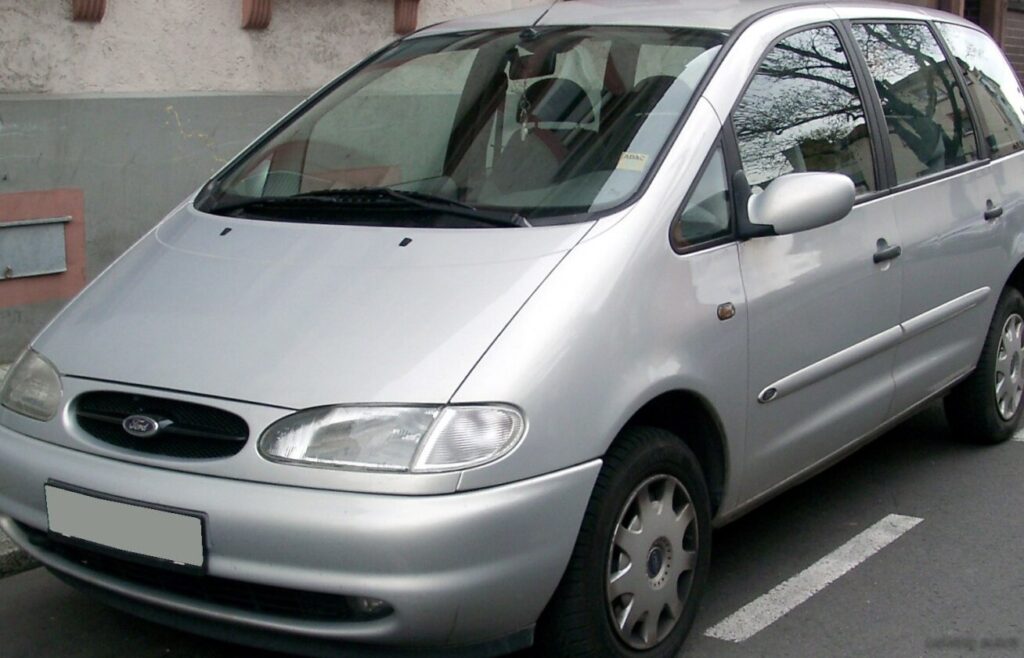
The Ford Galaxy I 1.9 TDI, producing 130 horsepower, was a significant offering in the first generation of Ford’s people-mover, sold from 2003 to 2006. Positioned as a mid-range option within the Galaxy lineup, it catered to families and those requiring substantial passenger and cargo space. This variant played a crucial role in establishing the Galaxy as a popular choice in the European minivan segment, competing with vehicles like the Renault Espace and Volkswagen Sharan. The Galaxy I, built in collaboration with Volkswagen (sharing a platform with the VW Sharan and SEAT Alhambra), represented Ford’s entry into the larger, more practical MPV market.
Technical Specifications
| Brand | Ford |
| Model | Galaxy |
| Generation | Galaxy I |
| Type (Engine) | 1.9 TDI (130 Hp) |
| Start of production | 2003 |
| End of production | 2006 |
| Powertrain Architecture | Internal Combustion engine |
| Body type | Minivan |
| Seats | 7 |
| Doors | 5 |
| Fuel consumption (urban) | 8.3 l/100 km (28.3 US mpg) |
| Fuel consumption (extra urban) | 5.5 l/100 km (42.8 US mpg) |
| Fuel consumption (combined) | 6.5 l/100 km (36.2 US mpg) |
| Fuel Type | Diesel |
| Acceleration 0 – 100 km/h | 12.8 sec |
| Acceleration 0 – 62 mph | 12.8 sec |
| Acceleration 0 – 60 mph | 12.2 sec |
| Maximum speed | 188 km/h (116.82 mph) |
| Weight-to-power ratio | 12.8 kg/Hp |
| Weight-to-torque ratio | 5.4 kg/Nm |
| Power | 130 Hp @ 4000 rpm |
| Torque | 310 Nm @ 1900 rpm (228.64 lb.-ft. @ 1900 rpm) |
| Engine layout | Front, Transverse |
| Engine Model/Code | ASZ |
| Engine displacement | 1896 cm3 (115.7 cu. in.) |
| Number of cylinders | 4 |
| Engine configuration | Inline |
| Cylinder Bore | 79.5 mm (3.13 in.) |
| Piston Stroke | 95.5 mm (3.76 in.) |
| Compression ratio | 19:1 |
| Number of valves per cylinder | 2 |
| Fuel injection system | Pump-nozzle (Unit Injector) |
| Engine aspiration | Turbocharger, Intercooler |
| Engine oil capacity | 4.3 l (4.54 US qt | 3.78 UK qt) |
| Kerb Weight | 1670 kg (3681.72 lbs.) |
| Max. weight | 2430 kg (5357.23 lbs.) |
| Max load | 760 kg (1675.51 lbs.) |
| Trunk (boot) space – minimum | 330 l (11.65 cu. ft.) |
| Trunk (boot) space – maximum | 2600 l (91.82 cu. ft.) |
| Fuel tank capacity | 70 l (18.49 US gal | 15.4 UK gal) |
| Length | 4641 mm (182.72 in.) |
| Width | 1810 mm (71.26 in.) |
| Height | 1730 mm (68.11 in.) |
| Wheelbase | 2835 mm (111.61 in.) |
| Front track | 1530 mm (60.24 in.) |
| Rear track | 1518 mm (59.76 in.) |
| Drivetrain Architecture | Front wheel drive |
| Number of gears | 6 |
| Gearbox type | Manual transmission |
| Front suspension | Wishbone |
| Rear suspension | Coil spring |
| Front brakes | Disc |
| Rear brakes | Disc |
| Assisting systems | ABS (Anti-lock braking system) |
| Steering type | Steering rack and pinion |
| Power steering | Hydraulic |
| Tires size | 215/55 R16 |
Powertrain & Engine Architecture
The heart of the Galaxy I 1.9 TDI was the ASZ engine, a 1.9-liter inline-four cylinder diesel. This engine was a mainstay in the Volkswagen Group’s offerings during the early 2000s, known for its robust construction and relatively good fuel economy. The ASZ utilized a pump-nozzle (unit injector) fuel injection system, a technology that allowed for precise fuel delivery and contributed to the engine’s efficiency and power output. A turbocharger with an intercooler was employed to boost performance, providing 130 horsepower at 4000 rpm and a substantial 310 Nm (228.64 lb.-ft.) of torque at a low 1900 rpm. This torque characteristic was particularly beneficial for a minivan, providing strong pulling power for hauling passengers and cargo. The engine featured a cast iron block and an aluminum cylinder head, a common configuration for durability. The six-speed manual transmission was the standard offering, providing a good balance between fuel efficiency and performance.
Driving Characteristics
The 1.9 TDI 130 hp engine in the Galaxy I delivered a practical and usable driving experience. While not particularly sporty, the engine provided ample power for everyday driving, including highway cruising with a full load. The six-speed manual transmission allowed drivers to keep the engine in its optimal torque band, resulting in responsive acceleration. Compared to the more powerful 2.8-liter VR6 gasoline engine option, the 1.9 TDI offered significantly better fuel economy, but lacked the VR6’s refined power delivery and overall performance. Against the 1.8-liter gasoline engines, the TDI provided more torque and better fuel economy, but was noticeably louder and had a more agricultural feel. The gear ratios were well-chosen for maximizing fuel efficiency and providing adequate acceleration in most situations.
Equipment & Trim Levels
The 1.9 TDI variant of the Galaxy I typically came with a reasonable level of standard equipment. This included power windows, central locking, air conditioning, and an audio system. Higher trim levels offered options such as alloy wheels, upgraded upholstery, a sunroof, and parking sensors. Interior upholstery was typically cloth, with the option of leather on higher-spec models. The dashboard layout was functional and straightforward, prioritizing practicality over luxury. Optional extras often included a navigation system (a relatively new feature at the time) and rear parking sensors, which were particularly useful for maneuvering the large minivan in tight spaces.
Chassis & Braking
The Galaxy I utilized a front-wheel-drive layout with independent wishbone suspension at the front and a coil spring setup at the rear. This suspension configuration provided a comfortable ride, although it wasn’t particularly sporty. The braking system consisted of disc brakes on all four wheels, providing adequate stopping power for the vehicle’s weight. Anti-lock Braking System (ABS) was standard, enhancing safety. The steering was rack and pinion with hydraulic power assistance, offering a reasonably direct and responsive feel. Stabilizer bars were fitted to both the front and rear axles to reduce body roll during cornering.
Market Reception & Comparison
The Ford Galaxy I 1.9 TDI was generally well-received by automotive critics. It was praised for its spacious interior, practicality, and fuel efficiency. The 1.9 TDI engine was considered a good compromise between performance and economy, making it a popular choice for families and those who frequently traveled long distances. Compared to the gasoline-powered Galaxy models, the TDI offered significantly better fuel economy, which was a major selling point in Europe where diesel fuel was often cheaper than gasoline. However, some critics noted the engine could be somewhat noisy and lacked the refinement of some of its competitors. Reliability was generally good, although the pump-nozzle injection system could be prone to issues if not properly maintained.
Legacy
The Ford Galaxy I 1.9 TDI has proven to be a relatively durable and reliable vehicle. Many examples are still on the road today, testament to the robust construction of the engine and chassis. On the used car market, these Galaxies represent a good value for money, offering a lot of space and practicality for a reasonable price. However, potential buyers should be aware of the potential for issues with the pump-nozzle injection system and ensure that the vehicle has been properly maintained. The ASZ engine, while generally reliable, requires regular servicing and the use of high-quality diesel fuel to prevent problems. The Galaxy I 1.9 TDI remains a popular choice for those seeking a spacious, economical, and practical minivan.
