
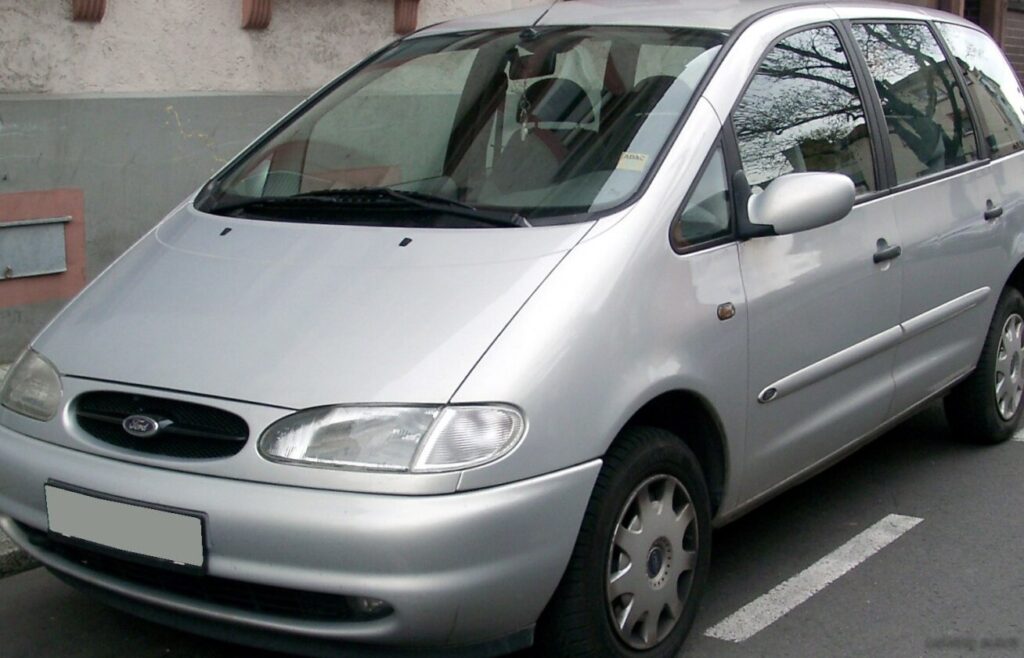
The Ford Galaxy I 1.9 TDI (90 hp) was a popular European minivan produced from 1996 to 2006. It represented Ford’s entry into the multi-purpose vehicle (MPV) segment, developed in collaboration with Volkswagen. This particular variant, powered by the 1.9-liter turbocharged diesel engine and paired with a five-speed manual transmission, served as a relatively affordable and fuel-efficient option within the Galaxy lineup, targeting families and those needing a versatile vehicle. It was a key model in Ford of Europe’s strategy to broaden its appeal beyond traditional passenger cars.
Technical Specifications
| Brand | Ford |
| Model | Galaxy |
| Generation | Galaxy I |
| Type (Engine) | 1.9 TDI (90 Hp) |
| Start of production | 1996 |
| End of production | 2006 |
| Powertrain Architecture | Internal Combustion engine |
| Body type | Minivan |
| Seats | 7 |
| Doors | 5 |
| Fuel consumption (urban) | 8.8 l/100 km (26.7 US mpg, 32.1 UK mpg, 11.4 km/l) |
| Fuel consumption (extra urban) | 5.6 l/100 km (42 US mpg, 50.4 UK mpg, 17.9 km/l) |
| Fuel consumption (combined) | 6.7 l/100 km (35.1 US mpg, 42.2 UK mpg, 14.9 km/l) |
| Fuel Type | Diesel |
| Acceleration 0 – 100 km/h | 17.1 sec |
| Acceleration 0 – 62 mph | 17.1 sec |
| Acceleration 0 – 60 mph | 16.2 sec |
| Maximum speed | 160 km/h (99.42 mph) |
| Weight-to-power ratio | 18.6 kg/Hp, 53.9 Hp/tonne |
| Weight-to-torque ratio | 8 kg/Nm, 125.7 Nm/tonne |
| Power | 90 Hp @ 4000 rpm |
| Power per litre | 47.5 Hp/l |
| Torque | 210 Nm @ 1900 rpm (154.89 lb.-ft. @ 1900 rpm) |
| Engine layout | Front, Transverse |
| Engine Model/Code | 1Z, AHU, ANU |
| Engine displacement | 1896 cm3 (115.7 cu. in.) |
| Number of cylinders | 4 |
| Engine configuration | Inline |
| Cylinder Bore | 79.5 mm (3.13 in.) |
| Piston Stroke | 95.5 mm (3.76 in.) |
| Compression ratio | 19.5:1 |
| Number of valves per cylinder | 2 |
| Fuel injection system | Direct injection |
| Engine aspiration | Turbocharger, Intercooler |
| Valvetrain | SOHC |
| Engine oil capacity | 4.3 l (4.54 US qt | 3.78 UK qt) |
| Kerb Weight | 1670 kg (3681.72 lbs.) |
| Max. weight | 2430 kg (5357.23 lbs.) |
| Max load | 760 kg (1675.51 lbs.) |
| Trunk (boot) space – minimum | 266 l (9.39 cu. ft.) |
| Trunk (boot) space – maximum | 2610 l (92.17 cu. ft.) |
| Fuel tank capacity | 70 l (18.49 US gal | 15.4 UK gal) |
| Length | 4641 mm (182.72 in.) |
| Width | 1810 mm (71.26 in.) |
| Height | 1732 mm (68.19 in.) |
| Wheelbase | 2835 mm (111.61 in.) |
| Front track | 1520 mm (59.84 in.) |
| Rear (Back) track | 1506 mm (59.29 in.) |
| Drivetrain Architecture | The Internal combustion engine (ICE) drives the front wheels of the vehicle. |
| Drive wheel | Front wheel drive |
| Number of gears and type of gearbox | 5 gears, manual transmission |
| Front suspension | Wishbone |
| Rear suspension | Coil spring |
| Front brakes | Ventilated discs |
| Rear brakes | Disc |
| Assisting systems | ABS (Anti-lock braking system) |
| Steering type | Steering rack and pinion |
| Power steering | Hydraulic Steering |
| Tires size | 195/65R15 |
Powertrain & Engine Architecture
The heart of this Galaxy variant was the 1.9-liter (1896 cc) inline-four cylinder diesel engine, available with engine codes 1Z, AHU, and ANU. These engines were direct injection diesels, utilizing a Bosch VE distributor-type fuel injection pump. This system, while robust, was less sophisticated than later common-rail diesel technologies. The engine featured a single overhead camshaft (SOHC) valvetrain operating two valves per cylinder. A turbocharger with an intercooler was employed to boost power and torque, delivering 90 horsepower at 4000 rpm and 210 Nm (155 lb-ft) of torque at 1900 rpm. The five-speed manual transmission was the standard offering, providing a balance between fuel efficiency and usability. The transmission’s gear ratios were tuned for maximizing fuel economy and providing adequate acceleration for a vehicle of this size and weight.
Driving Characteristics
The 1.9 TDI 90 hp Galaxy was not a performance-oriented vehicle. Acceleration was modest, taking around 17 seconds to reach 60 mph. However, the engine’s strong low-end torque made it reasonably capable for everyday driving, especially when fully loaded with passengers and luggage. The manual transmission allowed for greater driver control compared to the later available automatic options. Compared to the more powerful 1.9 TDI 110 hp or the petrol-powered variants, this version prioritized fuel economy and affordability over outright speed. The gear ratios were relatively long, contributing to good highway cruising but requiring downshifts for quicker acceleration.
Equipment & Trim Levels
The 1.9 TDI 90 hp Galaxy typically occupied the entry-level or mid-range position in the lineup. Standard equipment generally included power steering, central locking, electric front windows, and an adjustable steering column. Interior upholstery was typically cloth, and the dashboard featured a functional, if somewhat basic, design. Optional extras included air conditioning, alloy wheels, a sunroof, and upgraded audio systems. Higher trim levels added features like rear electric windows, upgraded interior trim, and more sophisticated audio systems.
Chassis & Braking
The Galaxy I utilized a front-wheel-drive layout with independent wishbone suspension at the front and a coil spring rear suspension. This setup provided a comfortable ride, although handling was not particularly sporty. The braking system consisted of ventilated discs at the front and solid discs at the rear. Anti-lock Braking System (ABS) was standard, enhancing safety. The suspension was tuned to prioritize ride comfort and stability when carrying a full load. Stabilizer bars were fitted to both the front and rear axles to reduce body roll during cornering.
Market Reception & Comparison
The Ford Galaxy I 1.9 TDI (90 hp) was well-received in the European market as a practical and affordable MPV. Critics praised its spacious interior, versatility, and fuel efficiency. However, some noted the engine’s lack of outright power, particularly when the vehicle was fully loaded. Compared to the more powerful TDI variants, this version offered a lower purchase price and slightly better fuel economy. Against competitors like the Renault Espace and Citroën Evasion, the Galaxy offered a compelling combination of practicality, value, and Ford’s established reputation for reliability.
Legacy
The 1.9 TDI engine, in its various iterations, proved to be a durable and reliable powerplant. While the Bosch VE injection pump could require maintenance over time, the engine itself was generally robust. Today, well-maintained examples of the Galaxy I 1.9 TDI can still be found on the used car market, often representing a cost-effective option for those needing a spacious and practical vehicle. The Galaxy I established Ford as a serious contender in the MPV segment, paving the way for subsequent generations of the model. The 1.9 TDI variant, while not the most powerful, remains a popular choice for its fuel efficiency and relatively simple mechanical design.
