
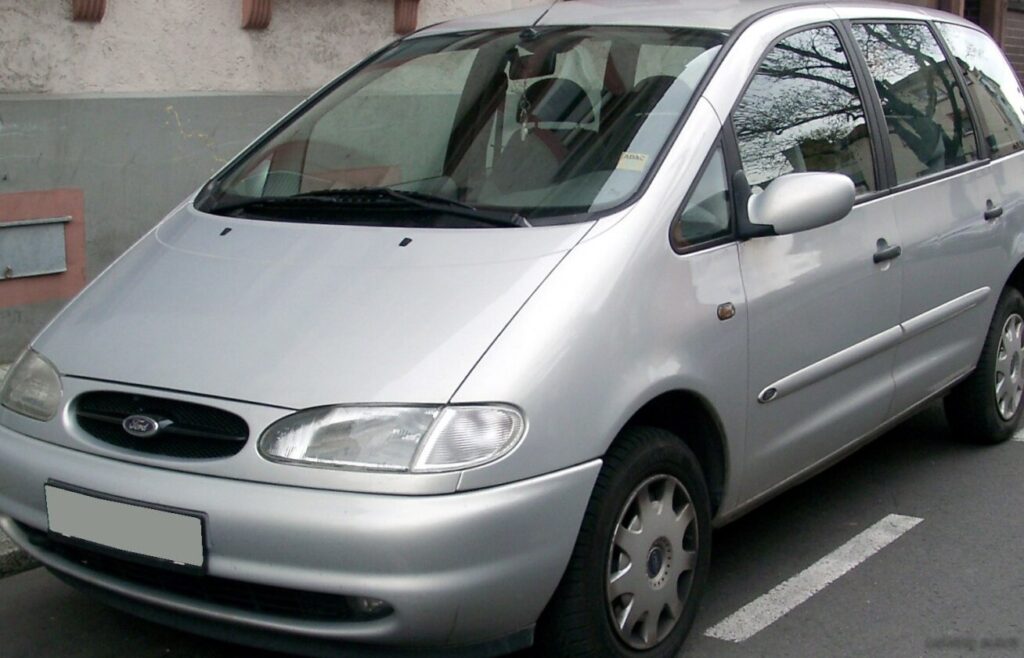
The Ford Galaxy I 2.0 i, producing 116 horsepower, was a significant model within the first generation of the Galaxy minivan, manufactured from 1995 to 2006. Developed as part of a joint venture between Ford and Volkswagen (sharing a platform with the VW Sharan and SEAT Alhambra), the Galaxy aimed to provide a spacious and versatile seven-seater option for European families. This 2.0-liter variant occupied a middle ground in the Galaxy lineup, offering a balance between affordability and acceptable performance. It was positioned as a step up from the base 1.9-liter models, but below the more powerful 2.3-liter and later diesel options.
Technical Specifications
| Brand | Ford |
| Model | Galaxy |
| Generation | Galaxy I |
| Type (Engine) | 2.0 i (116 Hp) |
| Start of production | 1995 |
| End of production | 2006 |
| Powertrain Architecture | Internal Combustion engine |
| Body type | Minivan |
| Seats | 7 |
| Doors | 5 |
| Fuel consumption (urban) | 13.8 l/100 km (17 US mpg, 20.5 UK mpg) |
| Fuel consumption (extra urban) | 7.9 l/100 km (29.8 US mpg, 35.8 UK mpg) |
| Fuel consumption (combined) | 10.1 l/100 km (23.3 US mpg, 28 UK mpg) |
| Fuel Type | Petrol (Gasoline) |
| Acceleration 0 – 100 km/h | 13.1 sec |
| Acceleration 0 – 62 mph | 13.1 sec |
| Acceleration 0 – 60 mph | 12.4 sec |
| Maximum speed | 177 km/h (109.98 mph) |
| Weight-to-power ratio | 14.4 kg/Hp |
| Weight-to-torque ratio | 9.8 kg/Nm |
| Power | 116 Hp @ 5500 rpm |
| Torque | 170 Nm @ 2300 rpm (125.39 lb.-ft. @ 2300 rpm) |
| Engine layout | Front, Transverse |
| Engine Model/Code | NSE, ZVSA |
| Engine displacement | 1998 cm3 (121.93 cu. in.) |
| Number of cylinders | 4 |
| Engine configuration | Inline |
| Cylinder Bore | 86 mm (3.39 in.) |
| Piston Stroke | 86 mm (3.39 in.) |
| Compression ratio | 9.8:1 |
| Number of valves per cylinder | 2 |
| Fuel injection system | Multi-port manifold injection |
| Engine aspiration | Naturally aspirated engine |
| Valvetrain | DOHC |
| Engine oil capacity | 4.25 l (4.49 US qt | 3.74 UK qt) |
| Coolant capacity | 8.2 l (8.66 US qt | 7.21 UK qt) |
| Kerb Weight | 1665 kg (3670.7 lbs.) |
| Max. weight | 2350 kg (5180.86 lbs.) |
| Max load | 685 kg (1510.17 lbs.) |
| Trunk (boot) space – minimum | 266 l (9.39 cu. ft.) |
| Trunk (boot) space – maximum | 2610 l (92.17 cu. ft.) |
| Fuel tank capacity | 70 l (18.49 US gal | 15.4 UK gal) |
| Length | 4641 mm (182.72 in.) |
| Width | 1810 mm (71.26 in.) |
| Height | 1730 mm (68.11 in.) |
| Wheelbase | 2835 mm (111.61 in.) |
| Front track | 1520 mm (59.84 in.) |
| Rear track | 1524 mm (60 in.) |
| Drivetrain Architecture | Front wheel drive |
| Number of gears | 5 |
| Gearbox type | Manual transmission |
| Front suspension | Wishbone |
| Rear suspension | Coil spring |
| Front brakes | Disc |
| Rear brakes | Disc |
| Assisting systems | ABS (Anti-lock braking system) |
| Steering type | Steering rack and pinion |
| Power steering | Hydraulic |
| Tires size | 195/65R15 |
INTRODUCTION
The Ford Galaxy I 2.0 i, launched in 1995, represented Ford’s entry into the burgeoning European minivan market. Built on the shared Volkswagen Group ‘B’ platform (1HX0/A3), it was conceived as a more spacious and family-oriented alternative to traditional estate cars. The Galaxy aimed to capitalize on the growing demand for multi-purpose vehicles (MPVs) capable of carrying passengers and cargo with ease. The 2.0-liter engine, designated with engine codes like NSE and ZVSA, was a key component of the Galaxy’s appeal, offering a reasonable compromise between fuel economy and performance for the average family.
Powertrain & Engine Architecture
The 2.0-liter inline-four engine powering the Galaxy I 2.0 i was a naturally aspirated unit utilizing multi-port fuel injection. This engine, a mainstay in Ford’s European lineup during the 1990s and early 2000s, featured a double overhead camshaft (DOHC) valvetrain with two valves per cylinder. The engine’s 9.8:1 compression ratio was typical for the era, balancing performance with the need to run on readily available fuel grades. The 2.0 i was typically paired with a five-speed manual transmission, although a four-speed automatic was also offered. The automatic transmission, while providing convenience, did impact acceleration and fuel economy compared to the manual version. The engine’s design prioritized reliability and ease of maintenance, making it a relatively straightforward unit for mechanics to work on.
Driving Characteristics
The 2.0-liter Galaxy I, with its 116 horsepower and 170 Nm (125 lb-ft) of torque, offered adequate, but not exhilarating, performance. Acceleration from 0 to 60 mph took around 12.4 to 13.1 seconds, depending on whether it was equipped with the manual or automatic transmission. In real-world driving, the engine felt somewhat strained when fully loaded with passengers and luggage, particularly on inclines. The five-speed manual transmission allowed drivers to keep the engine in its optimal power band, while the automatic transmission, with its less aggressive gear ratios, prioritized smooth operation over outright speed. Handling was typical for a minivan – comfortable and predictable, but not particularly sporty. The Galaxy’s focus was on providing a comfortable and practical driving experience rather than engaging driving dynamics.
Equipment & Trim Levels
The 2.0 i Galaxy typically came with a reasonable level of standard equipment, reflecting its position as a mid-range trim. Features included power steering, central locking, electric front windows, and an adjustable steering column. Interior upholstery was generally cloth, with options for upgraded materials available. Dashboard configuration was functional and straightforward, prioritizing usability over aesthetic flair. Optional extras included air conditioning, alloy wheels, a sunroof, and a radio/cassette player. Higher trim levels, such as the Ghia, added more luxurious features like leather upholstery, wood trim, and upgraded audio systems.
Chassis & Braking
The Galaxy I utilized a front-wheel-drive layout with independent wishbone suspension at the front and a coil spring rear suspension. This setup provided a comfortable ride, absorbing bumps and imperfections in the road surface effectively. Braking was initially equipped with disc brakes on all four wheels, providing adequate stopping power. Anti-lock Braking System (ABS) was standard, enhancing safety by preventing wheel lockup during emergency braking. The Galaxy’s suspension was tuned for comfort rather than sporty handling, resulting in a slight degree of body roll during cornering. Stabilizer bars were included to help mitigate this roll and improve stability.
Market Reception & Comparison
The Ford Galaxy I 2.0 i was generally well-received by critics as a practical and spacious family vehicle. However, the 2.0-liter engine was sometimes criticized for feeling underpowered, especially when the vehicle was fully loaded. Compared to the more powerful 2.3-liter variant, the 2.0 i offered lower running costs but sacrificed performance. The diesel models, particularly the 1.9 TDI, provided superior fuel economy and torque, making them popular choices for long-distance drivers. The Galaxy’s main competitors included the Renault Espace, Citroën Evasion, and the VW Sharan/SEAT Alhambra, with which it shared its core mechanical components.
Legacy
The Ford Galaxy I 2.0 i has proven to be a relatively reliable vehicle, with many examples still on the road today. The 2.0-liter engine is known for its durability, although regular maintenance is essential to prevent issues such as oil leaks and timing belt failure. The automatic transmission, while convenient, can be prone to wear and tear if not serviced properly. In the used car market, the 2.0 i Galaxy represents a relatively affordable entry point into the world of MPVs, offering a spacious and practical vehicle for families on a budget. Its enduring popularity is a testament to its well-rounded design and practicality.
