
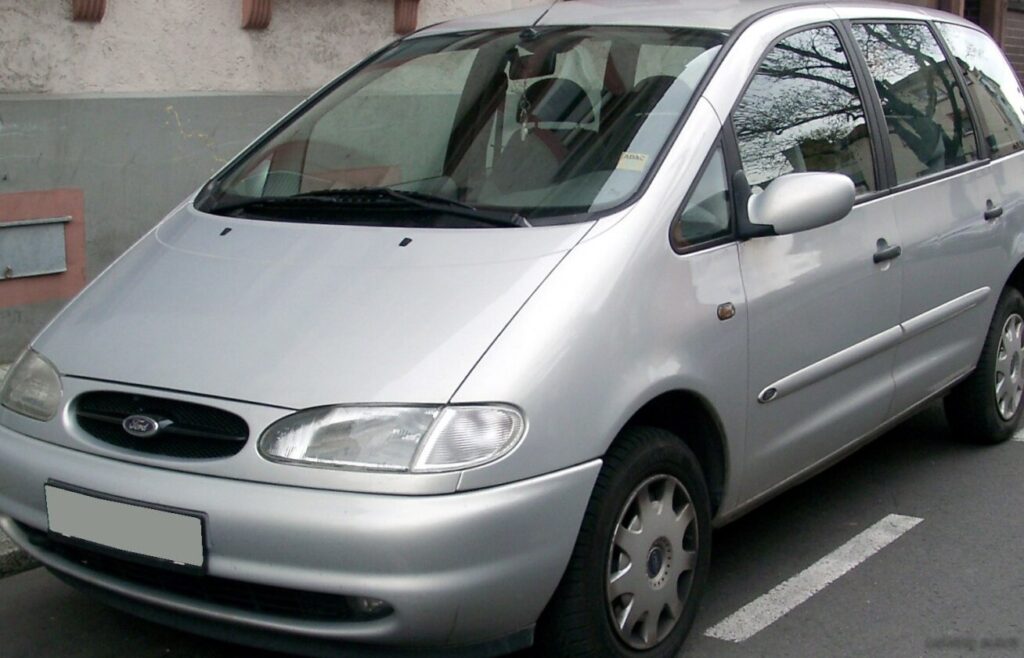
The Ford Galaxy I 2.3 16V Automatic, produced from 1997 to 2006, represents a significant entry in Ford’s foray into the European minivan (MPV) market. Developed in collaboration with Volkswagen – sharing a platform with the VW Sharan and SEAT Alhambra – the Galaxy aimed to provide a spacious, comfortable, and practical vehicle for families. This particular variant, equipped with the 2.3-liter 16-valve engine paired with a four-speed automatic transmission, occupied a mid-range position within the Galaxy lineup, offering a balance between performance and convenience. It was positioned above the base 1.9-liter models and below the more powerful 2.8-liter V6 options.
Technical Specifications
| Brand | Ford |
| Model | Galaxy |
| Generation | Galaxy I |
| Type (Engine) | 2.3 16V (145 Hp) Automatic |
| Start of production | 1997 |
| End of production | 2006 |
| Powertrain Architecture | Internal Combustion engine |
| Body type | Minivan |
| Seats | 7 |
| Doors | 5 |
| Fuel consumption (urban) | 15.1 l/100 km (15.6 US mpg, 18.7 UK mpg, 6.6 km/l) |
| Fuel consumption (extra urban) | 8.6 l/100 km (27.4 US mpg, 32.8 UK mpg, 11.6 km/l) |
| Fuel consumption (combined) | 11 l/100 km (21.4 US mpg, 25.7 UK mpg, 9.1 km/l) |
| Fuel Type | Petrol (Gasoline) |
| Acceleration 0 – 100 km/h | 14.1 sec |
| Acceleration 0 – 62 mph | 14.1 sec |
| Acceleration 0 – 60 mph | 13.4 sec |
| Maximum speed | 196 km/h (121.79 mph) |
| Weight-to-power ratio | 11.1 kg/Hp, 90.1 Hp/tonne |
| Weight-to-torque ratio | 7.9 kg/Nm, 126.1 Nm/tonne |
| Power | 145 Hp @ 5500 rpm |
| Power per litre | 63.2 Hp/l |
| Torque | 203 Nm @ 2500 rpm (149.73 lb.-ft. @ 2500 rpm) |
| Engine layout | Front, Transverse |
| Engine Model/Code | E5SA, Y5B |
| Engine displacement | 2295 cm3 (140.05 cu. in.) |
| Number of cylinders | 4 |
| Engine configuration | Inline |
| Cylinder Bore | 89.6 mm (3.53 in.) |
| Piston Stroke | 91 mm (3.58 in.) |
| Compression ratio | 10:1 |
| Number of valves per cylinder | 4 |
| Fuel injection system | Multi-port manifold injection |
| Engine aspiration | Naturally aspirated engine |
| Engine oil capacity | 4 l (4.23 US qt | 3.52 UK qt) |
| Coolant capacity | 8.9 l (9.4 US qt | 7.83 UK qt) |
| Kerb Weight | 1610 kg (3549.44 lbs.) |
| Max. weight | 2420 kg (5335.19 lbs.) |
| Max load | 810 kg (1785.74 lbs.) |
| Trunk (boot) space – minimum | 330 l (11.65 cu. ft.) |
| Trunk (boot) space – maximum | 2600 l (91.82 cu. ft.) |
| Fuel tank capacity | 70 l (18.49 US gal | 15.4 UK gal) |
| Length | 4641 mm (182.72 in.) |
| Width | 1810 mm (71.26 in.) |
| Height | 1732 mm (68.19 in.) |
| Wheelbase | 2835 mm (111.61 in.) |
| Front track | 1532 mm (60.31 in.) |
| Rear (Back) track | 1518 mm (59.76 in.) |
| Drivetrain Architecture | Front wheel drive |
| Number of gears | 4 |
| Gearbox type | Automatic transmission |
| Front suspension | Wishbone |
| Rear suspension | Coil spring |
| Front brakes | Disc |
| Rear brakes | Disc |
| Assisting systems | ABS (Anti-lock braking system) |
| Steering type | Steering rack and pinion |
| Power steering | Hydraulic Steering |
| Tires size | 215/65 R16 |
| Wheel rims size | 16 |
Powertrain & Engine Architecture
The heart of this Galaxy variant is the Ford 2.3-liter inline-four cylinder engine, internally designated as the E5SA or Y5B depending on specific production nuances. This engine, a member of Ford’s DOHC (Double Overhead Camshaft) 16-valve family, featured multi-port fuel injection. The engine’s design prioritized smooth operation and reasonable power output over outright performance. The four-speed automatic transmission, a Ford-sourced unit, was chosen for its ease of use and suitability for family transport. While not known for its sportiness, the transmission provided adequate shifting and contributed to the Galaxy’s comfortable driving experience. The engine’s 10:1 compression ratio was a standard figure for the era, balancing efficiency and performance.
Driving Characteristics
The 2.3-liter automatic Galaxy offered a comfortable, if not particularly exhilarating, driving experience. Acceleration from 0-60 mph took around 13.4 to 14.1 seconds, making it slower than the manual transmission versions or those equipped with the larger 2.8-liter V6. The automatic transmission’s gear ratios were tuned for fuel economy and smooth cruising rather than rapid acceleration. In real-world driving, the engine felt adequate for everyday tasks, such as commuting and highway driving with a moderate load. However, fully loaded with passengers and luggage, the engine could feel strained, especially when tackling hills. The steering was light and easy, contributing to the vehicle’s maneuverability in urban environments.
Equipment & Trim Levels
The 2.3 16V Automatic Galaxy typically came with a reasonable level of standard equipment. This included power windows, central locking, an AM/FM radio, and basic cloth upholstery. Higher trim levels, often denoted by “GLX” or similar designations, added features such as alloy wheels, air conditioning, upgraded audio systems, and optional extras like a sunroof. Interior trim was generally functional and durable, prioritizing practicality over luxury. The seven-seat configuration was standard, with the rear seats folding flat to maximize cargo space.
Chassis & Braking
The Galaxy I utilized a front-wheel-drive chassis with independent wishbone suspension at the front and a coil spring setup at the rear. This suspension configuration provided a comfortable ride, absorbing bumps and imperfections in the road surface effectively. Braking was handled by disc brakes on all four wheels, supplemented by an Anti-lock Braking System (ABS) for improved stopping power and stability. The braking system was adequate for the vehicle’s weight and performance, but not particularly sporty. The steering employed a hydraulic power steering system, providing light and easy steering assistance.
Market Reception & Comparison
The Ford Galaxy I 2.3 16V Automatic was generally well-received by critics as a practical and spacious family vehicle. However, the engine and automatic transmission combination were often criticized for being underpowered, particularly when compared to the V6 options. Fuel economy was considered average for the class. Compared to the manual transmission 2.3-liter models, the automatic version offered less engaging driving experience but greater convenience. Reliability was generally good, although some owners reported minor issues with the automatic transmission over time.
Legacy
The Ford Galaxy I 2.3 16V Automatic remains a relatively common sight on used car markets today. The 2.3-liter engine, while not known for its exceptional performance, is generally considered reliable and relatively easy to maintain. The automatic transmission, if properly serviced, can provide years of trouble-free operation. However, potential buyers should be aware of the possibility of age-related wear and tear on components such as suspension bushings and brake systems. Overall, the Galaxy I 2.3 16V Automatic represents a solid and practical choice for those seeking an affordable and spacious family vehicle.
