
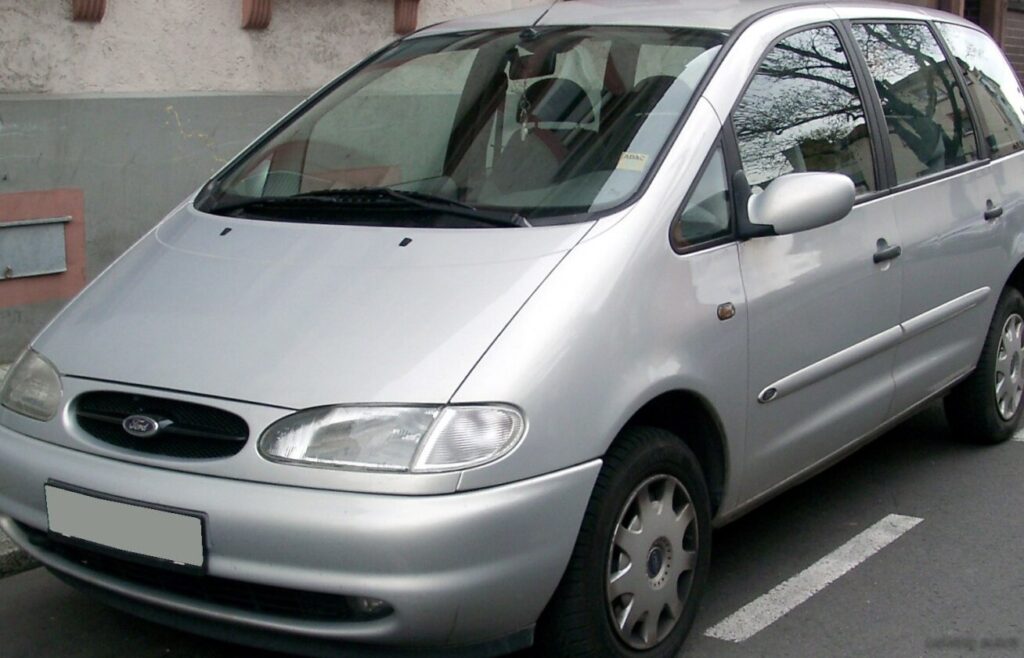
The Ford Galaxy I 2.8 V6 Automatic, produced between 2000 and 2006, represents a significant offering in Ford’s foray into the European minivan (MPV) market. Developed in collaboration with Volkswagen – sharing a platform with the VW Sharan and SEAT Alhambra (the 1HX0/A3 platform) – the Galaxy aimed to provide a spacious, comfortable, and practical vehicle for families. This 2.8L V6 variant, positioned as a premium trim level, distinguished itself with a more powerful engine and automatic transmission, catering to buyers prioritizing effortless performance and convenience over fuel economy. It was a key model in establishing the Galaxy’s reputation as a versatile and well-equipped people carrier.
Technical Specifications
| Brand | Ford |
| Model | Galaxy |
| Generation | Galaxy I |
| Type (Engine) | 2.8 V6 (204 Hp) Automatic |
| Start of production | 2000 year |
| End of production | 2006 year |
| Powertrain Architecture | Internal Combustion engine |
| Body type | Minivan |
| Seats | 7 |
| Doors | 5 |
| Fuel consumption (economy) – urban | 16.8 l/100 km (14 US mpg, 16.8 UK mpg, 6 km/l) |
| Fuel consumption (economy) – extra urban | 9.2 l/100 km (25.6 US mpg, 30.7 UK mpg, 10.9 km/l) |
| Fuel consumption (economy) – combined | 12 l/100 km (19.6 US mpg, 23.5 UK mpg, 8.3 km/l) |
| Fuel Type | Petrol (Gasoline) |
| Acceleration 0 – 100 km/h | 10.4 sec |
| Acceleration 0 – 62 mph | 10.4 sec |
| Acceleration 0 – 60 mph | 9.9 sec |
| Maximum speed | 212 km/h (131.73 mph) |
| Weight-to-power ratio | 8.3 kg/Hp, 120 Hp/tonne |
| Weight-to-torque ratio | 6.4 kg/Nm, 155.9 Nm/tonne |
| Power | 204 Hp @ 6200 rpm |
| Power per litre | 73.1 Hp/l |
| Torque | 265 Nm @ 3400 rpm (195.45 lb.-ft. @ 3400 rpm) |
| Engine layout | Front, Transverse |
| Engine Model/Code | AYL |
| Engine displacement | 2792 cm3 (170.38 cu. in.) |
| Number of cylinders | 6 |
| Engine configuration | V-engine |
| Cylinder Bore | 81 mm (3.19 in.) |
| Piston Stroke | 90.3 mm (3.56 in.) |
| Compression ratio | 10.8:1 |
| Number of valves per cylinder | 4 |
| Fuel injection system | Multi-port manifold injection |
| Engine aspiration | Naturally aspirated engine |
| Engine oil capacity | 5.5 l (5.81 US qt | 4.84 UK qt) |
| Coolant | 9.7 l (10.25 US qt | 8.53 UK qt) |
| Kerb Weight | 1700 kg (3747.86 lbs.) |
| Max. weight | 2470 kg (5445.42 lbs.) |
| Max load | 770 kg (1697.56 lbs.) |
| Trunk (boot) space – minimum | 330 l (11.65 cu. ft.) |
| Trunk (boot) space – maximum | 2600 l (91.82 cu. ft.) |
| Fuel tank capacity | 70 l (18.49 US gal | 15.4 UK gal) |
| Length | 4641 mm (182.72 in.) |
| Width | 1810 mm (71.26 in.) |
| Height | 1732 mm (68.19 in.) |
| Wheelbase | 2835 mm (111.61 in.) |
| Front track | 1532 mm (60.31 in.) |
| Rear (Back) track | 1518 mm (59.76 in.) |
| Drivetrain Architecture | The Internal combustion engine (ICE) drives the front wheels of the vehicle. |
| Drive wheel | Front wheel drive |
| Number of gears and type of gearbox | 5 gears, automatic transmission |
| Front suspension | Wishbone |
| Rear suspension | Coil spring |
| Front brakes | Disc |
| Rear brakes | Disc |
| Assisting systems | ABS (Anti-lock braking system) |
| Steering type | Steering rack and pinion |
| Power steering | Hydraulic Steering |
| Tires size | 205/60 R15 |
| Wheel rims size | 15 |
Powertrain & Engine Architecture
The heart of the Galaxy I 2.8 V6 Automatic is the Ford AYL engine, a 2.8-liter, naturally aspirated V6. This engine, part of Ford’s Duratec family, features a 60-degree V-angle and utilizes a multi-port fuel injection system. The engine’s aluminum cylinder head houses four valves per cylinder (two intake, two exhaust), contributing to its respectable power output. The AYL engine is known for its relatively smooth operation and decent reliability, though it isn’t without its potential issues (discussed later). Paired with this engine is a five-speed automatic transmission, providing convenient gear changes. This transmission, while generally reliable, isn’t known for particularly quick or sporty shifts, prioritizing comfort and ease of use. The transmission’s gear ratios are tuned for relaxed cruising and adequate acceleration, rather than outright performance.
Driving Characteristics
The 2.8L V6 Automatic Galaxy offers a comfortable and relaxed driving experience. With 204 horsepower, acceleration is adequate for most situations, with a 0-60 mph time of around 9.9 seconds. However, it’s not a particularly sporty vehicle. The automatic transmission contributes to a smooth ride, but can feel somewhat sluggish when downshifting. Compared to the available 1.9 TDI diesel engine, the V6 offers significantly more power but at the cost of considerably worse fuel economy. The V6 also provides a more refined and quieter driving experience than the diesel. Compared to the lower-powered 1.8L inline-four variants, the V6 offers a substantial performance upgrade, making highway merging and overtaking much easier.
Equipment & Trim Levels
The 2.8 V6 Automatic typically came with a generous level of standard equipment. This included air conditioning, power windows and mirrors, central locking, and an integrated radio/CD player. Higher trim levels often added features like leather upholstery, alloy wheels, a sunroof, and upgraded audio systems. Safety features such as ABS and driver/passenger airbags were standard. The Galaxy was designed with family practicality in mind, offering a flexible seating arrangement with individual, removable second-row seats and a large cargo area. Optional extras included rear parking sensors and a navigation system.
Chassis & Braking
The Galaxy I utilizes a front-wheel-drive layout with independent wishbone suspension at the front and a coil spring setup at the rear. This suspension configuration provides a comfortable ride, absorbing bumps and imperfections in the road effectively. Braking duties are handled by disc brakes on all four wheels, coupled with an ABS system to prevent wheel lockup during hard braking. The steering is rack and pinion, providing reasonably precise control. The Galaxy’s weight, around 1700 kg (3748 lbs), contributes to its stable handling, but also impacts its agility.
Market Reception & Comparison
The Ford Galaxy I 2.8 V6 Automatic was generally well-received by critics as a spacious, comfortable, and practical family vehicle. However, its fuel economy was often criticized, particularly compared to the diesel alternatives. The V6 engine was praised for its smoothness and power, but some reviewers found the automatic transmission to be somewhat unresponsive. In terms of reliability, the AYL engine is generally considered reasonably durable, but potential issues include oil leaks and occasional problems with the variable valve timing system. The Galaxy competed with other MPVs such as the Renault Espace, Citroën Evasion, and, of course, its platform siblings, the VW Sharan and SEAT Alhambra.
Legacy
The Ford Galaxy I 2.8 V6 Automatic remains a relatively affordable and practical option in the used car market. While fuel economy isn’t its strong suit, its spacious interior, comfortable ride, and decent performance make it a viable choice for families. The AYL engine, while requiring regular maintenance, is generally considered reliable if properly cared for. Parts availability is generally good, thanks to the Galaxy’s popularity and shared components with Volkswagen and SEAT models. Today, these Galaxies are often sought after by those needing a large, versatile vehicle without the expense of a newer model.
