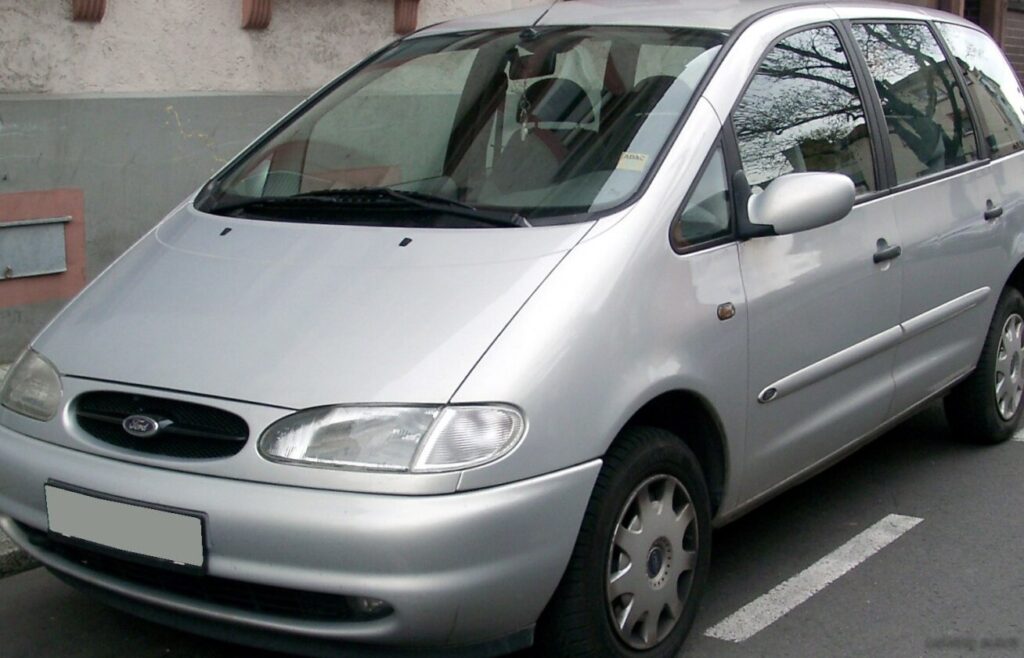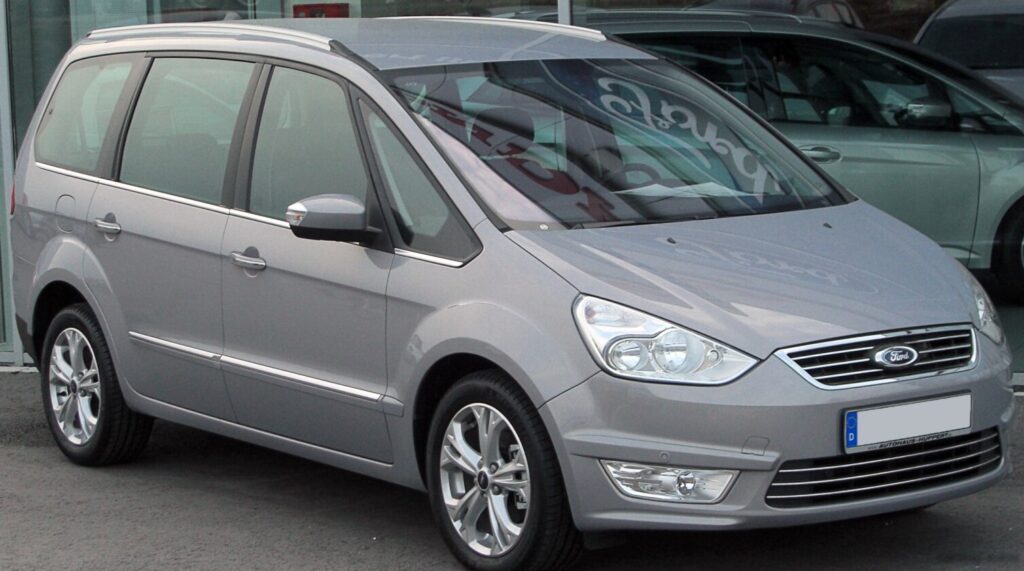
The Ford Galaxy II, specifically the facelifted version introduced in May 2010, represented a significant evolution of Ford’s people-carrying offering in the European market. Positioned as a larger, more premium alternative to compact MPVs, the Galaxy aimed to provide spaciousness, practicality, and a degree of driving refinement. The 2.0 TDCi 140 horsepower variant with the PowerShift dual-clutch transmission was a key model within the range, offering a balance between fuel efficiency, performance, and affordability. Production of this configuration continued until 2015, solidifying its place as a popular choice for families and those requiring versatile passenger and cargo space.
Technical Specifications
| Brand | Ford |
| Model | Galaxy |
| Generation | Galaxy II (facelift 2010) |
| Type (Engine) | 2.0 TDCi (140 Hp) PowerShift |
| Start of production | May, 2010 |
| End of production | 2015 |
| Powertrain Architecture | Internal Combustion engine |
| Body type | Minivan |
| Seats | 7 |
| Doors | 5 |
| Fuel consumption (economy) – urban (NEDC) | 7.4 l/100 km (31.8 US mpg, 38.2 UK mpg, 13.5 km/l) |
| Fuel consumption (economy) – extra urban (NEDC) | 5.2 l/100 km (45.2 US mpg, 54.3 UK mpg, 19.2 km/l) |
| Fuel consumption (economy) – combined (NEDC) | 6 l/100 km (39.2 US mpg, 47.1 UK mpg, 16.7 km/l) |
| CO2 emissions (NEDC) | 159 g/km |
| Fuel Type | Diesel |
| Acceleration 0 – 100 km/h | 11.1 sec |
| Acceleration 0 – 62 mph | 11.1 sec |
| Acceleration 0 – 60 mph | 10.5 sec |
| Maximum speed | 190 km/h (118.06 mph) |
| Emission standard | Euro 5 |
| Weight-to-power ratio | 11.8 kg/Hp, 84.5 Hp/tonne |
| Weight-to-torque ratio | 5.2 kg/Nm, 193.2 Nm/tonne |
| Power | 140 Hp @ 3750 rpm |
| Power per litre | 70.1 Hp/l |
| Torque | 320 Nm @ 1750-2750 rpm (236.02 lb.-ft. @ 1750-2750 rpm) |
| Engine layout | Front, Transverse |
| Engine Model/Code | UFWA |
| Engine displacement | 1997 cm3 (121.86 cu. in.) |
| Number of cylinders | 4 |
| Engine configuration | Inline |
| Cylinder Bore | 85 mm (3.35 in.) |
| Piston Stroke | 88 mm (3.46 in.) |
| Number of valves per cylinder | 4 |
| Fuel injection system | Diesel Commonrail |
| Engine aspiration | Turbocharger, Intercooler |
| Valvetrain | DOHC |
| Engine oil capacity | 5.5 l (5.81 US qt | 4.84 UK qt) |
| Coolant | 8.1 l (8.56 US qt | 7.13 UK qt) |
| Kerb Weight | 1656 kg (3650.86 lbs.) |
| Max. weight | 2505 kg (5522.58 lbs.) |
| Max load | 849 kg (1871.72 lbs.) |
| Trunk (boot) space – minimum | 308 l (10.88 cu. ft.) |
| Trunk (boot) space – maximum | 2325 l (82.11 cu. ft.) |
| Fuel tank capacity | 70 l (18.49 US gal | 15.4 UK gal) |
| Max. roof load | 75 kg (165.35 lbs.) |
| Permitted trailer load with brakes (8%) | 1800 kg (3968.32 lbs.) |
| Permitted trailer load with brakes (12%) | 1800 kg (3968.32 lbs.) |
| Permitted trailer load without brakes | 750 kg (1653.47 lbs.) |
| Permitted towbar download | 90 kg (198.42 lbs.) |
| Length | 4819 mm (189.72 in.) |
| Width | 1884 mm (74.17 in.) |
| Width with mirrors folded | 1961 mm (77.2 in.) |
| Width including mirrors | 2154 mm (84.8 in.) |
| Height | 1770-1811 mm (69.69 – 71.3 in.) |
| Wheelbase | 2850 mm (112.2 in.) |
| Front track | 1578-1588 mm (62.13 – 62.52 in.) |
| Rear (Back) track | 1595-1605 mm (62.8 – 63.19 in.) |
| Minimum turning circle (turning diameter) | 11.9 m (39.04 ft.) |
| Drivetrain Architecture | The Internal combustion engine (ICE) drives the front wheels of the vehicle. |
| Drive wheel | Front wheel drive |
| Number of gears and type of gearbox | 6 gears, automatic transmission PowerShift |
| Front suspension | Independent, type McPherson with coil spring and anti-roll bar |
| Rear suspension | Independent multi-link spring suspension with stabilizer |
| Front brakes | Ventilated discs |
| Rear brakes | Disc |
| Assisting systems | ABS (Anti-lock braking system) |
| Steering type | Steering rack and pinion |
| Power steering | Electric Steering |
| Tires size | 215/60 R16; 225/50 R17; 235/45 R18 |
| Wheel rims size | 6.5J x 16; 7J x 17; 8J x 18 |
INTRODUCTION
The Ford Galaxy II, launched in 2006 and receiving a significant facelift in 2010, was a key component of Ford of Europe’s MPV strategy. Built on the Ford C1 platform (also known as the 1HX0/A3 platform, shared with the S-MAX), the Galaxy aimed to offer a more sophisticated and spacious alternative to traditional five-seater family cars. The 2.0 TDCi 140 PS PowerShift model occupied a middle ground in the Galaxy lineup, appealing to buyers who prioritized fuel economy and smooth operation over outright performance. It sat below the more powerful 2.2 TDCi variants and the petrol-powered engines, making it a popular choice for those covering long distances or frequently carrying passengers.
Powertrain & Engine Architecture
The heart of this Galaxy variant is the 2.0-liter TDCi diesel engine, specifically the UFWA engine code. This engine is a four-cylinder, inline configuration featuring common-rail direct injection and a turbocharger with an intercooler. The common-rail system, operating at high pressure, ensures precise fuel delivery for optimized combustion and reduced emissions. The engine utilizes a double overhead camshaft (DOHC) valvetrain, contributing to efficient gas exchange. The 140 horsepower output is achieved at 3750 rpm, while the peak torque of 320 Nm (236 lb-ft) is available between 1750 and 2750 rpm, providing a broad and usable powerband. Paired with this engine is Ford’s PowerShift six-speed dual-clutch transmission (DCT). This transmission offers the convenience of an automatic while maintaining the efficiency and responsiveness of a manual gearbox. It operates by utilizing two separate clutches, one for the odd gears and one for the even gears, allowing for seamless gear changes without interruption of power delivery.
Driving Characteristics
The 2.0 TDCi 140 PS PowerShift Galaxy delivers a comfortable and refined driving experience, prioritizing usability over sporty performance. Acceleration from 0-60 mph takes around 10.5 seconds, and 0-100 km/h in 11.1 seconds, which is adequate for everyday driving and highway cruising. The PowerShift transmission contributes to smooth gear changes, particularly during normal driving conditions. However, some drivers have reported occasional hesitation or jerkiness at low speeds, a characteristic sometimes associated with early dual-clutch transmissions. The broad torque curve ensures that the engine feels responsive in most situations, making overtaking maneuvers relatively effortless. Compared to the higher-output 2.2 TDCi models, this variant offers less outright acceleration, but it compensates with improved fuel economy and a more relaxed driving experience. The gear ratios are tuned for efficiency, prioritizing fuel savings over rapid acceleration.
Equipment & Trim Levels
The 2.0 TDCi 140 PS PowerShift Galaxy typically came equipped with a respectable level of standard features. These generally included air conditioning, electric front and rear windows, power-adjustable mirrors, a basic audio system with CD player, and alloy wheels. Higher trim levels, such as Titanium, added features like automatic climate control, rear parking sensors, a more advanced audio system with Bluetooth connectivity, and leather upholstery. Optional extras included a panoramic sunroof, navigation system, and adaptive cruise control. Interior upholstery was typically cloth on lower trims, with leather options available on higher-spec models. The dashboard layout was functional and well-designed, with clear instrumentation and intuitive controls.
Chassis & Braking
The Galaxy II utilizes an independent suspension setup on both the front and rear axles. The front suspension employs a McPherson strut design with coil springs and an anti-roll bar, while the rear features a multi-link setup, also with coil springs and a stabilizer bar. This suspension configuration provides a comfortable ride quality, effectively absorbing bumps and irregularities in the road surface. Braking duties are handled by ventilated discs on the front wheels and solid discs on the rear. Anti-lock Braking System (ABS) is standard, enhancing braking performance and stability, particularly in emergency situations. The steering is rack and pinion with electric power assistance, providing a light and responsive feel.
Market Reception & Comparison
The Ford Galaxy II 2.0 TDCi 140 PS PowerShift was generally well-received by automotive critics. It was praised for its spacious interior, comfortable ride, and fuel efficiency. However, some reviewers noted the occasional hesitation of the PowerShift transmission and the relatively modest performance compared to more powerful variants. In terms of fuel economy, this variant consistently delivered around 39.2 US mpg on the combined cycle, making it an attractive option for those seeking to minimize running costs. Compared to the 2.2 TDCi models, it offered a lower purchase price and better fuel economy, but at the expense of performance. Compared to petrol-powered Galaxies, the 2.0 TDCi offered significantly better fuel economy and torque, making it more suitable for long-distance driving and carrying heavy loads.
Legacy
The 2.0 TDCi 140 PS PowerShift powertrain has proven to be reasonably reliable over the long term, although the PowerShift transmission has been the subject of some reported issues, including clutch wear and software glitches. Regular maintenance, including timely oil changes and transmission fluid services, is crucial for ensuring longevity. In the used car market today, these Galaxies represent a good value proposition for families seeking a spacious and practical MPV. They are generally available at affordable prices, and with proper maintenance, can provide many years of reliable service. However, potential buyers should be aware of the potential issues with the PowerShift transmission and thoroughly inspect the vehicle before purchase.