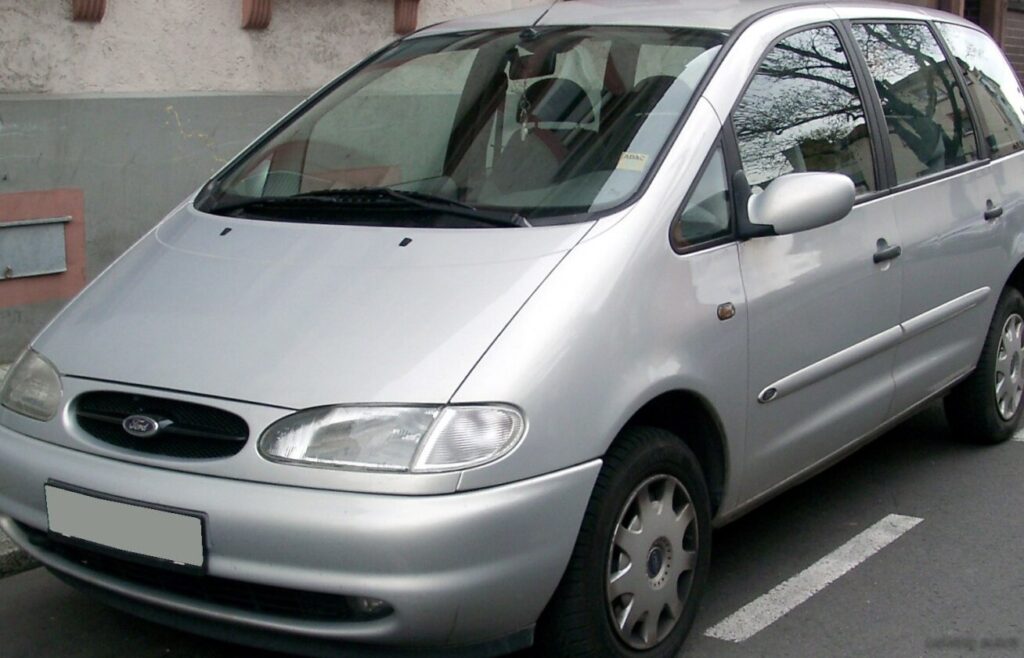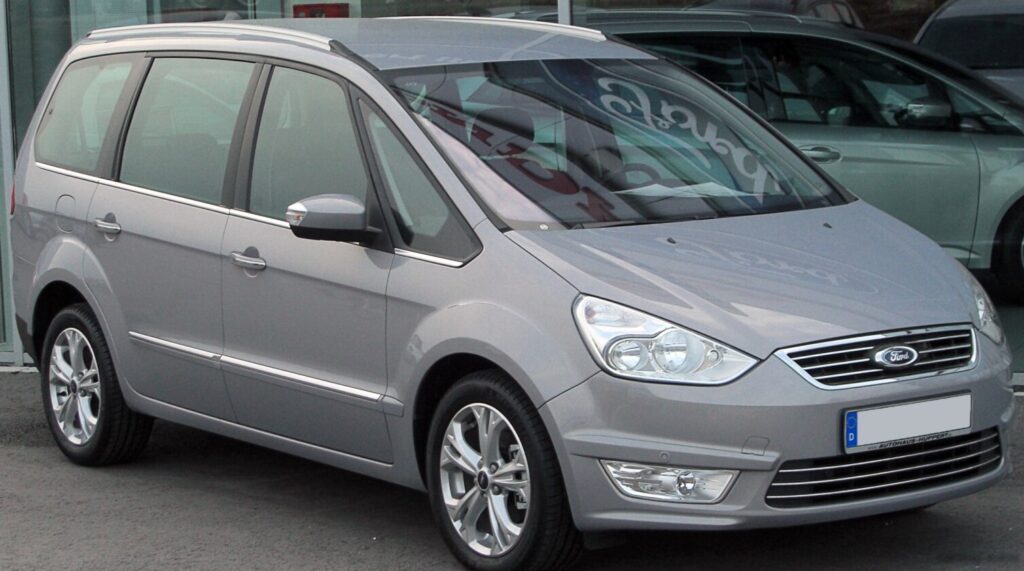
The Ford Galaxy II, specifically the facelifted version introduced in May 2010 and continuing through 2015, represented a significant evolution of Ford’s people-carrying offering in the European market. Positioned as a premium multi-purpose vehicle (MPV), the Galaxy competed with models like the Volkswagen Sharan and the Renault Espace. The 2.0 TDCi variant, producing 163 horsepower and paired with Ford’s PowerShift dual-clutch transmission, was a popular choice, offering a balance between fuel efficiency, performance, and practicality for families. This configuration aimed to provide a more refined driving experience than lower-powered versions while remaining more accessible than the higher-specification trims.
Technical Specifications
| Brand | Ford |
| Model | Galaxy |
| Generation | Galaxy II (facelift 2010) |
| Type (Engine) | 2.0 TDCi (163 Hp) PowerShift |
| Start of production | May, 2010 |
| End of production | 2015 |
| Powertrain Architecture | Internal Combustion engine |
| Body type | Minivan |
| Seats | 7 |
| Doors | 5 |
| Fuel consumption (economy) – urban (NEDC) | 7.4 l/100 km (31.8 US mpg, 38.2 UK mpg, 13.5 km/l) |
| Fuel consumption (economy) – extra urban (NEDC) | 5.2 l/100 km (45.2 US mpg, 54.3 UK mpg, 19.2 km/l) |
| Fuel consumption (economy) – combined (NEDC) | 6 l/100 km (39.2 US mpg, 47.1 UK mpg, 16.7 km/l) |
| CO2 emissions (NEDC) | 159 g/km |
| Fuel Type | Diesel |
| Acceleration 0 – 100 km/h | 10.4 sec |
| Acceleration 0 – 62 mph | 10.4 sec |
| Acceleration 0 – 60 mph | 9.9 sec |
| Maximum speed | 200 km/h (124.27 mph) |
| Emission standard | Euro 5 |
| Weight-to-power ratio | 10.2 kg/Hp, 98.4 Hp/tonne |
| Weight-to-torque ratio | 4.9 kg/Nm, 205.3 Nm/tonne |
| Power | 163 Hp @ 3750 rpm |
| Power per litre | 81.6 Hp/l |
| Torque | 340 Nm @ 2000-3250 rpm (250.77 lb.-ft. @ 2000-3250 rpm) |
| Engine layout | Front, Transverse |
| Engine Model/Code | TXWA |
| Engine displacement | 1997 cm3 (121.86 cu. in.) |
| Number of cylinders | 4 |
| Engine configuration | Inline |
| Cylinder Bore | 85 mm (3.35 in.) |
| Piston Stroke | 88 mm (3.46 in.) |
| Number of valves per cylinder | 4 |
| Fuel injection system | Diesel Commonrail |
| Engine aspiration | Turbocharger, Intercooler |
| Valvetrain | DOHC |
| Engine oil capacity | 5.5 l (5.81 US qt | 4.84 UK qt) |
| Coolant | 8.1 l (8.56 US qt | 7.13 UK qt) |
| Kerb Weight | 1656 kg (3650.86 lbs.) |
| Max. weight | 2505 kg (5522.58 lbs.) |
| Max load | 849 kg (1871.72 lbs.) |
| Trunk (boot) space – minimum | 308 l (10.88 cu. ft.) |
| Trunk (boot) space – maximum | 2325 l (82.11 cu. ft.) |
| Fuel tank capacity | 70 l (18.49 US gal | 15.4 UK gal) |
| Max. roof load | 75 kg (165.35 lbs.) |
| Permitted trailer load with brakes (8%) | 1800 kg (3968.32 lbs.) |
| Permitted trailer load with brakes (12%) | 1800 kg (3968.32 lbs.) |
| Permitted trailer load without brakes | 750 kg (1653.47 lbs.) |
| Permitted towbar download | 90 kg (198.42 lbs.) |
| Length | 4819 mm (189.72 in.) |
| Width | 1884 mm (74.17 in.) |
| Width with mirrors folded | 1961 mm (77.2 in.) |
| Width including mirrors | 2154 mm (84.8 in.) |
| Height | 1770-1811 mm (69.69 – 71.3 in.) |
| Wheelbase | 2850 mm (112.2 in.) |
| Front track | 1578-1588 mm (62.13 – 62.52 in.) |
| Rear (Back) track | 1595-1605 mm (62.8 – 63.19 in.) |
| Minimum turning circle (turning diameter) | 11.9 m (39.04 ft.) |
| Drivetrain Architecture | The Internal combustion engine (ICE) drives the front wheels of the vehicle. |
| Drive wheel | Front wheel drive |
| Number of gears and type of gearbox | 6 gears, automatic transmission PowerShift |
| Front suspension | Independent, type McPherson with coil spring and anti-roll bar |
| Rear suspension | Independent multi-link spring suspension with stabilizer |
| Front brakes | Ventilated discs |
| Rear brakes | Disc |
| Assisting systems | ABS (Anti-lock braking system) |
| Steering type | Steering rack and pinion |
| Power steering | Electric Steering |
| Tires size | 215/60 R16; 225/50 R17; 235/45 R18 |
| Wheel rims size | 6.5J x 16; 7J x 17; 8J x 18 |
INTRODUCTION
The Ford Galaxy II, launched in 2006 and receiving a significant facelift in 2010, was a key model for Ford of Europe, designed to cater to the growing demand for spacious and versatile family vehicles. Built on the Ford C1 platform (shared with the S-MAX), the Galaxy aimed to offer a more dynamic driving experience than traditional MPVs. The 2.0 TDCi 163 horsepower PowerShift variant, produced from 2010 to 2015, occupied a middle ground in the Galaxy lineup, offering a compelling blend of performance, economy, and features. It was positioned above the lower-powered 1.6 TDCi models and below the more expensive 2.2 TDCi versions.
Powertrain & Engine Architecture
The heart of this Galaxy variant is the Ford 2.0 TDCi engine, specifically the TXWA engine code. This is a four-cylinder, inline diesel engine featuring common-rail direct injection and a turbocharger with an intercooler. The engine benefits from Ford’s Duratorq technology, designed for improved refinement and efficiency. The common-rail system, supplied by Bosch, delivers fuel at extremely high pressure, optimizing combustion and reducing emissions. The engine utilizes a double overhead camshaft (DOHC) valvetrain with four valves per cylinder, enhancing breathing and contributing to its power output. The 163 horsepower peak is achieved at 3750 rpm, while the 340 Nm (250.77 lb.-ft.) of torque is available between 2000 and 3250 rpm, providing strong mid-range pull. Paired with this engine is Ford’s PowerShift six-speed dual-clutch transmission (DCT). This transmission offers quicker and smoother gear changes compared to a traditional automatic, contributing to a more engaging driving experience and improved fuel economy. The PowerShift utilizes two separate clutches, one for odd gears and one for even gears, allowing for pre-selection of the next gear and seamless shifts.
Driving Characteristics
The 2.0 TDCi 163 hp PowerShift Galaxy offers a comfortable and capable driving experience. While not overtly sporty, the engine provides sufficient power for everyday driving and overtaking maneuvers. The PowerShift transmission contributes to a responsive feel, although some drivers have reported occasional low-speed jerkiness, a known characteristic of early PowerShift units. The gear ratios are well-chosen, providing good acceleration in lower gears and relaxed cruising at highway speeds. Compared to the lower-powered 1.6 TDCi versions, the 2.0 TDCi feels noticeably more effortless, particularly when fully loaded with passengers and luggage. Against the 2.2 TDCi, the 2.0 TDCi offers a slightly less powerful experience, but the difference is often considered acceptable for the cost savings and improved fuel economy.
Equipment & Trim Levels
The 2.0 TDCi 163 hp PowerShift Galaxy typically came equipped with a generous level of standard features. These included air conditioning, electric front and rear windows, alloy wheels, a CD/radio system with steering wheel-mounted controls, and ABS brakes. Higher trim levels, such as Titanium, added features like leather upholstery, a panoramic sunroof, rear parking sensors, and a more advanced infotainment system. Optional extras included navigation, heated front seats, and a premium sound system. Interior upholstery was typically cloth on lower trims, with leather available as an upgrade. The dashboard layout was functional and well-designed, with clear instrumentation and intuitive controls.
Chassis & Braking
The Galaxy II utilizes an independent suspension setup on both the front and rear axles. The front suspension employs McPherson struts with coil springs and an anti-roll bar, while the rear features a multi-link setup, also with coil springs and a stabilizer bar. This configuration provides a comfortable ride quality and good handling characteristics. Braking duties are handled by ventilated discs on the front wheels and solid discs on the rear. ABS (Anti-lock Braking System) is standard, enhancing safety and stability during emergency braking. The steering is rack and pinion with electric power assistance, providing a light and precise feel.
Market Reception & Comparison
The Ford Galaxy II, and specifically the 2.0 TDCi PowerShift variant, received generally positive reviews from automotive critics. It was praised for its spacious interior, comfortable ride, and versatile seating configuration. The PowerShift transmission was often highlighted as a positive feature, although concerns about its long-term reliability were also noted. Fuel economy was considered to be good for a vehicle of its size and type. Compared to rivals like the Volkswagen Sharan and Renault Espace, the Galaxy offered a more engaging driving experience and a more modern interior design. However, some critics pointed to the slightly higher price tag compared to some competitors.
Legacy
The Ford Galaxy II 2.0 TDCi PowerShift has proven to be a relatively reliable vehicle, although the PowerShift transmission has been the subject of some concern. Early versions of the PowerShift were prone to issues such as clutch failure and software glitches, but Ford issued several updates to address these problems. Today, well-maintained examples of this Galaxy variant can be found on the used car market at reasonable prices. The 2.0 TDCi engine is generally considered to be durable and long-lasting, provided it has been regularly serviced. The Galaxy II remains a popular choice for families seeking a spacious, practical, and comfortable MPV.