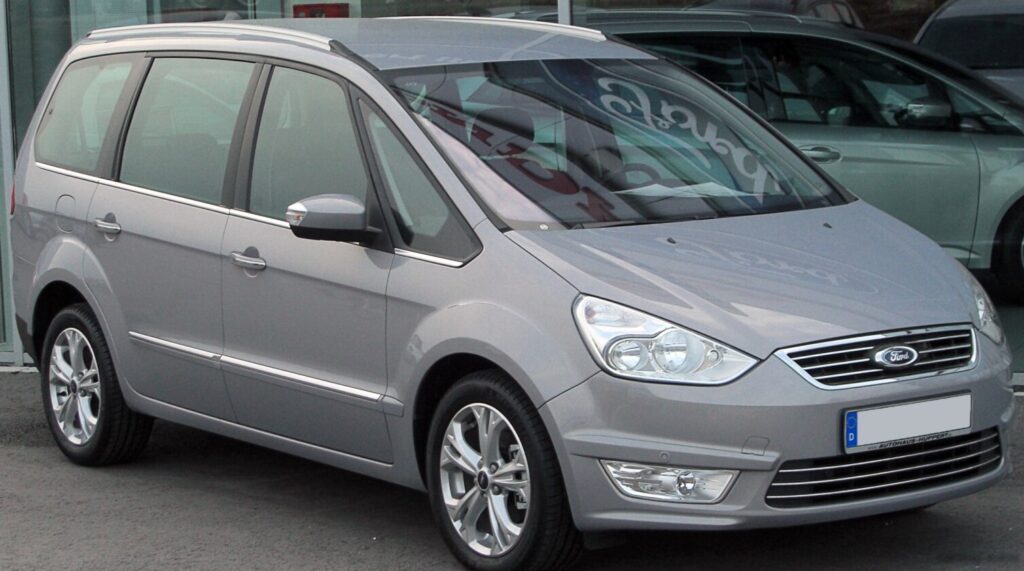
The Ford Galaxy II, specifically the facelifted version introduced in 2010, represented a significant evolution of Ford’s popular people carrier. This iteration, produced through 2015, continued the Galaxy’s role as a spacious and versatile family vehicle, primarily aimed at the European market. The 2.2 TDCi variant, producing 200 horsepower, occupied a mid-to-upper position within the Galaxy II lineup, offering a balance of performance and fuel efficiency. It was positioned above the lower-powered diesel options and below potential future performance trims, appealing to buyers needing substantial power for long journeys and hauling capacity. The Galaxy II, built on the Ford C1 platform (shared with the S-MAX), aimed to provide a more dynamic driving experience than some of its competitors while maintaining the practicality expected of a minivan.
Technical Specifications
| Brand | Ford |
| Model | Galaxy |
| Generation | Galaxy II (facelift 2010) |
| Type (Engine) | 2.2 TDCi (200 Hp) |
| Start of production | 2010 |
| End of production | 2015 |
| Powertrain Architecture | Internal Combustion engine |
| Body type | Minivan |
| Seats | 7 |
| Doors | 5 |
| Fuel consumption (economy) – urban (NEDC) | 8.4 l/100 km (28 US mpg, 33.6 UK mpg, 11.9 km/l) |
| Fuel consumption (economy) – extra urban (NEDC) | 5.8 l/100 km (40.6 US mpg, 48.7 UK mpg, 17.2 km/l) |
| Fuel consumption (economy) – combined (NEDC) | 6.8 l/100 km (34.6 US mpg, 41.5 UK mpg, 14.7 km/l) |
| CO2 emissions (NEDC) | 179 g/km |
| Fuel Type | Diesel |
| Acceleration 0 – 100 km/h | 8.8 sec |
| Acceleration 0 – 62 mph | 8.8 sec |
| Acceleration 0 – 60 mph | 8.4 sec |
| Maximum speed | 215 km/h (133.59 mph) |
| Emission standard | Euro 5 |
| Weight-to-power ratio | 8.8 kg/Hp, 113.3 Hp/tonne |
| Weight-to-torque ratio | 4.2 kg/Nm, 238 Nm/tonne |
| Power | 200 Hp @ 3500 rpm |
| Power per litre | 91.8 Hp/l |
| Torque | 420 Nm @ 1750-3000 rpm (309.78 lb.-ft. @ 1750-3000 rpm) |
| Engine layout | Front, Transverse |
| Engine Model/Code | KNWA |
| Engine displacement | 2179 cm3 (132.97 cu. in.) |
| Number of cylinders | 4 |
| Engine configuration | Inline |
| Cylinder Bore | 85 mm (3.35 in.) |
| Piston Stroke | 96 mm (3.78 in.) |
| Number of valves per cylinder | 4 |
| Fuel injection system | Diesel Commonrail |
| Engine aspiration | Turbocharger, Intercooler |
| Valvetrain | DOHC |
| Engine oil capacity | 6 l (6.34 US qt | 5.28 UK qt) |
| Coolant | 8.4 l (8.88 US qt | 7.39 UK qt) |
| Kerb Weight | 1765 kg (3891.16 lbs.) |
| Max. weight | 2505 kg (5522.58 lbs.) |
| Max load | 740 kg (1631.42 lbs.) |
| Trunk (boot) space – minimum | 308 l (10.88 cu. ft.) |
| Trunk (boot) space – maximum | 2325 l (82.11 cu. ft.) |
| Fuel tank capacity | 70 l (18.49 US gal | 15.4 UK gal) |
| Max. roof load | 75 kg (165.35 lbs.) |
| Permitted trailer load with brakes (8%) | 2000 kg (4409.25 lbs.) |
| Permitted trailer load with brakes (12%) | 1800 kg (3968.32 lbs.) |
| Permitted trailer load without brakes | 750 kg (1653.47 lbs.) |
| Permitted towbar download | 90 kg (198.42 lbs.) |
| Length | 4819 mm (189.72 in.) |
| Width | 1884 mm (74.17 in.) |
| Width with mirrors folded | 1961 mm (77.2 in.) |
| Width including mirrors | 2154 mm (84.8 in.) |
| Height | 1770-1811 mm (69.69 – 71.3 in.) |
| Wheelbase | 2850 mm (112.2 in.) |
| Front track | 1578-1588 mm (62.13 – 62.52 in.) |
| Rear (Back) track | 1595-1605 mm (62.8 – 63.19 in.) |
| Minimum turning circle (turning diameter) | 11.9 m (39.04 ft.) |
| Drivetrain Architecture | The Internal combustion engine (ICE) drives the front wheels of the vehicle. |
| Drive wheel | Front wheel drive |
| Number of gears and type of gearbox | 6 gears, manual transmission |
| Front suspension | Independent, type McPherson with coil spring and anti-roll bar |
| Rear suspension | Independent multi-link spring suspension with stabilizer |
| Front brakes | Ventilated discs |
| Rear brakes | Disc |
| Assisting systems | ABS (Anti-lock braking system) |
| Steering type | Steering rack and pinion |
| Power steering | Electric Steering |
| Tires size | 225/50 R17; 235/45 R18 |
| Wheel rims size | 7J x 17; 8J x 18 |
INTRODUCTION
The Ford Galaxy II (facelift 2010) 2.2 TDCi 200 hp model represents a compelling option within the second-generation Galaxy range. Introduced as part of a mid-cycle refresh in 2010, this variant combined a potent diesel engine with a practical seven-seat layout, targeting families and individuals requiring substantial space and towing capacity. Built on the Ford C1 platform, also underpinning the S-MAX, the Galaxy II aimed to offer a more engaging driving experience than traditional minivans. The 2.2-liter TDCi engine, a mainstay of Ford’s diesel lineup, provided a significant power upgrade over the lower-spec engines, making it suitable for both urban driving and long-distance highway journeys. This particular engine and trim level was a popular choice in European markets, offering a balance between performance, economy, and price.
Powertrain & Engine Architecture
The heart of this Galaxy variant is the 2.2-liter Duratorq TDCi diesel engine, identified by the engine code KNWA. This engine is a four-cylinder, inline configuration, utilizing a common-rail direct fuel injection system. The common-rail system, operating at very high pressures, ensures precise fuel delivery and contributes to both power and efficiency. The engine features a variable geometry turbocharger (VGT) and an intercooler, further enhancing performance. The DOHC (Double Overhead Camshaft) valvetrain, with four valves per cylinder, optimizes gas flow for improved combustion. The 200 horsepower output is achieved at 3500 rpm, while the substantial 420 Nm (309.78 lb.-ft.) of torque is available between 1750 and 3000 rpm, providing strong pulling power. The engine is transversely mounted in the front of the vehicle. The Galaxy II 2.2 TDCi typically came equipped with a six-speed manual transmission, although a six-speed automatic transmission was also available as an option. The automatic transmission was designed to provide smooth gear changes and enhance driving comfort, but it did slightly impact fuel economy compared to the manual version.
Driving Characteristics
The 2.2 TDCi engine in the Galaxy II delivers a noticeable step up in performance compared to the lower-powered diesel options. The readily available torque makes overtaking and hill climbing effortless. While not a sports car, the Galaxy II 2.2 TDCi offers a surprisingly responsive driving experience for a minivan. The six-speed manual transmission allows drivers to maintain optimal engine speed for efficient cruising or spirited acceleration. The automatic transmission, while convenient, can feel slightly less engaging and may exhibit some hesitation during quick downshifts. The Galaxy’s suspension, tuned for comfort, absorbs bumps and imperfections in the road well, providing a smooth ride for passengers. However, this does translate to some body roll during cornering. The steering is precise and well-weighted, offering a decent level of feedback. Overall, the driving experience is refined and comfortable, making it well-suited for long journeys.
Equipment & Trim Levels
The 2.2 TDCi variant of the Galaxy II was typically offered in higher trim levels, such as Titanium or Ghia, depending on the market. Standard equipment generally included air conditioning, power windows, power mirrors, a CD/radio system with auxiliary input, and alloy wheels. Higher trims added features like leather upholstery, heated front seats, a sunroof, rear parking sensors, and a more advanced audio system with navigation. Optional extras included a panoramic sunroof, a DVD entertainment system for rear passengers, and advanced safety features like adaptive cruise control and lane departure warning. The interior design was functional and well-built, with a focus on practicality and durability. The seven-seat configuration offered flexible seating arrangements, with the rear seats folding flat to maximize cargo space.
Chassis & Braking
The Galaxy II utilizes an independent suspension system on both the front and rear axles. The front suspension employs a McPherson strut design with coil springs and an anti-roll bar, while the rear suspension features a multi-link setup, also with coil springs and a stabilizer bar. This configuration provides a good balance of ride comfort and handling. The braking system consists of ventilated discs on the front wheels and solid discs on the rear wheels. ABS (Anti-lock Braking System) is standard, enhancing safety during emergency braking situations. The steering system is a rack and pinion type with electric power assistance, providing precise and responsive steering feel.
Market Reception & Comparison
The Ford Galaxy II 2.2 TDCi 200 hp received generally positive reviews from automotive critics. It was praised for its spacious interior, comfortable ride, and strong engine performance. The 2.2 TDCi engine was considered a good compromise between power and fuel economy. Compared to the lower-powered diesel variants, the 2.2 TDCi offered a significant performance boost, making it more suitable for drivers who frequently carry passengers or tow trailers. However, it was also noted that the automatic transmission could sometimes feel sluggish. In terms of fuel economy, the 2.2 TDCi achieved around 34.6 US mpg on the combined cycle, which was competitive for a vehicle of its size and weight. Reliability was generally good, although some owners reported issues with the diesel particulate filter (DPF) and the dual-mass flywheel.
Legacy
The Ford Galaxy II 2.2 TDCi 200 hp remains a popular choice in the used car market, particularly for families seeking a spacious and versatile vehicle. The Duratorq TDCi engine is known for its durability, although regular maintenance is essential to prevent issues with the DPF and dual-mass flywheel. The Galaxy II’s practical interior, comfortable ride, and strong performance continue to appeal to buyers today. While newer minivans and SUVs offer more advanced technology and features, the Galaxy II 2.2 TDCi represents a solid and reliable option for those seeking a well-rounded family vehicle at a reasonable price.