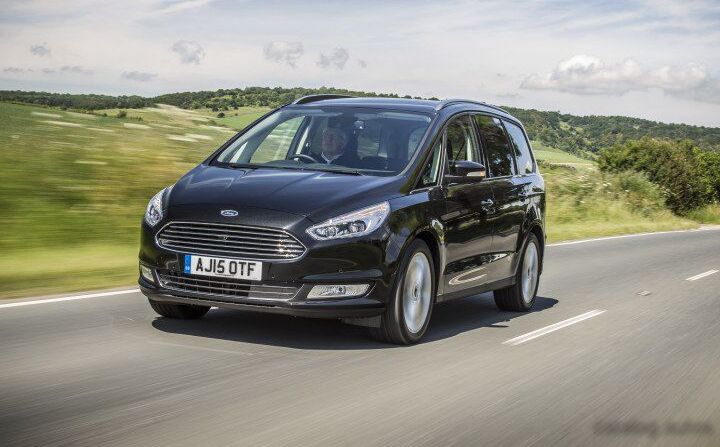
The Ford Galaxy III 2.0 EcoBlue Bi-Turbo (240 Hp) Automatic S&S represents a sophisticated iteration of Ford’s long-running people carrier, produced between 2018 and 2019. Positioned as a high-end trim within the Galaxy III range (introduced in 2015, based on the EUCD platform shared with the Ford S-Max and Mondeo), this variant aimed to deliver a blend of performance, efficiency, and practicality for families and those requiring substantial passenger and cargo space. It was primarily marketed in Europe, where large MPVs remained a popular choice, offering a premium alternative to smaller crossovers and SUVs.
Technical Specifications
| Brand | Ford |
| Model | Galaxy |
| Generation | Galaxy III |
| Type | 2.0 EcoBlue Bi-Turbo (240 Hp) Automatic S&S |
| Start of production | 2018 |
| End of production | 2019 |
| Powertrain Architecture | Internal Combustion engine |
| Body type | Minivan |
| Seats | 5-7 |
| Doors | 5 |
| Fuel consumption (urban) | 7.3-7.4 l/100 km (32.2 – 31.8 US mpg) |
| Fuel consumption (extra urban) | 5.4 l/100 km (43.6 US mpg) |
| Fuel consumption (combined) | 6.1-6.3 l/100 km (38.6 – 37.3 US mpg) |
| CO2 emissions | 158-163 g/km |
| Fuel Type | Diesel |
| Acceleration 0 – 100 km/h | 8.7 sec |
| Acceleration 0 – 62 mph | 8.7 sec |
| Acceleration 0 – 60 mph | 8.3 sec |
| Maximum speed | 216 km/h (134.22 mph) |
| Emission standard | Euro 6 d-TEMP |
| Weight-to-power ratio | 7.1 kg/Hp |
| Weight-to-torque ratio | 3.4 kg/Nm |
| Power | 240 Hp @ 4000 rpm |
| Torque | 500 Nm @ 2000 rpm (368.78 lb.-ft. @ 2000 rpm) |
| Engine layout | Front, Transverse |
| Engine Model/Code | YLCB |
| Engine displacement | 1997 cm3 (121.86 cu. in.) |
| Number of cylinders | 4 |
| Engine configuration | Inline |
| Cylinder Bore | 85 mm (3.35 in.) |
| Piston Stroke | 88 mm (3.46 in.) |
| Compression ratio | 16:1 |
| Number of valves per cylinder | 4 |
| Fuel injection system | Diesel Commonrail |
| Engine aspiration | BiTurbo, Intercooler |
| Valvetrain | DOHC |
| Engine oil capacity | 6.4 l (6.76 US qt | 5.63 UK qt) |
| Coolant | 10.7 l (11.31 US qt | 9.41 UK qt) |
| Kerb Weight | 1704 kg (3756.68 lbs.) |
| Max. weight | 2620 kg (5776.11 lbs.) |
| Max load | 916 kg (2019.43 lbs.) |
| Trunk (boot) space – minimum | 300 l (10.59 cu. ft.) |
| Trunk (boot) space – maximum | 2339 l (82.6 cu. ft.) |
| Fuel tank capacity | 70 l (18.49 US gal | 15.4 UK gal) |
| Permitted trailer load with brakes (8%) | 2000 kg (4409.25 lbs.) |
| Permitted trailer load with brakes (12%) | 2000 kg (4409.25 lbs.) |
| Permitted trailer load without brakes | 750 kg (1653.47 lbs.) |
| Permitted towbar download | 90 kg (198.42 lbs.) |
| Length | 4848 mm (190.87 in.) |
| Width | 1916 mm (75.43 in.) |
| Width with mirrors folded | 1953 mm (76.89 in.) |
| Width including mirrors | 2137 mm (84.13 in.) |
| Height | 1747 mm (68.78 in.) |
| Wheelbase | 2849 mm (112.17 in.) |
| Front track | 1606 mm (63.23 in.) |
| Rear track | 1606 mm (63.23 in.) |
| Ride height (ground clearance) | 124 mm (4.88 in.) |
| Minimum turning circle | 12 m (39.37 ft.) |
| Drivetrain Architecture | Front wheel drive |
| Number of gears | 8 |
| Gearbox type | Automatic transmission |
| Front suspension | Independent, McPherson with coil spring and anti-roll bar |
| Rear suspension | Independent multi-link spring suspension with stabilizer |
| Front brakes | Ventilated discs |
| Rear brakes | Disc |
| Assisting systems | ABS (Anti-lock braking system) |
| Steering type | Steering rack and pinion |
| Tires size | 235/55 R17; 235/50 R18; 245/45 R19 |
| Wheel rims size | 7.5J x 17; 7.5J x 18; 8J x 19 |
INTRODUCTION
The Ford Galaxy III 2.0 EcoBlue Bi-Turbo Automatic S&S, launched in 2018, represented a significant upgrade within the third-generation Galaxy lineup. Building upon the foundation laid by the initial 2015 models, this variant offered a potent diesel engine paired with a smooth-shifting eight-speed automatic transmission. The “S&S” designation indicates the inclusion of Ford’s Start/Stop technology, aimed at improving fuel economy in urban driving conditions. This trim level was positioned towards the higher end of the Galaxy range, appealing to buyers who prioritized performance and refinement alongside the MPV’s inherent practicality.
Powertrain & Engine Architecture
At the heart of this Galaxy variant lies Ford’s 2.0-liter EcoBlue Bi-Turbo diesel engine, identified by the code YLCB. This engine is a member of Ford’s EcoBlue family, known for its focus on efficiency and reduced emissions. The ‘Bi-Turbo’ configuration utilizes two turbochargers – a smaller, low-inertia turbo for immediate response and a larger turbo for sustained power at higher engine speeds. This setup effectively minimizes turbo lag and delivers a broad torque curve. The engine employs a common-rail direct fuel injection system, operating at extremely high pressures to optimize combustion. The valvetrain features a double overhead camshaft (DOHC) design with four valves per cylinder. The eight-speed automatic transmission, sourced from Aisin, provides smooth and efficient gear changes, contributing to both performance and fuel economy. This transmission is known for its responsiveness and ability to adapt to various driving conditions.
Driving Characteristics
The 240 horsepower and 368 lb-ft of torque produced by the 2.0 EcoBlue Bi-Turbo engine provide the Galaxy III with surprisingly brisk acceleration for a large MPV. The 0-60 mph sprint is dispatched in around 8.3 seconds, and the car feels composed and stable even when fully loaded. The eight-speed automatic transmission is well-matched to the engine’s characteristics, offering seamless shifts and keeping the engine within its optimal power band. Compared to lower-powered Galaxy variants (like the 1.5 EcoBlue), this version offers a noticeably more relaxed driving experience, particularly when overtaking or climbing hills. While not a sports car, the 2.0 Bi-Turbo provides ample power for confident and comfortable long-distance cruising. The automatic transmission, while convenient, doesn’t offer the same level of driver engagement as a manual gearbox.
Equipment & Trim Levels
The S&S trim level typically included a generous array of standard features. Interior appointments generally featured comfortable cloth or leather upholstery, depending on optional packages. The dashboard layout is modern and functional, with a central touchscreen infotainment system providing access to navigation, audio controls, and vehicle settings. Standard equipment often included features like automatic climate control, cruise control, parking sensors, and a rearview camera. Optional extras could include a panoramic sunroof, premium sound system, adaptive cruise control, and advanced driver-assistance systems (ADAS) such as lane-keeping assist and automatic emergency braking.
Chassis & Braking
The Galaxy III utilizes an independent suspension setup on both the front and rear axles. The front suspension employs a McPherson strut design with a coil spring and anti-roll bar, while the rear features a multi-link setup, also with a stabilizer bar. This configuration provides a good balance between ride comfort and handling. Braking duties are handled by ventilated discs on the front wheels and solid discs on the rear. The car is equipped with an Anti-lock Braking System (ABS) as standard, enhancing safety and control during emergency braking situations. The steering is rack and pinion, providing precise and responsive steering feel.
Market Reception & Comparison
The Ford Galaxy III 2.0 EcoBlue Bi-Turbo Automatic S&S was generally well-received by automotive critics. Reviewers praised the engine’s performance, the transmission’s smoothness, and the Galaxy’s overall practicality and spaciousness. Fuel economy was considered competitive for its class, although real-world figures could vary depending on driving style and load. Compared to the lower-powered 1.5 EcoBlue variants, the 2.0 Bi-Turbo offered a significant performance upgrade, justifying the higher price tag for buyers who frequently travel long distances or carry heavy loads. However, some critics noted that the Galaxy’s size could make it challenging to maneuver in tight urban environments.
Legacy
The 2.0 EcoBlue Bi-Turbo engine has proven to be a relatively reliable unit, although, like any diesel engine, it requires regular maintenance and the use of high-quality oil. The eight-speed automatic transmission has also demonstrated good durability. On the used car market, Galaxy III 2.0 EcoBlue Bi-Turbo models tend to command a premium over lower-powered variants, reflecting their superior performance and refinement. These models remain a popular choice for families and those seeking a versatile and spacious MPV with a comfortable driving experience. The Galaxy, in general, has maintained a reputation for being a practical and dependable vehicle, and this particular variant continues to offer a compelling blend of performance, efficiency, and space.