Technical Specifications
| Brand | Ford |
| Model | Galaxy |
| Generation | Galaxy III |
| Type (Engine) | 2.0 TDCi (210 Hp) Powershift S&S |
| Start of production | 2015 |
| End of production | 2018 |
| Powertrain Architecture | Internal Combustion engine |
| Body type | Minivan |
| Seats | 5-7 |
| Doors | 5 |
| Fuel consumption (urban) | 6.3 l/100 km (37.3 US mpg, 44.8 UK mpg, 15.9 km/l) |
| Fuel consumption (extra urban) | 5.1 l/100 km (46.1 US mpg, 55.4 UK mpg, 19.6 km/l) |
| Fuel consumption (combined) | 5.5 l/100 km (42.8 US mpg, 51.4 UK mpg, 18.2 km/l) |
| CO2 emissions | 144 g/km |
| Fuel Type | Diesel |
| Acceleration 0 – 100 km/h | 8.9 sec |
| Acceleration 0 – 62 mph | 8.9 sec |
| Acceleration 0 – 60 mph | 8.5 sec |
| Maximum speed | 214 km/h (132.97 mph) |
| Emission standard | Euro 6 |
| Weight-to-power ratio | 8.1 kg/Hp, 123.2 Hp/tonne |
| Weight-to-torque ratio | 3.8 kg/Nm, 264.1 Nm/tonne |
| Power | 210 Hp @ 3750 rpm |
| Torque | 450 Nm @ 2000-2250 rpm (331.9 lb.-ft. @ 2000-2250 rpm) |
| Engine layout | Front, Transverse |
| Engine Model/Code | T9CB, T9CC, T9CD |
| Engine displacement | 1997 cm3 (121.86 cu. in.) |
| Number of cylinders | 4 |
| Engine configuration | Inline |
| Cylinder Bore | 85 mm (3.35 in.) |
| Piston Stroke | 88 mm (3.46 in.) |
| Compression ratio | 16:1 |
| Number of valves per cylinder | 4 |
| Fuel injection system | Diesel Commonrail |
| Engine aspiration | BiTurbo, Intercooler |
| Valvetrain | DOHC |
| Engine oil capacity | 6.1 l (6.45 US qt | 5.37 UK qt) |
| Coolant | 8.2 l (8.66 US qt | 7.21 UK qt) |
| Kerb Weight | 1704 kg (3756.68 lbs.) |
| Max. weight | 2620 kg (5776.11 lbs.) |
| Max load | 916 kg (2019.43 lbs.) |
| Trunk (boot) space – minimum | 300 l (10.59 cu. ft.) |
| Trunk (boot) space – maximum | 2339 l (82.6 cu. ft.) |
| Fuel tank capacity | 70 l (18.49 US gal | 15.4 UK gal) |
| Permitted trailer load with brakes (8%) | 2000 kg (4409.25 lbs.) |
| Permitted trailer load with brakes (12%) | 2000 kg (4409.25 lbs.) |
| Permitted trailer load without brakes | 750 kg (1653.47 lbs.) |
| Permitted towbar download | 90 kg (198.42 lbs.) |
| Length | 4848 mm (190.87 in.) |
| Width | 1916 mm (75.43 in.) |
| Width with mirrors folded | 1953 mm (76.89 in.) |
| Width including mirrors | 2137 mm (84.13 in.) |
| Height | 1747 mm (68.78 in.) |
| Wheelbase | 2849 mm (112.17 in.) |
| Front track | 1606 mm (63.23 in.) |
| Rear (Back) track | 1606 mm (63.23 in.) |
| Ride height (ground clearance) | 124 mm (4.88 in.) |
| Minimum turning circle (turning diameter) | 12 m (39.37 ft.) |
| Drivetrain Architecture | The Internal combustion engine (ICE) drives the front wheels of the vehicle. |
| Drive wheel | Front wheel drive |
| Number of gears and type of gearbox | 6 gears, automatic transmission Powershift |
| Front suspension | Independent, type McPherson with coil spring and anti-roll bar |
| Rear suspension | Independent multi-link spring suspension with stabilizer |
| Front brakes | Ventilated discs |
| Rear brakes | Disc |
| Assisting systems | ABS (Anti-lock braking system) |
| Steering type | Steering rack and pinion |
| Tires size | 235/55 R17; 235/50 R18; 245/45 R19 |
| Wheel rims size | 7.5J x 17; 7.5J x 18; 8J x 19 |
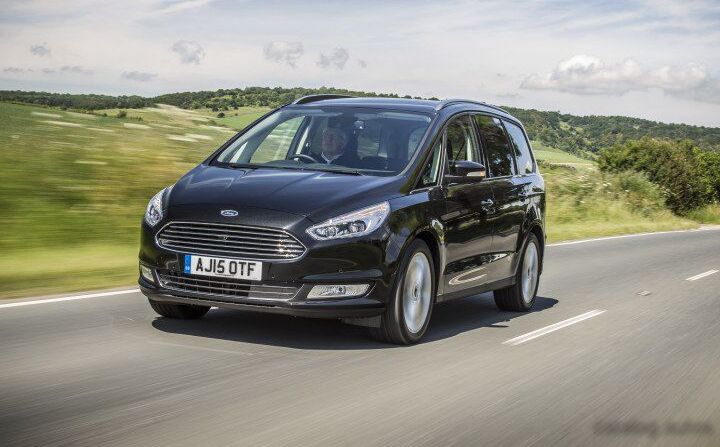
The Ford Galaxy III 2.0 TDCi (210 Hp) Powershift S&S, produced between 2015 and 2018, represents a refined iteration of Ford’s popular minivan. Positioned as a mid-to-high trim level within the Galaxy III range, this variant aimed to strike a balance between fuel efficiency and respectable performance, catering to families and those needing a versatile seven-seat vehicle. Built on the CD2 platform – shared with models from Ford and Volvo – it was primarily marketed in Europe as a competitor to vehicles like the Volkswagen Sharan and Citroën C4 Picasso.
Powertrain & Engine Architecture
At the core of this Galaxy variant lies the 2.0-liter TDCi diesel engine, identified by engine codes T9CB, T9CC, or T9CD depending on the production year and specific market. This engine is a four-cylinder, inline design featuring a sophisticated bi-turbocharger system. The two turbochargers operate sequentially – a smaller turbocharger provides boost at lower engine speeds for improved responsiveness, while a larger turbocharger takes over at higher speeds for sustained power output. This setup effectively minimizes turbo lag and delivers a wider, more usable torque curve. Fuel delivery is managed by a common-rail direct injection system, operating at high pressures to ensure efficient combustion. An intercooler further enhances performance by cooling the intake air. The engine is coupled with Ford’s six-speed Powershift dual-clutch transmission (DCT). This transmission offers quicker and smoother gear changes compared to a traditional automatic, contributing to both performance and fuel economy. While praised for its efficiency, the Powershift transmission has experienced some reliability concerns, particularly related to clutch pack wear.
Driving Characteristics
The 210 horsepower and 450 Nm (331.9 lb-ft) of torque provide the Galaxy III 2.0 TDCi with adequate performance for a large minivan. Acceleration from 0-60 mph is achieved in approximately 8.5 seconds, and it offers a comfortable cruising speed on highways. The Powershift transmission contributes to a more engaging driving experience than a conventional automatic, with quick shifts and a direct feel. However, it’s not designed for sporty driving; the emphasis is on providing a smooth and relaxed ride. Compared to the lower-powered 1.5 TDCi versions, the 2.0 TDCi offers significantly more pulling power, especially when carrying a full load of passengers and luggage. It also handles overtaking maneuvers with greater ease. In contrast to the gasoline-powered versions, the diesel engine delivers superior fuel economy and torque, although it lacks the immediate responsiveness of a petrol engine.
Equipment & Trim Levels
The 2.0 TDCi Powershift S&S trim typically included a comprehensive suite of standard features. These often encompassed alloy wheels, automatic climate control, a touchscreen infotainment system with navigation, parking sensors, and cruise control. The “S&S” designation signifies the inclusion of Ford’s Start/Stop system, designed to improve fuel economy by automatically shutting off the engine when the vehicle is stationary. Interior upholstery was generally cloth or a combination of cloth and leather, with higher trim levels offering full leather options. Optional extras included a panoramic sunroof, an upgraded sound system, and advanced driver-assistance systems such as lane-keeping assist and adaptive cruise control.
Chassis & Braking
The Galaxy III utilizes an independent suspension system on both the front and rear axles. The front suspension employs McPherson struts with coil springs and an anti-roll bar, while the rear features a multi-link setup, also incorporating a stabilizer bar. This configuration delivers a comfortable ride quality, even on uneven road surfaces. Braking is provided by ventilated discs on the front wheels and solid discs on the rear. The vehicle is equipped with ABS (Anti-lock Braking System) as standard. The suspension tuning prioritizes comfort and stability over sporty handling, aligning with the vehicle’s intended purpose as a family transport.
Market Reception & Comparison
The Ford Galaxy III 2.0 TDCi Powershift S&S generally received positive reviews from automotive critics. It was lauded for its spacious interior, comfortable ride, and fuel efficiency. The Powershift transmission was noted for its responsiveness, although concerns regarding its long-term reliability were frequently mentioned. Compared to competitors like the Volkswagen Sharan, the Galaxy offered a more affordable price point and a slightly more dynamic driving experience. However, the Sharan was often perceived as having a more premium interior. Fuel economy figures of around 42.8 US mpg combined were competitive within its class.
Legacy
The 2.0 TDCi Powershift powertrain has proven to be generally reliable, although the Powershift transmission remains a potential area of concern. Regular maintenance, including fluid changes, is crucial for ensuring the longevity of the transmission. In the used car market, the Galaxy III 2.0 TDCi Powershift S&S represents a good value proposition for buyers seeking a spacious and efficient seven-seat minivan. However, prospective buyers should be aware of the potential issues with the Powershift transmission and thoroughly inspect the vehicle before making a purchase. The Galaxy III, overall, continues to be a popular choice for families due to its practicality and versatility.