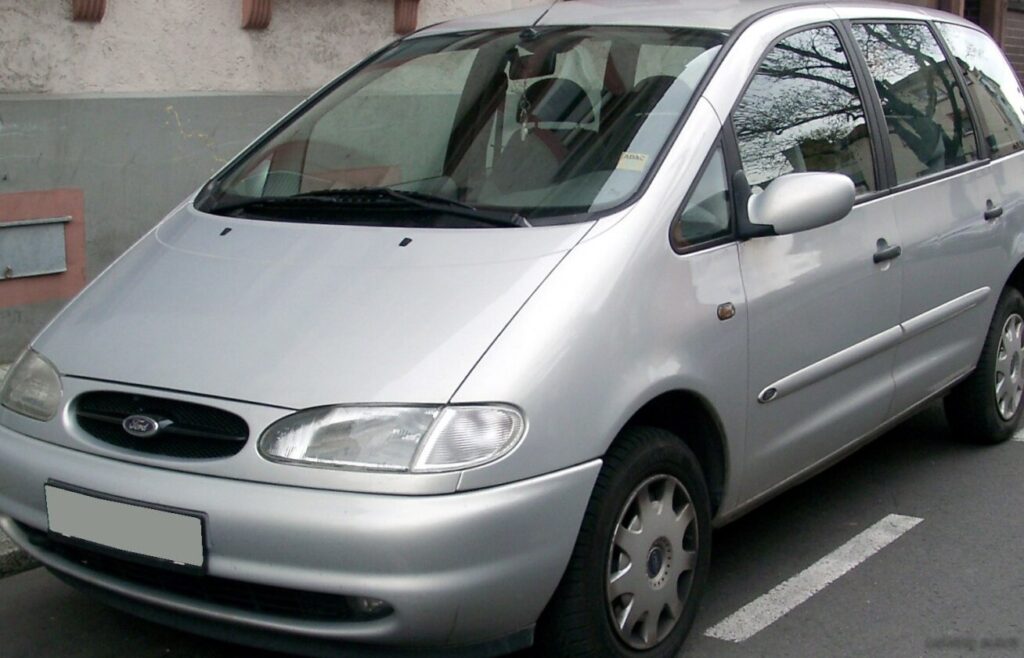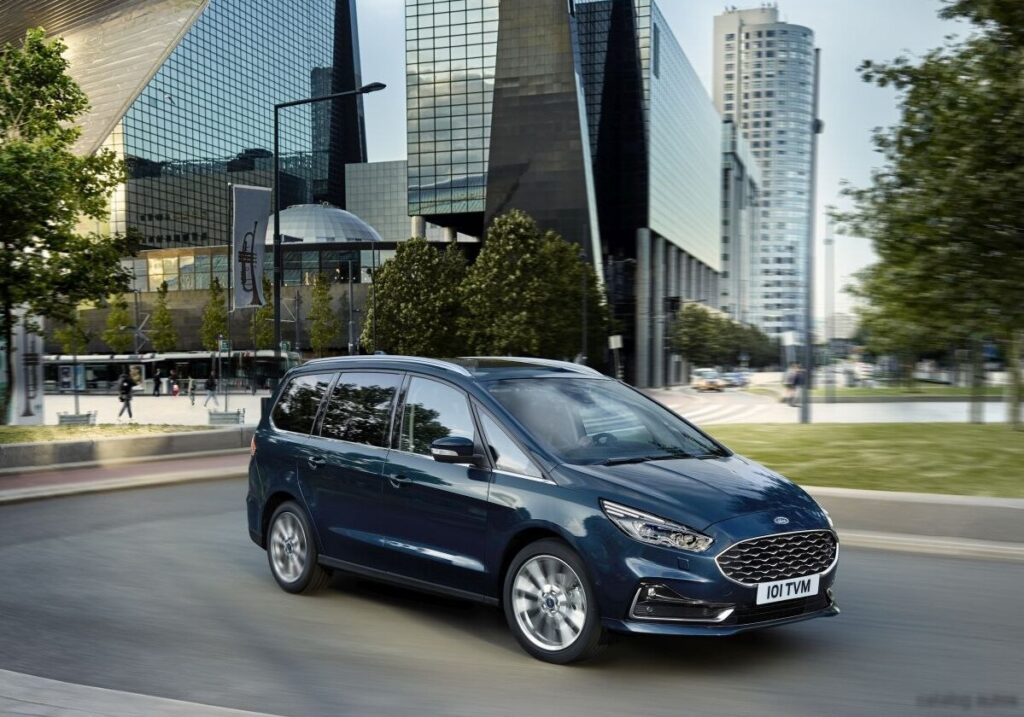
The Ford Galaxy III (facelift, 2019) 2.5 Duratec (190 Hp) Hybrid CVT 7-seat model represents a significant iteration of Ford’s long-running people carrier. Introduced in 2021 and continuing production until April 2023, this variant occupied a premium position within the Galaxy III range, offering a blend of space, comfort, and fuel efficiency through its full hybrid powertrain. It was primarily marketed in Europe, where large MPVs remained popular for family transport, and aimed at buyers seeking a practical yet technologically advanced vehicle.
Technical Specifications
| Brand | Ford |
| Model | Galaxy |
| Generation | Galaxy III (facelift 2019) |
| Type | 2.5 Duratec (190 Hp) Hybrid CVT 7 seats |
| Start of production | 2021 |
| End of production | April, 2023 |
| Powertrain Architecture | FHEV (Full Hybrid Electric Vehicle) |
| Body type | Minivan |
| Seats | 7 |
| Doors | 5 |
| Combined fuel consumption (WLTP) | 6.5 l/100 km (36.2 US mpg, 43.5 UK mpg, 15.4 km/l) |
| CO2 emissions (WLTP) | 148 g/km |
| Fuel consumption (urban NEDC) | 6.5-6.6 l/100 km (36.2 – 35.6 US mpg, 43.5 – 42.8 UK mpg, 15.4 – 15.2 km/l) |
| Fuel consumption (extra urban NEDC) | 5.5 l/100 km (42.8 US mpg, 51.4 UK mpg, 18.2 km/l) |
| Fuel consumption (combined NEDC) | 5.8-5.9 l/100 km (40.6 – 39.9 US mpg, 48.7 – 47.9 UK mpg, 17.2 – 16.9 km/l) |
| CO2 emissions (NEDC) | 134-135 g/km |
| Fuel Type | Petrol (Gasoline) |
| Acceleration 0 – 100 km/h | 10 sec |
| Acceleration 0 – 62 mph | 10 sec |
| Acceleration 0 – 60 mph | 9.5 sec |
| Maximum speed | 182 km/h (113.09 mph) |
| Emission standard | Euro 6d-ISC-FCM |
| Weight-to-power ratio | 10 kg/Hp, 99.8 Hp/tonne |
| Weight-to-torque ratio | 9.5 kg/Nm, 105.1 Nm/tonne |
| Gross battery capacity | 1.1 kWh |
| Battery technology | Lithium-ion (Li-Ion) |
| Battery location | Below the floor |
| Electric motor power | 133 Hp |
| System power | 190 Hp |
| Internal combustion engine power | 150 Hp |
| Power per litre | 60.3 Hp/l |
| Torque | 200 Nm @ 4500 rpm (147.51 lb.-ft. @ 4500 rpm) |
| Engine layout | Front, Transverse |
| Engine Model/Code | BGCA |
| Engine displacement | 2488 cm3 (151.83 cu. in.) |
| Number of cylinders | 4 |
| Engine configuration | Inline |
| Cylinder Bore | 89 mm (3.5 in.) |
| Piston Stroke | 100 mm (3.94 in.) |
| Number of valves per cylinder | 4 |
| Valvetrain | DOHC |
| Engine oil capacity | 5.4 l (5.71 US qt, 4.75 UK qt) |
| Kerb Weight | 1903 kg (4195.4 lbs.) |
| Max. weight | 2596 kg (5723.2 lbs.) |
| Max load | 693 kg (1527.8 lbs.) |
| Trunk (boot) space – minimum | 1206 l (42.59 cu. ft.) |
| Trunk (boot) space – maximum | 2339 l (82.6 cu. ft.) |
| Fuel tank capacity | 65 l (17.17 US gal, 14.3 UK gal) |
| Max. roof load | 75 kg (165.35 lbs.) |
| Permitted trailer load (braked) | 1510 kg (3328.98 lbs.) |
| Permitted trailer load (unbraked) | 750 kg (1653.47 lbs.) |
| Length | 4848 mm (190.87 in.) |
| Width | 1916 mm (75.43 in.) |
| Width (with mirrors) | 2137 mm (84.13 in.) |
| Height | 1747 mm (68.78 in.) |
| Wheelbase | 2850 mm (112.2 in.) |
| Ride height (ground clearance) | 150 mm (5.91 in.) |
| Drivetrain | Front wheel drive, FHEV |
| Gearbox | CVT automatic |
| Front suspension | Independent McPherson, Transverse stabilizer |
| Rear suspension | Independent multi-link, Transverse stabilizer |
| Front brakes | Ventilated discs |
| Rear brakes | Discs |
| Steering | Rack and pinion, Electric Power Steering |
| Tire size | 235/55 R17; 235/50 R18 |
| Wheel rim size | 7.5J x 17; 7.5J x 18 |
INTRODUCTION
The Ford Galaxy III, launched in 2015 and receiving a significant facelift in 2019, continued Ford’s tradition of providing spacious and versatile MPVs. The 2.5 Duratec Hybrid variant, introduced in 2021, represented a move towards greater fuel efficiency and reduced emissions. Built on the 1HX0 platform (shared with the Ford S-Max), the Galaxy aimed to compete with vehicles like the Volkswagen Sharan and the Citroën SpaceTourer. This particular trim level, with its 190 horsepower hybrid powertrain and seven-seat configuration, was positioned as a premium offering, appealing to families prioritizing comfort and technology.
Powertrain & Engine Architecture
The heart of the Galaxy III 2.5 Duratec Hybrid is the BGCA engine, a 2.5-liter inline-four cylinder gasoline engine. This engine produces 150 horsepower on its own, and is paired with a 133 horsepower electric motor, resulting in a combined system output of 190 horsepower. The engine utilizes multi-point fuel injection and a double overhead camshaft (DOHC) valvetrain. The hybrid system employs a lithium-ion battery pack with a gross capacity of 1.1 kWh, located under the floor of the vehicle. This allows for limited all-electric driving range, primarily used for low-speed maneuvers and assisting the gasoline engine during acceleration. The powertrain is mated to a continuously variable transmission (CVT), designed to optimize fuel efficiency and provide smooth acceleration. The CVT lacks fixed gear ratios, instead using a belt-and-pulley system to provide a seamless range of ratios.
Driving Characteristics
The 2.5 Duratec Hybrid CVT offers a distinctly different driving experience compared to the gasoline-only or diesel-powered Galaxy models. The CVT transmission prioritizes fuel economy over outright performance, resulting in a smooth but less engaging driving experience. Acceleration from 0-60 mph takes approximately 9.5 seconds, and 0-100 km/h in 10 seconds, which is adequate for everyday driving but not particularly sporty. The electric motor provides instant torque, assisting the gasoline engine during acceleration and contributing to a quieter and more refined driving experience. The hybrid system automatically manages the transition between electric and gasoline power, optimizing fuel efficiency based on driving conditions. Compared to the manual transmission options available on other Galaxy trims, the CVT offers greater convenience but sacrifices driver involvement.
Equipment & Trim Levels
The 2.5 Duratec Hybrid typically came with a high level of standard equipment. This included features such as Ford’s SYNC 3 infotainment system with an 8-inch touchscreen, navigation, Apple CarPlay and Android Auto compatibility, and a premium sound system. Interior upholstery was typically leather or a high-quality fabric, and the cabin featured metallic trim accents. Standard safety features included adaptive cruise control, lane-keeping assist, and automatic emergency braking. Optional extras included a panoramic sunroof, power-adjustable seats with massage function, and a rear-seat entertainment system. The overall interior ambiance was designed to be comfortable and luxurious, reflecting the premium positioning of this trim level.
Chassis & Braking
The Galaxy III utilizes an independent suspension system on both the front and rear axles. The front suspension employs a McPherson strut design with a transverse stabilizer bar, while the rear suspension features a multi-link setup, also with a stabilizer bar. This configuration provides a comfortable ride and good handling characteristics. The braking system consists of ventilated discs on the front wheels and solid discs on the rear wheels. Anti-lock braking system (ABS) is standard, along with electronic brakeforce distribution (EBD). The suspension tuning was optimized for comfort and stability, considering the vehicle’s weight and center of gravity.
Market Reception & Comparison
The Ford Galaxy III 2.5 Duratec Hybrid received generally positive reviews from automotive critics. The hybrid powertrain was praised for its fuel efficiency and smooth operation, although some reviewers noted the lack of sporty driving dynamics. Compared to the diesel-powered Galaxy models, the hybrid offered lower emissions and a quieter driving experience, but at a higher price point. Fuel economy figures of around 6.5 l/100 km (36.2 US mpg) were competitive within the MPV segment. Reliability reports suggest that the hybrid system is generally reliable, although the CVT transmission may require more frequent servicing than traditional automatic transmissions.
Legacy
The Ford Galaxy III 2.5 Duratec Hybrid represents a significant step in Ford’s efforts to offer more fuel-efficient and environmentally friendly vehicles. While the Galaxy has since been discontinued, the hybrid powertrain technology has been carried over to other Ford models. On the used car market, these Galaxy models hold their value relatively well, particularly those in good condition with low mileage. The combination of space, comfort, and fuel efficiency makes them an attractive option for families seeking a practical and versatile vehicle. The CVT transmission, while offering smooth operation, is a potential area of concern for prospective buyers, and regular maintenance is crucial to ensure its longevity.