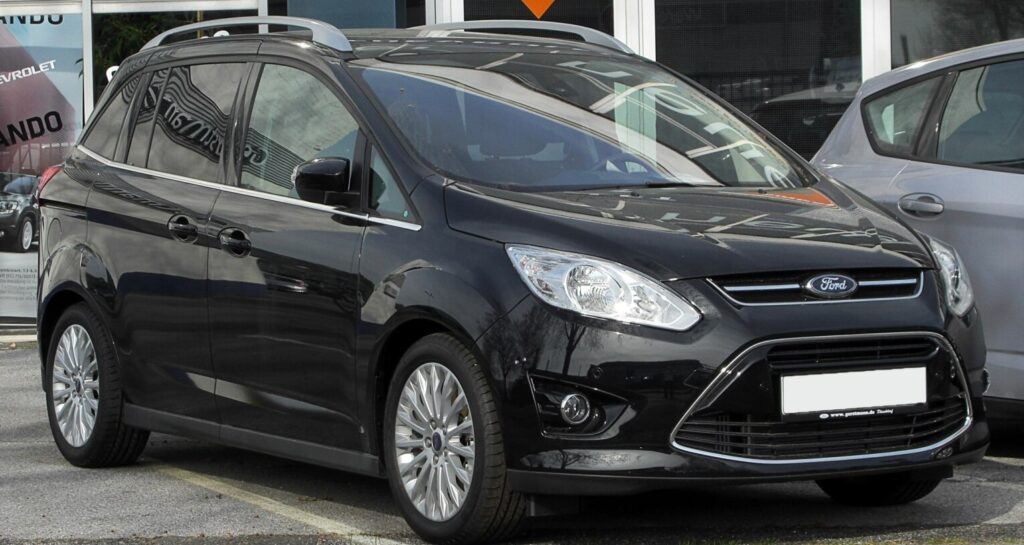
The Ford Grand C-MAX 1.0 EcoBoost (100 hp) S&S was a compact multi-purpose vehicle (MPV) produced by Ford between 2010 and 2015. Part of the second generation C-MAX range, this variant occupied an entry-level position within the Grand C-MAX lineup, offering a more economical option for families seeking a spacious and practical vehicle. It was primarily marketed in Europe, where the demand for compact MPVs remained strong, and represented Ford’s attempt to offer a fuel-efficient option in a segment traditionally dominated by larger engines. The “S&S” designation indicates the inclusion of Ford’s Auto-Start-Stop technology, further enhancing fuel economy.
| Brand | Ford |
| Model | C-MAX |
| Generation | Grand C-MAX |
| Type (Engine) | 1.0 EcoBoost (100 Hp) S&S |
| Start of production | 2010 |
| End of production | 2015 |
| Powertrain Architecture | Internal Combustion engine |
| Body type | MPV |
| Seats | 7 |
| Doors | 5 |
| Fuel consumption (urban) | 6.4 l/100 km (36.8 US mpg) |
| Fuel consumption (extra urban) | 4.6 l/100 km (51.1 US mpg) |
| Fuel consumption (combined) | 5.2 l/100 km (45.2 US mpg) |
| CO2 emissions | 118 g/km |
| Fuel Type | Petrol (Gasoline) |
| Acceleration 0 – 100 km/h | 13.6 sec |
| Acceleration 0 – 62 mph | 13.6 sec |
| Acceleration 0 – 60 mph | 12.9 sec |
| Maximum speed | 172 km/h (106.88 mph) |
| Emission standard | Euro 5 |
| Weight-to-power ratio | 14.9 kg/Hp |
| Weight-to-torque ratio | 8.8 kg/Nm |
| Power | 100 Hp |
| Torque | 170 Nm (125.39 lb.-ft.) |
| Engine layout | Front, Transverse |
| Engine Model/Code | M2DA |
| Engine configuration | Inline |
| Fuel injection system | Direct injection |
| Engine aspiration | Turbocharger, Intercooler |
| Engine oil capacity | 4.1 l (4.33 US qt) |
| Coolant capacity | 6.3 l (6.66 US qt) |
| Kerb Weight | 1493 kg (3291.5 lbs.) |
| Max. weight | 2150 kg (4739.94 lbs.) |
| Max load | 657 kg (1448.44 lbs.) |
| Trunk (boot) space – minimum | 56 l (1.98 cu. ft.) |
| Trunk (boot) space – maximum | 1706 l (60.25 cu. ft.) |
| Fuel tank capacity | 60 l (15.85 US gal) |
| Length | 4520 mm (177.95 in.) |
| Width | 1828 mm (71.97 in.) |
| Height | 1684 mm (66.3 in.) |
| Minimum turning circle | 11.2 m (36.75 ft.) |
| Drivetrain Architecture | Front wheel drive |
| Number of gears | 6 gears, manual transmission |
| Assisting systems | ABS (Anti-lock braking system) |
Powertrain & Engine Architecture
The heart of the Grand C-MAX 1.0 EcoBoost was the M2DA engine, a 999cc, three-cylinder turbocharged petrol engine. This engine was part of Ford’s EcoBoost family, designed to deliver a balance of performance and fuel efficiency. It featured direct fuel injection, a single-scroll turbocharger, and variable valve timing. The direct injection system allowed for precise fuel delivery, optimizing combustion and reducing emissions. The turbocharger, coupled with an intercooler, boosted power output despite the small displacement. The engine produced 100 horsepower and 170 Nm (125 lb-ft) of torque. The engine was paired with a six-speed manual transmission, chosen for its efficiency and driver engagement. The Auto-Start-Stop system, denoted by the “S&S” in the model name, automatically shut off the engine when the vehicle came to a halt, such as at traffic lights, and restarted it when the driver depressed the clutch pedal, further reducing fuel consumption and emissions.
Driving Characteristics
The 1.0 EcoBoost engine in the Grand C-MAX provided adequate, though not exhilarating, performance. Acceleration from 0-60 mph took around 12.9 seconds, and top speed was 106.88 mph. The engine felt responsive at lower RPMs thanks to the turbocharger, providing sufficient power for everyday driving situations. However, when fully loaded with passengers and luggage, or when tackling steep inclines, the engine could feel strained. The six-speed manual transmission was well-matched to the engine’s characteristics, offering smooth gear changes and allowing the driver to keep the engine in its optimal power band. Compared to the larger 1.6-liter petrol or 1.6-liter diesel versions of the Grand C-MAX, this variant prioritized fuel economy over outright performance. The manual transmission also offered a more engaging driving experience than the optional automatic transmission available on other trims.
Equipment & Trim Levels
The Grand C-MAX 1.0 EcoBoost S&S typically came with a reasonable level of standard equipment. This included air conditioning, power steering, electric front windows, a basic audio system with USB connectivity, and ABS brakes. Safety features such as front and side airbags were also standard. Higher trim levels, such as Zetec and Titanium, added features like alloy wheels, rear parking sensors, cruise control, and a more advanced infotainment system. Interior upholstery was typically cloth, with options for upgraded materials on higher trims. The Grand C-MAX’s flexible seating arrangement, with individual seats in the second and third rows, was a key selling point, allowing for various configurations to maximize passenger and cargo space.
Chassis & Braking
The Grand C-MAX featured a front-wheel-drive chassis with MacPherson strut front suspension and a twist-beam rear suspension. This setup provided a comfortable ride quality, suitable for everyday driving. The steering was light and precise, making it easy to maneuver in urban environments. Braking was handled by disc brakes on the front wheels and drum brakes on the rear wheels. ABS (Anti-lock Braking System) was standard, enhancing braking performance and stability. The suspension was tuned to prioritize comfort over sporty handling, reflecting the vehicle’s role as a family MPV. Stabilizer bars were included to reduce body roll during cornering, but the overall driving experience was geared towards practicality and ease of use.
Market Reception & Comparison
The Ford Grand C-MAX 1.0 EcoBoost S&S was generally well-received by critics for its fuel efficiency and practicality. It offered a compelling alternative to larger, more expensive MPVs, particularly for buyers who prioritized economy over performance. Fuel economy figures of around 45.2 US mpg combined were impressive for a seven-seater. However, some reviewers noted that the engine could feel underpowered when the vehicle was fully loaded. Compared to the 1.6-liter petrol and diesel variants, the 1.0 EcoBoost offered lower running costs but less outright performance. The 1.6-liter diesel, for example, provided significantly more torque and better fuel economy on longer journeys. The 1.0 EcoBoost’s appeal lay in its affordability and suitability for urban driving.
Legacy
The 1.0 EcoBoost engine proved to be a reliable and durable powertrain, and the Grand C-MAX 1.0 EcoBoost S&S remains a popular choice in the used car market. While early examples may have accumulated significant mileage, the engine is generally known for its longevity, provided it has been properly maintained. Common issues are relatively minor, often related to the turbocharger or fuel injection system. The Grand C-MAX’s spacious interior and flexible seating arrangement continue to appeal to families, making it a practical and affordable option for those seeking a versatile MPV. The success of the 1.0 EcoBoost engine helped establish Ford as a leader in small-displacement turbocharged technology, paving the way for its widespread adoption in other models.